









13 min read
Introduction
Ask someone in Accra where they want to work, and the answers often come down to a handful of names. The banks, the telecoms, the international agribusinesses. These are the companies that pay well, train their staff, and have built reputations that make people want to stay.
But what actually makes a company a good employer? It is not just salary. It is whether you get training that helps you grow. Whether your manager treats you with respect. Whether the workplace is somewhere you can speak up without fear. Whether the company cares about your wellbeing beyond the work you produce.
Key Takeaways
- The Top Employers Institute certifies companies based on a detailed audit of their human resource practices, covering areas like leadership, learning, diversity, and wellbeing .
- Absa Ghana has been named the number one Top Employer in Ghana for 2026, a distinction that comes as part of the Absa Group's fifth consecutive year of certification across six African markets .
- It is an independent certification awarded by the Top Employers Institute after a detailed audit of a company's HR policies and employee experience, covering areas like leadership, learning, diversity, and wellbeing .
There are independent assessments that try to measure these things. The Top Employers Institute certifies companies based on a detailed audit of their human resource practices, covering areas like leadership, learning, diversity, and wellbeing . Companies that pass the audit earn the right to call themselves a Top Employer. In Ghana, a few names appear on that list year after year.
This ASJ article looks at the companies in Accra that have earned reputations as strong employers. It covers the certifications they hold, the workplace cultures they have built, and what they offer to people who want to build careers there. It also looks at the broader picture of employment in the city—the sectors that are hiring, the skills that are in demand, and the challenges that still hold back too many workers.
The Top Employer Certifications and What They Mean
The Top Employers Institute is a global authority on recognising excellence in people management. Its certification process involves an independent assessment of a company’s HR policies and employee experience. In 2025, it certified nearly 2,500 companies across 131 countries, affecting more than 14 million employees worldwide .
For a company to be certified, it must demonstrate strong practices across six key dimensions: People Strategy, Work Environment, Talent Acquisition, Learning, Diversity and Inclusion, and Wellbeing . The assessment is not a popularity contest. It looks at documented policies, measured outcomes, and employee feedback.
In Ghana, several companies have achieved this certification. Their presence on the list tells you something about which employers are taking workplace culture seriously.
Absa Bank Ghana: The Number One Employer
Absa Ghana has been named the number one Top Employer in Ghana for 2026, a distinction that comes as part of the Absa Group’s fifth consecutive year of certification across six African markets .
The numbers behind the recognition are impressive. Absa Ghana scored 97.38% in the assessment, the highest among the group’s markets in Botswana, Ghana, Kenya, South Africa, Zambia, and Mauritius . The group’s overall score was 93.66%, well above the global benchmark of 85.9% .
What does this mean in practice? The assessment highlighted several areas where Absa excelled. It achieved perfect scores of 100% in Business Strategy, Leadership, and Performance, which suggests a strong alignment between what the company says it wants to achieve and how its leaders actually operate . Ethics and Integrity scored 99.49%, exceeding global and industry benchmarks. The Work Environment score was 98.41%, more than 10% above the global standard .

William Easmon, Human Capital Director for Absa Bank Ghana, described the recognition as reflecting “the trust, fairness and clarity employees experience daily” . The company also recorded significant year-on-year improvements in offboarding, diversity and inclusion, rewards and recognition, sustainability, and employer branding .
For someone considering a career at Absa Ghana, the certification suggests a workplace that takes leadership development, ethics, and employee experience seriously. It does not guarantee that every team is perfect, but it indicates that the systems and policies are designed with employees in mind.

Telecel Ghana: Eight Years of Consistency
Telecel Ghana, formerly Vodafone Ghana, has been certified as a Top Employer for the eighth consecutive year. That kind of consistency is rare. It suggests that the company’s people practices are not a one-off initiative but a sustained commitment.
The certification covers areas like leadership, learning and development, diversity and inclusion, employee wellbeing, and workplace culture . Patricia Obo-Nai, CEO of Telecel Ghana, said the recognition reflects a workplace where “employees feel valued, supported and empowered to grow” .
What is perhaps most telling is what employees themselves say. Torikubu Omar, a Management Information Systems and Data Science Analyst who has worked at Telecel for three years, described the experience this way: “Working at Telecel Ghana feels like belonging to a community that truly sees and supports you. There’s space to learn, to speak up, and to grow professionally and personally as well” .
Rachael Appenteng, the company’s Human Resources Director, emphasised that the recognition validates a culture “where employees are empowered to own their growth, advocate for themselves and shape their careers” . For a telecoms company operating in a competitive market, that focus on individual development is a meaningful signal.
Olam Agri Ghana: Six Years of Certification
Olam Agri Ghana, the agribusiness and food processing company, has been certified as a Top Employer for the sixth consecutive year . The company was also recognised as a Top Employer across the African continent, with certifications in nine other countries.
Audrey Achaw, HR Head at Olam Agri Ghana, said the certification validates a commitment to “creating a workplace where our people can thrive,” with continued investment in “employee development, welfare, and satisfaction” .
Baibhav Biswas, Country Head of Olam Agri Ghana, added that “our people are at the heart of everything we achieve in Ghana” and that the company is building “a workplace where Ghanaians can build meaningful careers” .
Olam Agri’s certification is notable because it comes from a sector—agriculture and agribusiness—that is not always associated with strong corporate workplaces. The company’s global footprint means employees may have access to international career paths and exposure, which is a draw for ambitious professionals.
Accra Brewery PLC: Third Consecutive Year
Accra Brewery PLC, part of the AB InBev group, was recognised as a Top Employer in Ghana for 2026 for the third consecutive year, improving its ranking to fourth overall . The company produces beverages and operates in a manufacturing environment that employs a significant number of people in Accra.
While detailed information on its specific workplace practices is limited, the certification itself indicates that the company meets the Top Employers Institute’s standards across the assessed dimensions.

Yango Ghana: A Newer Certification
Yango Ghana, the ride-hailing and mobility company, earned the Great Place to Work Certification for 2026. According to the company, 80% of staff said it is a great workplace, and 100% expressed pride in the company .
The Great Place to Work certification is different from the Top Employers Institute certification. It is based primarily on employee survey responses, which means it reflects how staff actually feel about their workplace. For a newer company operating in the gig economy space, earning that certification is a positive signal about internal culture, even if the workforce is relatively small.
What These Employers Have in Common
Looking at the companies that have earned certifications, a few patterns emerge.
They invest in development. The Top Employers assessment places significant weight on learning and development. Companies that pass are those that can show they are helping employees build skills and advance their careers. This matters in Ghana, where access to training is often limited and career progression can depend on who you know rather than what you can do.
They take wellbeing seriously. The assessment includes employee wellbeing as a key dimension. This can mean anything from health insurance and wellness programmes to flexible working arrangements and mental health support. The best employers recognise that productivity depends on people being healthy and supported.
They have clear values. Absa’s perfect score in Business Strategy and Leadership suggests that employees understand what the company is trying to achieve and how their work contributes. That kind of clarity is rare and valuable.
They listen to employees. Absa’s improvements in offboarding and diversity suggest a company that uses data to understand where it is falling short and then acts on it. Telecel’s employee testimonials suggest a culture where people feel heard.
The Sectors That Are Hiring
Beyond the certified employers, Accra’s job market is shaped by a few sectors that are actively hiring and investing in talent.
Banking and finance. The first quartile banks—GCB, Absa, Ecobank, Stanbic, Fidelity, and Zenith—are among the largest employers in the formal sector. They offer structured graduate programmes, professional development, and competitive compensation. The trade-off is that banking can be demanding, with long hours and performance pressure.
Telecommunications. MTN, Telecel, and AirtelTigo employ significant numbers of people in engineering, sales, customer service, and digital roles. The sector is investing heavily in 5G and digital infrastructure, which creates demand for technical skills.
Agribusiness and FMCG. Companies like Olam Agri, Unilever, and Nestlé Ghana offer careers in supply chain, manufacturing, sales, and marketing. These roles often come with training programmes and the possibility of regional or international postings.
Technology and digital. The growth of fintech, e-commerce, and digital services has created new categories of jobs: software developers, data analysts, product managers, digital marketers. These are roles that did not exist in Ghana in the same way a decade ago. Companies like Complete Farmer, Turntabl, and the local offices of international tech firms are hiring, though the sector remains small relative to its potential.
Healthcare and pharmaceuticals. With the government’s push for local pharmaceutical manufacturing and the expansion of private hospitals, there are opportunities for pharmacists, lab technicians, nurses, and administrators.
Internships and Training Programmes
For young people trying to break into the formal job market, internships and graduate programmes are often the entry point.
Absa Ghana runs a graduate programme that rotates participants through different areas of the bank. Telecel Ghana offers internships and a graduate trainee scheme. Olam Agri has a global graduate programme that brings participants into different parts of the business.
The National Coders Programme, a government initiative, has been integrated into eleven universities, including the University of Ghana and KNUST. It offers training in cybersecurity, data analytics, AI, and project management, with certifications that employers recognise. This is a pathway into technology roles for graduates from non-technical backgrounds as well.
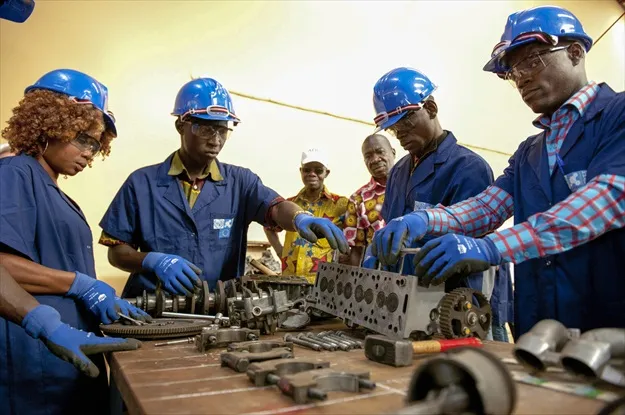
CTVET is pushing for deeper private sector involvement in technical and vocational training, with workplace learning and apprenticeship models that give young people hands-on experience. Companies that participate in these schemes get early access to talent, and trainees get the experience that employers demand.
The Challenges
Not everyone in Accra has access to a good employer. The city’s labour market is segmented, and the gap between formal and informal work is wide.
The informal sector dominates. Most working Ghanaians are in the informal economy—traders, artisans, drivers, domestic workers. These workers do not have access to the training, benefits, or career progression that formal employers offer. For them, workplace culture is a different question entirely.
Skills mismatch. Employers often complain that graduates have certificates but lack practical skills. The education system is changing, but slowly. Companies that invest in training their own staff are partly compensating for this, but not everyone gets that opportunity.
Youth unemployment. Every year, hundreds of thousands of young people enter the labour market. The formal sector cannot absorb them all. The companies profiled here employ thousands, but they cannot employ everyone. Entrepreneurship and self-employment are the reality for many.
Retention. Good employers train their staff, but trained staff are attractive to competitors. Keeping talent requires not just competitive pay but a culture that makes people want to stay. The companies with Top Employer certifications are working on this, but it is an ongoing challenge.
Why It Matters
A good employer does more than pay a salary. It gives people dignity, purpose, and a path forward. For a young Ghanaian who lands a job at Absa or Telecel or Olam Agri, the impact is not just on their own life. It is on their family, their community, and the economy.
The companies that have earned certifications are not perfect. They are large organisations with the same pressures and politics as any workplace. But they have chosen to invest in the things that make work better: training, wellbeing, ethics, inclusion. In a city where too many people work without contracts, without benefits, and without hope of advancement, that matters.
There are gaps. The companies on this list are concentrated in finance, telecoms, and agribusiness. Sectors like healthcare, education, and technology have strong employers too, but they are smaller and less visible. The informal sector, which employs most Ghanaians, is largely absent from this conversation. Until the quality of work improves across the whole economy, the best employers will remain the exception rather than the rule.
Quick Facts
Topic: Best Companies to Work for in Accra
Top Employer in Ghana (2026): Absa Ghana (score: 97.38%)
Most Consistent Certification: Telecel Ghana (8 consecutive years)
Agribusiness Leader: Olam Agri Ghana (6 consecutive years)
Brewery Sector: Accra Brewery PLC (3rd consecutive year, 4th overall)
Great Place to Work: Yango Ghana (2026 certification)
Key Assessment Dimensions: People Strategy, Work Environment, Talent Acquisition, Learning, Diversity & Inclusion, Wellbeing
Main Hiring Sectors: Banking, Telecoms, Agribusiness, Technology, Healthcare
Key Challenge: Skills mismatch, informal sector dominance, youth unemployment
FAQ Section
1. Which company is the best employer in Ghana in 2026?
Absa Ghana was ranked number one in the Top Employers Institute’s assessment for Ghana in 2026, with a score of 97.38% .
2. What is a Top Employer certification?
It is an independent certification awarded by the Top Employers Institute after a detailed audit of a company’s HR policies and employee experience, covering areas like leadership, learning, diversity, and wellbeing .
3. Which company has been a Top Employer the longest in Ghana?
Telecel Ghana has been certified for eight consecutive years, the longest streak among the companies identified in this article .
4. Does Olam Agri Ghana hire graduates?
Olam Agri has a global graduate programme and offers careers in agribusiness, supply chain, and food processing. It has been certified as a Top Employer in Ghana for six consecutive years .
5. What does Absa Ghana look for in employees?
Absa’s assessment scores suggest a focus on leadership, ethics, and performance. The bank runs graduate programmes and invests in development. Specific hiring criteria vary by role.
6. Are there internships in Accra?
Yes. Absa, Telecel, Olam Agri, and many other companies offer internships. The government’s National Coders Programme also provides training and certification that can lead to employment.
7. What sectors are hiring in Accra?
Banking, telecommunications, agribusiness, technology, and healthcare are among the sectors actively hiring. Technology roles in fintech, e-commerce, and software development are growing.
8. What is the Great Place to Work certification?
It is a certification based primarily on employee survey responses. Yango Ghana earned it for 2026, with 80% of staff saying it is a great workplace .
9. What is the biggest challenge for job seekers in Accra?
Skills mismatch is a major issue. Many graduates have certificates but lack the practical skills employers need. Internships, graduate programmes, and vocational training can help bridge the gap.
10. Do these companies pay well?
Salaries vary by role and level. Banking and telecoms generally pay above average for the formal sector. The certifications focus on workplace practices rather than pay specifically, though competitive compensation is part of being a strong employer.
Source: Accra Street Journal
Last Updated on November 26, 2026 by Samuel Kwame Boadu
Disclaimer: Some content on Accra Street Journal may be aggregated, summarized, or edited from third-party sources for informational purposes. Images and media are used under fair use or royalty-free licenses. Accra Street Journal is a subsidiary of SamBoad Publishing Hub under SamBoad Business Group Ltd, registered in Ghana since 2014.
For concerns or inquiries, please visit our Privacy Policy or Contact Page.

Samuel Kwame Boadu is a Ghanaian media entrepreneur and storyteller with a passion for amplifying urban voices and uncovering everyday truths. He is the Editor-in-Chief and Founder of Accra Street Journal, a dynamic digital platform dedicated to capturing the pulse of Ghana’s capital—its people, culture, challenges, business, sports and innovations.
Use the following reference when citing or referencing this article.
Your feedback helps us improve our journalism.
Report an Error
Help us maintain accuracy. Let our editorial team know if you spot an issue in this article.
Report a problem with this article