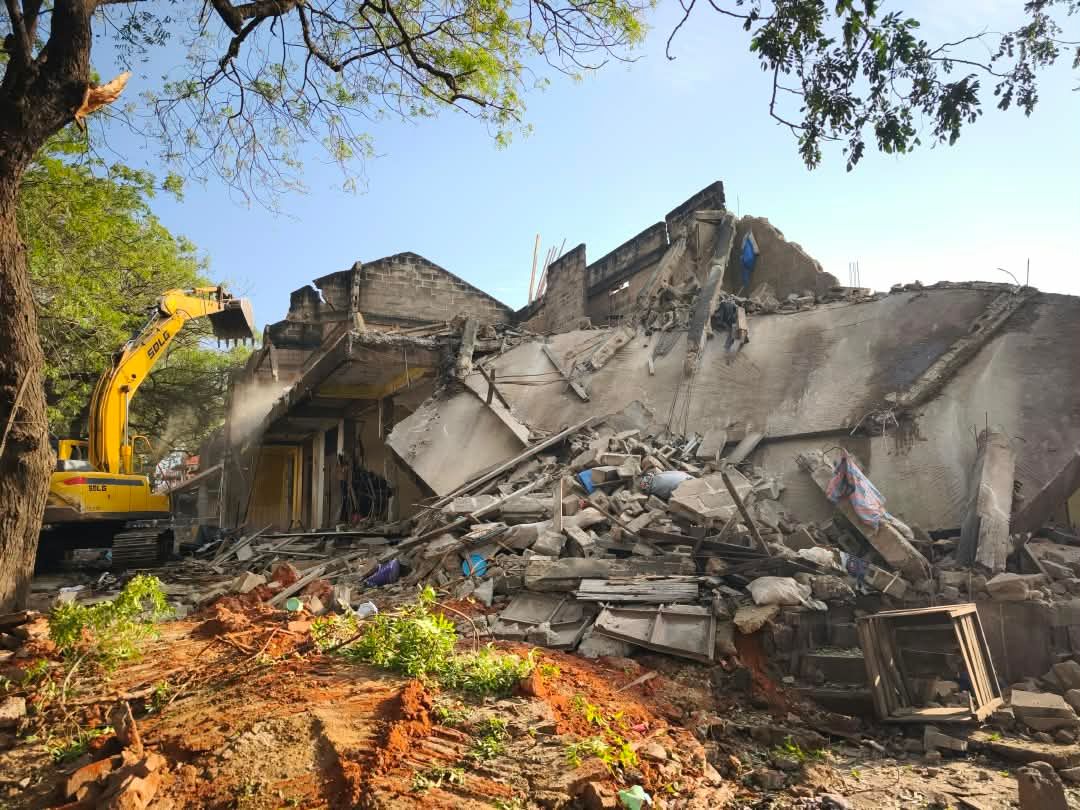
The Madina Market demolition commenced on October 22, 2026, as the La Nkwantanang-Madina Municipal Assembly (LANMMA) deployed heavy machinery under strict security to clear the old Madina Zonal Council section of the market. The exercise has generated tension and debate, balancing urgent public safety concerns against traders’ livelihoods.
The Context & Background
The Madina Zonal Council structure, located inside the heavily congested Madina Market near the Trotro station, has served as a central commercial and administrative hub for decades.

However, parts of the market have historically struggled with severe overcrowding, sanitation violations, illegal temporary extensions, and repeated fire outbreaks. As Madina expanded into one of Accra’s busiest commercial transit points, the old structures deteriorated under the weight of excessive traffic and lack of formal structural updates.
📢 GET A DETAILED ARTICLES + JOBS
Join ASJ's WhatsApp Channel and never miss a post or opportunity.

Why Now? The Core Reasons
The local assembly cited two urgent imperatives for the demolition.
Reason 1: Failure of Structural Integrity (The Safety Hazard)
The Municipal Head of Works, Engineer Mohammed Danjumah Ahmed, revealed that rigorous structural integrity tests were conducted on the old building. The tests recorded concrete strength readings as low as 11 to 20 Newtons per square millimetre (N/mm²).

LANMMA declared the building a collapsing hazard, noting that delaying the demolition would be public negligence.
Reason 2: The 24-Hour Economy Market Project
The cleared zone is earmarked for a flagship modernisation project: a modernised 24-Hour Model Market.
The assembly plans to transition the enclave into a round-the-clock commercial ecosystem with expanded capacities, improved sanitation, and organised stalls.
The Official Directives & Temporary Relief
The directive was enforced by Municipal Chief Executive (MCE) Ibrahim Faila Fuseini.
-
Power Disconnection: Prior to the bulldozers moving in, the Volta River Authority (VRA) officially cut off power supply to the zone to secure the perimeter.
-
Alternative Spaces: To minimise immediate economic displacement, LANMMA designated an alternative temporary trading space near the existing market. Affected traders can set up temporary stalls there while redevelopment takes place.
-
Reallocation Guarantee: The Assembly has formally assured all affected shop owners that they hold primary rights and will be allocated permanent spaces once the new 24-hour market structure is completed.
Trader Reactions & Controversies
The exercise has left the local trading community heavily polarised.
Loss of Livelihood & Debt Fears
Many traders are watching their shops go down in ruins. Several complain that while they understand the safety hazards, the notice period was too short to properly relocate heavy inventory or salvage built capital. Many are worried about servicing active microfinance loans with their daily sales suspended.
Compliance vs. Resistance
Some trade groups originally lobbied the Presidency and the MCE for a 3-month grace period. However, as the structural reality became clear, a significant number opted to vacate voluntarily to salvage roofing sheets, wooden counters, and electronics before the demolition crew arrived.
Key Facts at a Glance
| Aspect | Detail |
|---|---|
| Date Commenced | October 22, 2026 |
| Enforcing Agency | La Nkwantanang-Madina Municipal Assembly (LANMMA) |
| MCE | Ibrahim Faila Fuseini |
| Structure Affected | Old Madina Zonal Council section, Madina Market |
| Concrete Strength Readings | 11–20 N/mm² (declared collapsing hazard) |
| Redevelopment Plan | 24-Hour Model Market |
| Power Disconnection | VRA cut supply before demolition |
| Temporary Relocation | Alternative trading space designated near market |
| Reallocation | Primary rights assured for affected shop owners |
| Traders’ Request | 3-month grace period (not granted) |
What Happens Next
The focus now shifts to redevelopment and trader resettlement. LANMMA must deliver on its guarantee of permanent stalls in the new 24-hour market, and affected traders face months of uncertainty in temporary spaces while servicing debts and rebuilding working capital.
Source: Accra Street Journal

Last Updated on October 22, 2026 by Samuel Kwame Boadu
Disclaimer: Some content on Accra Street Journal may be aggregated, summarized, or edited from third-party sources for informational purposes. Images and media are used under fair use or royalty-free licenses. Accra Street Journal is a subsidiary of SamBoad Publishing Hub under SamBoad Business Group Ltd, registered in Ghana since 2014.
For concerns or inquiries, please visit our Privacy Policy or Contact Page.

Samuel Kwame Boadu is a Ghanaian media entrepreneur and storyteller with a passion for amplifying urban voices and uncovering everyday truths. He is the Editor-in-Chief and Founder of Accra Street Journal, a dynamic digital platform dedicated to capturing the pulse of Ghana’s capital—its people, culture, challenges, business, sports and innovations.