The rules for verifying a Ghana Card changed fundamentally in 2026. Visual inspection is out. Photocopies are out. Biometric verification against the National Identity Register is now the only legally accepted method. Here is what individuals and organisations need to understand.
The New Legal Reality: L.I. 2523
On 9 June 2026, the National Identity Register (Amendment) Regulations, 2026 (L.I. 2523) came into force . The regulations replace the long-standing practice of relying on visual inspection, photocopies, or scanned images of the Ghana Card for identity verification.

Under the new rules, identity must be confirmed through real-time biometric verification against the NIA’s database, or through match-on-card verification using devices approved by the National Identification Authority .
📢 GET A DETAILED ARTICLES + JOBS
Join ASJ's WhatsApp Channel and never miss a post or opportunity.

The rationale is straightforward: to strengthen identity security, protect personal data, and eliminate opportunities for identity fraud and misuse.
What Is No Longer Allowed
The regulations are explicit about what organisations and individuals must stop doing:

No visual inspection. Looking at a Ghana Card and deciding it appears genuine is no longer sufficient proof of identity .
No photocopying or scanning. Organisations may not request, reproduce, or retain photocopies, scanned copies, or images of the Ghana Card for verification purposes .
No reliance on the physical card alone. Where biometric verification is available, there is no requirement for individuals to present the physical card .
The Minister for the Interior, Muntaka Mohammed-Mubarak, stated that organisations are prohibited from requesting, retaining, or reproducing photocopies, scanned copies, or images of the Ghana Card for verification purposes.
How Verification Now Works
Verification is conducted through the NIA’s Identity Verification System Platform (IVSP) . Organisations must onboard onto this platform to perform biometric checks .
There are two accepted methods:
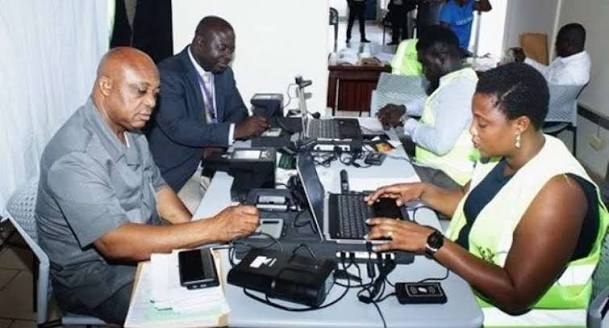
Match-on-card verification. The card’s secure chip is read using an NIA-approved device, and the biometric data on the chip is matched against the person presenting the card .
Database verification. The person’s biometrics—fingerprints and/or facial image—are matched against the National Identity Register in real time .
The key principle is that the person presenting the card must be confirmed as its rightful owner. As the Interior Minister put it, the new regulation “ensures that the person presenting the Ghana Card is its rightful owner while reducing the risk of identity theft and the misuse of personal information” .

What Organisations Must Do
Any organisation that verifies identity using the Ghana Card is affected. This includes banks and financial institutions, insurance companies, telecommunications operators, hospitals, government agencies, and any business that collects the card for customer onboarding or KYC .
Onboard onto the IVSP. Institutions must integrate with the NIA’s verification platform. The NIA is providing onboarding, technical support, and public education for organisations required to integrate.
Procure approved biometric devices. Verification requires NIA-approved devices capable of reading the card’s chip or capturing biometrics for database matching .
Update policies. Onboarding, KYC, and records-retention policies must be revised to end any copying or retention of cards. Personal data read from a card must be handled in line with the Data Protection Act, 2012 (Act 843) .
Train frontline staff. Staff must be trained on the new procedures before the transition period ends .
Penalties for Non-Compliance
The regulations carry substantial penalties.
Organisations face fines of GHS 6,000 to GHS 24,000 (partnerships: GHS 2,400 to GHS 12,000, payable by each partner), suspension from the Identity Verification Services Platform, and a surcharge .
Individuals who refuse verification face a fine or two to six months imprisonment .
The Interior Minister stated that organisations and individuals that fail to comply could face significant penalties, including hefty fines, suspension or termination of access to the NIA’s Identity Verification System, while individuals who misuse Ghana Cards could face fines, imprisonment, or both .
The Transition Period
The government granted institutions a three-month transition period from 27 July to 2 November 2026 to complete the installation of required systems, infrastructure, and staff training .
Importantly, the transition period does not suspend any legal obligations. The Interior Minister urged institutions to begin implementing compliance measures immediately .

The NIA has published technical specifications for approved biometric verification devices on its website (www.nia.gov.gh) and will provide technical support .
What This Means for Individuals
If you are asked to verify your identity using your Ghana Card, the process should now involve a biometric check—a fingerprint scan or facial capture. You should not be asked to hand over your card for photocopying.
The Interior Minister urged Ghanaians to insist on biometric verification whenever they are required to present their Ghana Card.
If you are transacting privately or informally, the regulations expect you to use biometric verification where practicable and to refrain from retaining or sharing copies of Ghana Cards unless permitted by law or with the cardholder’s consent.
Quick Facts
| Topic | Details |
|---|---|
| Governing Law | National Identity Register (Amendment) Regulations, 2026 (L.I. 2523) |
| In Force Since | 9 June 2026 |
| Verification Method | Real-time biometric against NIA database or match-on-card |
| Visual Inspection | No longer sufficient |
| Photocopying | Prohibited |
| Organisation Fines | GHS 6,000 – GHS 24,000 |
| Individual Penalty | Fine or 2–6 months imprisonment |
| Transition Period Ends | 2 November 2026 |
| NIA Portal | www.nia.gov.gh |
Frequently Asked Questions
1. Can I still use a photocopy of my Ghana Card for identification?
No. Under L.I. 2523, organisations may not request, reproduce, or retain photocopies, scanned copies, or images of the Ghana Card for verification purposes .
2. What is the only accepted method for Ghana Card verification?
Biometric verification—either match-on-card using an approved device or real-time verification against the National Identity Register .
3. Do I need to present my physical Ghana Card for verification?
Where biometric verification is available, there is no requirement to present the physical card. Verification can be done using your personal identification number and biometrics .
4. What happens if an organisation refuses to comply with the new rules?
Organisations face fines of GHS 6,000 to GHS 24,000, suspension from the verification platform, and a surcharge .
5. When did the new verification rules take effect?
The regulations came into force on 9 June 2026. A transition period for institutions runs until 2 November 2026 .
6. What should I do if an organisation asks to photocopy my Ghana Card?
You should refuse and insist on biometric verification. The Interior Minister has urged Ghanaians to insist on biometric verification whenever they are required to present their Ghana Card.
7. How do organisations onboard onto the NIA verification system?
Visit www.nia.gov.gh or email [email protected] to begin the onboarding process .
8. Does the new law apply to private individuals, not just organisations?
Yes. Individuals involved in private or informal transactions are expected to use biometric verification where practicable and must not retain or share copies of Ghana Cards unless permitted by law or with consent
Source: Accra Street Journal
Last Updated on October 22, 2026 by Samuel Kwame Boadu
Disclaimer: Some content on Accra Street Journal may be aggregated, summarized, or edited from third-party sources for informational purposes. Images and media are used under fair use or royalty-free licenses. Accra Street Journal is a subsidiary of SamBoad Publishing Hub under SamBoad Business Group Ltd, registered in Ghana since 2014.
For concerns or inquiries, please visit our Privacy Policy or Contact Page.

Samuel Kwame Boadu is a Ghanaian media entrepreneur and storyteller with a passion for amplifying urban voices and uncovering everyday truths. He is the Editor-in-Chief and Founder of Accra Street Journal, a dynamic digital platform dedicated to capturing the pulse of Ghana’s capital—its people, culture, challenges, business, sports and innovations.