President Mahama has released GH¢300 million in emergency funds and deployed military personnel as catastrophic flooding inundates low-lying communities across Greater Accra
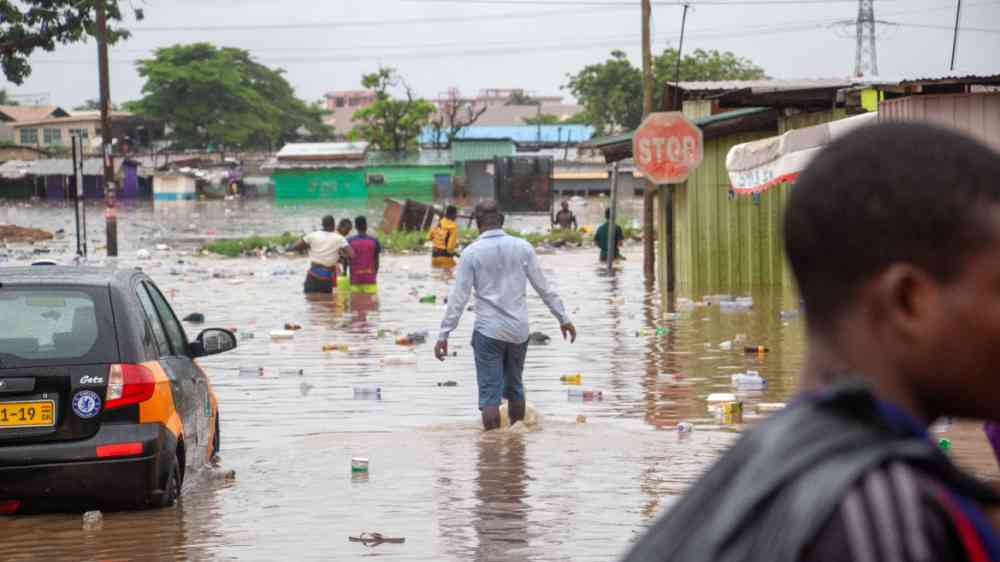
At least 13 people have lost their lives and over 70,000 residents have been displaced across the Greater Accra Region following catastrophic, record-breaking torrential rains that began on Sunday night, June 28, and intensified through Monday, June 29, 2026.

The devastating flash floods have submerged large portions of the capital city, destroying vast amounts of personal property, infrastructure, and businesses. The Ghana National Fire Service and the National Disaster Management Organisation have officially confirmed at least 13 fatalities, with emergency teams actively recovering more bodies from floodwaters.
📢 GET A DETAILED ARTICLES + JOBS
Join ASJ's WhatsApp Channel and never miss a post or opportunity.

Displaced households have surged past 70,000, with low-lying and flood-prone communities bearing the brunt of the damage. In Adabraka alone, specifically the Odawna Sahara area, more than 22,000 people and 2,000 households were completely inundated. Heavy destruction is also recorded in Weija, Alajo, Kaneshie, Adenta (Lakeside/Nanakrom), and Mallam.
The Electricity Company of Ghana and GRIDCo temporarily deactivated power distribution substations in flooded regions to safeguard operational personnel and protect heavy electrical infrastructure. Major arterial motorways, standard roads, and critical segments of the N1 highway corridor were rendered entirely impassable or completely washed away. Roughly 140 millimetres of rainfall fell in a single day, causing the primary Odaw River basin and central drainage networks to overflow heavily.

President John Dramani Mahama has authorized the immediate disbursement of GH¢300 million from the national Contingency Fund to finance ongoing relief and mitigation efforts. The Ghana Armed Forces and national police units have been deployed to reinforce NADMO in high-risk rescue and evacuation operations. Following an aerial assessment of the capital, the President ordered the immediate demolition of illegal structures built on natural waterways and drainage paths.
The Ghana Health Service has issued a critical health alert for Greater Accra, warning residents of heightened risks for malaria, typhoid fever, snakebites, and potential cholera outbreaks due to stagnant water mixed with displaced filth.
According to a report by Accra Street Journal, the disaster has exposed the persistent vulnerability of Accra’s drainage infrastructure and the consequences of unchecked development on waterways. Emergency teams continue to work through the night as the full scale of the devastation becomes clearer.
Source: Accra Street Journal
Last Updated on July 2, 2026 by Samuel Kwame Boadu
Disclaimer: Some content on Accra Street Journal may be aggregated, summarized, or edited from third-party sources for informational purposes. Images and media are used under fair use or royalty-free licenses. Accra Street Journal is a subsidiary of SamBoad Publishing Hub under SamBoad Business Group Ltd, registered in Ghana since 2014.
For concerns or inquiries, please visit our Privacy Policy or Contact Page.

Samuel Kwame Boadu is a Ghanaian media entrepreneur and storyteller with a passion for amplifying urban voices and uncovering everyday truths. He is the Editor-in-Chief and Founder of Accra Street Journal, a dynamic digital platform dedicated to capturing the pulse of Ghana’s capital—its people, culture, challenges, business, sports and innovations.