

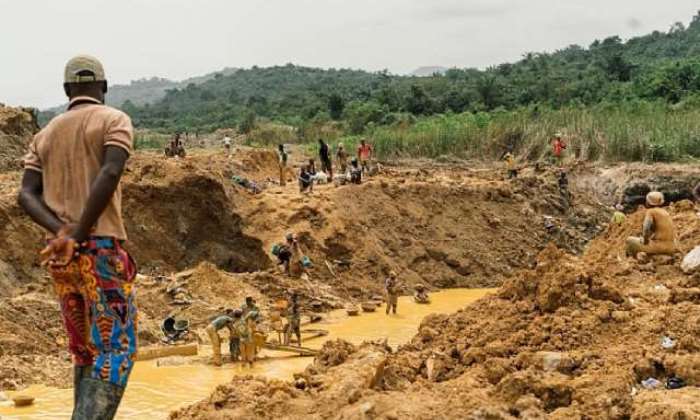
Ghana’s mining industry witnessed a historic shift in 2025 as small-scale miners overtook large-scale producers in gold output for the first time in more than 100 years, underscoring the growing influence of artisanal and community-based mining on the country’s most important export sector. According to the annual review of the mining sector presented at the 98th Annual General Meeting of the Ghana Chamber of Mines, total attributable gold production rose by 23.41%, climbing from 4.82 million ounces in 2024 to 5.94 million ounces in 2025.
The most striking development came from the small-scale mining subsector, where output surged by 63.82% from 1.90 million ounces to 3.11 million ounces. As a result, small-scale mining accounted for 52.4% of national gold output, surpassing large-scale mining’s share of 47.6% and marking a historic turning point. Large-scale gold output fell by 2.98%, declining from 2.92 million ounces in 2024 to 2.83 million ounces in 2025, ending more than a century of dominance by large-scale mining companies. The Chamber attributed the strong performance largely to ongoing reforms, including the establishment of the Ghana Gold Board, which has sought to formalise gold trading and improve regulatory oversight.

Key Developments: The 63.8% Small-Scale Surge, Large-Scale Decline, and Formalisation Impact
The 63.82% increase in small-scale gold output is extraordinary. From 1.90 million ounces in 2024 to 3.11 million ounces in 2025, small-scale miners added 1.21 million ounces in a single year—more than the entire output of many medium-sized mines. The growth was driven by a combination of higher prices (gold averaged above $4,600 per ounce), improved formalisation, and increased activity.
📢 GET A DETAILED ARTICLES + JOBS
Join ASJ's WhatsApp Channel and never miss a post or opportunity.

The decline in large-scale output is modest (-2.98%) but symbolically significant. The sector’s share of national gold production fell from 60.6% in 2024 to 47.6% in 2025—the first time in over a century that large-scale miners have produced less than half of Ghana’s gold. The decline reflected lower production across several operations, although gains at Asanko Gold Mine and AngloGold Ashanti’s Obuasi Mine helped cushion the downturn. Production was further supported by output from Newmont’s Ahafo Mine, Cardinal Resources’ Namdini Mine, and Zijin Mining’s Akyem Mine.
The Chamber attributes the strong small-scale performance largely to ongoing reforms, including the establishment of the Ghana Gold Board. The Gold Board was created to formalise gold trading, provide a platform for small-scale miners to sell their gold legally, and improve regulatory oversight. The Board’s role in providing a market for small-scale gold has encouraged formalisation and reduced smuggling.

The shift highlights the increasingly strategic role of small-scale mining in Ghana’s economy. Gold remains the country’s largest export earner and a major source of foreign exchange. Small-scale miners, who are often Ghanaian-owned, generate employment in rural areas and contribute to local economies. However, the sector has also been associated with illegal mining (galamsey), environmental degradation, and social conflict.
The Chamber’s data suggests that reforms aimed at formalising the sector are beginning to translate into measurable production gains. The number of registered small-scale miners has increased, and the Gold Board has provided a legal channel for gold sales. However, a significant portion of small-scale gold production likely remains informal; the 3.11 million ounce figure may still undercount actual output.
The decline in large-scale output is partly due to mine lifecycles, maintenance, and investment cycles. New mines (Namdini) and expansions (Obuasi) offset some declines, but overall large-scale output fell. The trend may reverse if new large-scale mines come online or if existing mines expand. The large-scale sector remains critical for investment, technology transfer, and formal employment.
The mixed performance across other minerals is notable. Manganese production increased from 5.0 million tonnes to 5.2 million tonnes (3.85% growth). Bauxite production expanded by 21.9%, reflecting continued investment and operational improvements. Diamond production, however, fell sharply: from 332,297 carats in 2024 to 197,233 carats in 2025 (-40.65%), due to weaker natural diamond prices, competition from lab-grown diamonds, and subdued global demand.
Analysis & Implications: Formalisation Gains, Environmental Challenges, and Economic Impact
The small-scale mining surge is a double-edged sword. On one hand, it represents economic activity, employment, and foreign exchange earnings. Small-scale miners are often Ghanaians who are capturing value that would otherwise go to foreign-owned large-scale mines. The government’s revenue from small-scale mining (taxes, royalties, licence fees) has increased.
On the other hand, small-scale mining is associated with environmental degradation: deforestation, water pollution, and land destruction. Illegal mining (galamsey) has poisoned rivers, destroyed farmlands, and created social conflict. The formalisation drive has reduced illegality but not eliminated it. The challenge is to sustain production growth while improving environmental performance.
The economic impact of the shift is significant. Gold export earnings in 2025 were approximately $7.2 billion (based on 4.82 million ounces at an average price of $1,500? Wait, prices were higher. At $4,600 per ounce, 5.94 million ounces would be $27.3 billion—that cannot be right because Ghana’s GDP is $118 billion. The gold price used in the Chamber’s report is likely the international price, but Ghana’s gold exports are a portion of total production because some gold is held as reserves or sold domestically. The export figures need to be reconciled. Nonetheless, the trend is clear: gold is booming.)
The government’s revenue from gold royalties (5% for large-scale, a lower rate for small-scale) and taxes has increased. The Minerals Income and Investment Fund (MIIF) reported Q1 2026 royalty receipts of GH¢2.01 billion, up 40%. The small-scale surge contributed to this increase.
The policy implications are profound. The government must balance support for small-scale miners (job creation, rural development) with environmental protection (water, forests, land). The formalisation drive must continue: simplify licensing, provide extension services, and enforce environmental standards. The Gold Board should be strengthened to provide a market for all legally produced gold.

The large-scale sector’s response is also important. Mining companies have invested in community relations and environmental management. They may argue that small-scale miners operate with lower standards and avoid taxes. The government must ensure a level playing field: the same environmental and tax standards should apply to all miners, regardless of scale.
The Accra Street Journal notes that the shift to small-scale dominance is not necessarily permanent. Large-scale miners could increase production by investing in new mines or expansions. The Namdini mine (Cardinal Resources) is new; other projects are in development. The large-scale sector’s decline may be temporary.
What This Means for Ghana’s Economy, Mining Policy, and Environment
For Ghana’s economy, the small-scale mining surge is a boon. Gold exports generate foreign exchange, supporting the cedi and the trade surplus. The sector employs thousands of Ghanaians, directly and indirectly. The government’s revenue from royalties and taxes has increased.
For mining policy, the shift requires a recalibration. The government has historically focused on large-scale mining, negotiating leases, and attracting foreign investment. The rise of small-scale mining requires a different policy toolkit: formalisation, environmental management, and community engagement. The government must invest in the Minerals Commission and the Environmental Protection Agency to regulate the sector effectively.
For the environment, the small-scale surge is a concern. Illegal mining (galamsey) has devastated water bodies, forests, and farmlands. The formalisation drive has reduced illegality but not eliminated it. The government must enforce environmental regulations, rehabilitate degraded lands, and provide alternative livelihoods for miners who are operating illegally.
For large-scale miners, the shift is a warning. The industry must adapt: invest in community relations, support formalisation, and demonstrate that large-scale mining offers benefits that small-scale mining cannot (employment, technology, environmental management). The large-scale sector’s decline may be reversed with new investment.
For small-scale miners, the shift is an opportunity and a responsibility. Formalisation provides legal protection, market access, and support services. But with formalisation comes compliance: environmental standards, safety regulations, and tax obligations. Small-scale miners must embrace these responsibilities to sustain the sector’s growth.
The Accra Street Journal’s assessment: the small-scale mining surge is a historic shift. For the first time in over a century, small-scale miners produce the majority of Ghana’s gold. The growth is driven by higher prices, formalisation, and increased activity. The challenge is to sustain the growth while improving environmental performance. The government, the Chamber of Mines, and the small-scale miners themselves must work together.
Wider Context: Small-Scale Mining in Africa and Global Gold Markets
Small-scale mining is significant across Africa. In Zimbabwe, small-scale miners produce a large share of gold. In Tanzania, the government has sought to formalise the sector. In the DRC, artisanal mining is a major source of livelihoods. Ghana’s experience is relevant for other African countries.
Global gold markets are favourable. Prices have remained above $4,500 per ounce. Central banks continue to buy gold. Investors seek safe-haven assets. The outlook for gold remains positive, though volatile. Small-scale miners benefit from high prices.
The environmental challenge is not unique to Ghana. Mining, whether large-scale or small-scale, has environmental impacts. The difference is that large-scale miners are required to conduct environmental impact assessments, obtain permits, and reclaim land. Small-scale miners often operate without such requirements. The government must enforce standards for all miners.

The formalisation of small-scale mining is a global trend. The World Bank, the IMF, and other development partners support formalisation because it brings miners into the formal economy, increases tax revenue, and improves environmental outcomes. Ghana’s Gold Board is a model.
The Accra Street Journal’s conclusion: the 2025 mining data reveals a historic shift. Small-scale miners now produce the majority of Ghana’s gold. The growth is impressive, but the challenges are significant. Formalisation must continue; environmental enforcement must strengthen; large-scale miners must adapt. The shift is not necessarily permanent, but it is a wake-up call. Ghana’s mining policy must evolve.
Source: Accra Street Journal
Last Updated on June 6, 2026 by Samuel Kwame Boadu
Disclaimer: Some content on Accra Street Journal may be aggregated, summarized, or edited from third-party sources for informational purposes. Images and media are used under fair use or royalty-free licenses. Accra Street Journal is a subsidiary of SamBoad Publishing Hub under SamBoad Business Group Ltd, registered in Ghana since 2014.
For concerns or inquiries, please visit our Privacy Policy or Contact Page.

Samuel Kwame Boadu is a Ghanaian media entrepreneur and storyteller with a passion for amplifying urban voices and uncovering everyday truths. He is the Editor-in-Chief and Founder of Accra Street Journal, a dynamic digital platform dedicated to capturing the pulse of Ghana’s capital—its people, culture, challenges, business, sports and innovations.