




6 min read
A major demolition exercise at La Pleasure Beach (Labadi Beach) and surrounding beachfront resorts in Accra has left a trail of destroyed businesses, distressed workers, and political controversy. Here is a full explainer of what happened, the competing reasons behind it, and the fallout.
What Happened
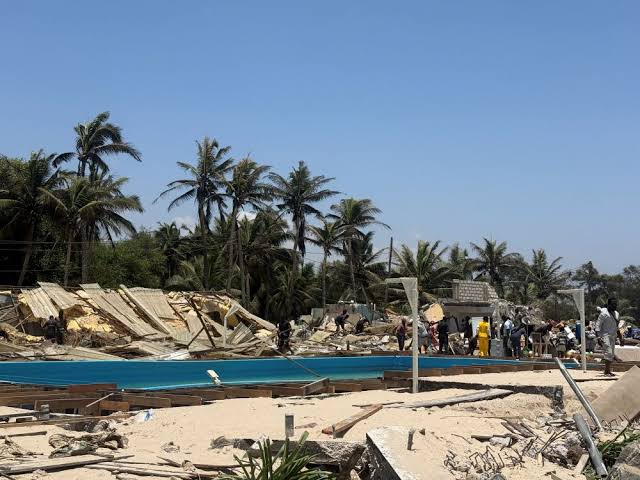
In the early hours of Friday, October 2, 2026, personnel from the Ghana Armed Forces’ 48 Engineer Regiment, backed by the Ghana Police Service, moved into the La Pleasure Beach area at approximately 4:00 a.m. and ordered workers, residents, and business operators to vacate the premises . Demolition began roughly 15 minutes after occupants were instructed to leave, according to one worker who spoke to JoyNews .
Key Takeaways
- A major demolition exercise at La Pleasure Beach (Labadi Beach) and surrounding beachfront resorts in Accra has left a trail of destroyed businesses, distressed workers, and political controversy.
- Polo Beach Club — a well-known entertainment venue near Labadi Beach Hotel, completely demolished
- However, Deputy Chief of Staff Stan Dogbe clarified on October 2 that the La Pleasure Beach demolition was NOT part of the government's flood mitigation operations .
Several structures were completely pulled down, while others were partially demolished. Workers and residents were seen attempting to retrieve belongings from the rubble .
Businesses Affected
The demolition targeted multiple popular entertainment, hospitality, and dining venues along the beachfront. High-profile establishments brought down or heavily affected include:
-
Polo Beach Club — a well-known entertainment venue near Labadi Beach Hotel, completely demolished
ADWUMAFIE JOB JOB OPPORTUNITYFrontline Pensions Trust LimitedFrontline Pensions Trust Limited · 5th Floor, GNAT Heights, AccraPowered by Adwumafie View Job → -
La Pleasure Beach facilities — the popular destination also known as Labadi Beach
-
Laboma Beach structures — over 20 structures demolished in an earlier phase on September 13
-
Pink Flamingo Lounge — demolished at Laboma Beach
-
Other beachfront clubs and eateries including ULA Beach Club, Trophy, Bliss Escape, Amsterdam Kitchen, Si Beach Resort, and Alora Beach Resort
The Competing Reasons Behind the Demolition
The demolition has generated multiple, sometimes conflicting, explanations from officials and stakeholders.
Reason 1: Flood Mitigation and Lagoon Buffer Zone Protection
The government’s official position — articulated through the Information Services Department (ISD) — is that the exercise is part of a post-flood mitigation campaign in the Greater Accra Region . Authorities say many structures were built within the protected buffer zone of the Kpeshie Lagoon, blocking vital water flow into the ocean and contributing to flooding .
The operation followed a 21-day ultimatum issued by the Greater Accra Regional Security Council (REGSEC) on August 6, 2026, giving occupants until the end of August to vacate . The demolition of structures at Laboma Beach on September 13 was explicitly framed as part of this flood mitigation effort, with the Task Force combining dredging, demolition, waste removal, and restoration of retention basins .
Reason 2: Labadi Beach Hotel’s Request to Reclaim Beachfront
However, Deputy Chief of Staff Stan Dogbe clarified on October 2 that the La Pleasure Beach demolition was NOT part of the government’s flood mitigation operations . In a Facebook post, Dogbe said the Friday exercise was conducted under the supervision of National Security following a request from Labadi Beach Hotel .
According to Dogbe, the hotel raised concerns that the structures were affecting its safety, tranquillity, and reputation, while diminishing the visitor experience . He stated: “Let’s not get it twisted. Friday’s action along a section of the beach front was not a Flood Mitigation Action by the government task force” .
Reason 3: Land Ownership Dispute
The demolition is also entangled in a long-running land ownership dispute. Management of La Pleasure Beach had previously rejected a 24-hour directive to vacate the premises, arguing that an ownership dispute involving the beachfront was before the courts . The resort disputed claims that the land belonged to the government and insisted it is owned by Ga traditional authorities .
Polo Beach Club, through its operators Spartan-Ives Limited, had filed a lawsuit on September 16, 2026, against Labadi Beach Hotel and Richard Jakpa, Director of Special Operations at the National Security Council Secretariat, accusing Jakpa of abusing his office to demolish the club on behalf of the hotel . The club claims it lawfully acquired the land through a 20-year lease from the La Stool in June 2022 at a cost of GH¢1.5 million .

Political Fallout and Confrontations
The demolition has sparked intense political controversy and on-the-ground confrontations.
MP Confronts Military
La Dadekotopon MP Rita Naa Odoley Sowah directly confronted military personnel at the scene, expressing profound shock. She stated she had previously engaged top authorities who assured her that the Labadi Beach structures would be spared from demolition . She said: “I went to where I had to do, the authorities, and they assured me that Labadi Beach would not be demolished” .

The MP later pointed fingers at the Board Chairman of Labadi Beach Hotel, claiming he was behind the demolition and insisting “the government has no knowledge” .
Reports of Violence Against Journalists and Civilians
There have been multiple reports of physical altercations at the site. Activist and media personality Ralph St Williams alleged he was whipped with canes and sticks by a military officer after identifying himself as a journalist . Blogger SikaOfficial also alleged he was hit with a rod by a soldier while covering the exercise . Videos circulating on social media reportedly show a civilian being flogged out of the demolition zone by a soldier .
Laboma Beach Director’s Reaction
The Director of Laboma Beach Resort, Daniel Okpoti, expressed deep disappointment, warning that the exercise could affect the livelihoods of about 3,000 people employed by businesses in the area . He disputed the rationale, stating: “The water does not affect this particular side, yet the demolition has taken place here” .
Accountability Questions
The President of the Chamber for Local Governance (ChaLoG), Dr. Richard Fiadomor, has called for accountability from La Dade-Kotopon Municipal Assembly staff who may have issued illegal permits for structures within the lagoon buffer zone . He argued that pulling down the buildings should not be the final word, as some assembly staff were complicit in allowing construction to proceed .
Key Facts at a Glance
| Aspect | Detail |
|---|---|
| Date of Main Demolition | October 2, 2026 (4:00 a.m.) |
| Lead Agency | 48 Engineer Regiment, Ghana Armed Forces, with Police |
| Official Reason (Flood) | Structures in Kpeshie Lagoon buffer zone |
| Official Reason (Hotel) | Labadi Beach Hotel request for safety/reputation |
| Legal Basis | REGSEC 21-day ultimatum (August 6, 2026) |
| Affected Businesses | Polo Beach Club, Pink Flamingo, ULA Beach Club, and others |
| Political Fallout | MP confrontation, government denial, legal disputes |
| Casualties | Reports of journalists and civilians assaulted |
What Happens Next
The demolition remains ongoing, with security personnel restricting access to cleared sections . The Polo Beach Club lawsuit against Labadi Beach Hotel and Richard Jakpa remains active, with the club seeking perpetual injunctions to prevent further demolition .
The government’s broader post-flood mitigation task force is expected to continue operations at other flood-prone locations across Greater Accra, including Tesa Dam, Lafa Water Retention Basin, and Kpeshie Lagoon .
For affected businesses and workers, the immediate challenge is recovery and relocation. For the government, the challenge is managing the political fallout while pursuing its stated objectives of flood mitigation and environmental protection.
Source: Accra Street Journal
Last Updated on October 2, 2026 by Samuel Kwame Boadu
Disclaimer: Some content on Accra Street Journal may be aggregated, summarized, or edited from third-party sources for informational purposes. Images and media are used under fair use or royalty-free licenses. Accra Street Journal is a subsidiary of SamBoad Publishing Hub under SamBoad Business Group Ltd, registered in Ghana since 2014.

For concerns or inquiries, please visit our Privacy Policy or Contact Page.

Samuel Kwame Boadu is a Ghanaian media entrepreneur and storyteller with a passion for amplifying urban voices and uncovering everyday truths. He is the Editor-in-Chief and Founder of Accra Street Journal, a dynamic digital platform dedicated to capturing the pulse of Ghana’s capital—its people, culture, challenges, business, sports and innovations.
Use the following reference when citing or referencing this article.
Your feedback helps us improve our journalism.
Report an Error
Help us maintain accuracy. Let our editorial team know if you spot an issue in this article.
Report a problem with this article