










8 min read
Breast cancer is the most common cancer among Ghanaian women, yet most cases are still diagnosed at advanced stages. Screening is the bridge between awareness and survival—but knowing what to screen for, where to go, and what to expect is essential. Here is what every Ghanaian woman should understand.
Why Screening Matters: The Survival Gap
The numbers tell a stark story. At Komfo Anokye Teaching Hospital (KATH), only 10.3% of patients undergoing staging were diagnosed with early breast cancer (stage I or II). Half were diagnosed at stage III, and 39.3% at stage IV . The Global Breast Cancer Initiative (GBCI) target is at least 60% early-stage diagnosis.
Key Takeaways
- The World Health Organization recommends organized mammography screening for women aged 50–69 every two years in well-resourced settings .
- NGOs like the Mctonne Cancer Care Foundation and events like the Juaben Municipal Health Directorate's screening exercise offer free breast cancer screening .
- The Juaben Municipal Health Directorate, for example, offered free breast cancer screening in October 2025
The survival difference is dramatic. Five-year survival drops from 91% for stage I to just 15% for stage IV. A 2026 meta-analysis of 2,114 patients across Ghana found a pooled 5-year survival rate of 46.5% and a median overall survival of 4.4 years .
Screening exists to catch the disease before it reaches those later stages—when treatment is most effective, best tolerated, and least costly.
Who Should Screen and When
The Global Guidelines (Adapted for Ghana)
The World Health Organization recommends organized mammography screening for women aged 50–69 every two years in well-resourced settings . The International Agency for Research on Cancer (IARC) similarly recommends screening programs targeting women aged 50–69, with evidence for women 50–59 being sufficient .
For Ghana, a 2025 simulation study published in PLOS ONE recommends a biennial (every two years) screening interval for the Ghanaian population, citing benefits of improved early detection .
However, the reality in Ghana differs. Ghana performs well on timely diagnosis—at KATH, all patients received their cancer diagnosis within 31 days, and 95% had biopsies within 21 days . The challenge is getting women to present early, not diagnosing them quickly once they do.
What This Means for You
If you are 40 or older, you should begin regular screening. If you have a family history of breast cancer or other risk factors, speak with your doctor about starting earlier.
The Ghana Health Service has integrated breast examination into wellness clinics, outreach programmes, and routine health campaigns across the Greater Accra Region .
Types of Screening Available in Ghana
Clinical Breast Examination (CBE)
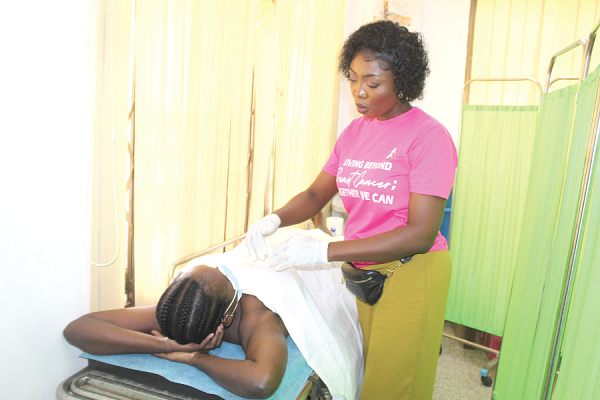
A trained healthcare provider examines your breasts for lumps or other abnormalities. This is the most accessible screening method in Ghana, available at many health facilities.

A study of Islamic women in Kumasi found that while awareness of breast cancer was high, actual screening practices were poor due to fear of unmet cultural preferences at screening centers and poor knowledge .
Mammography
Mammography is an X-ray of the breast and is the gold standard for early detection. However, access in Ghana is limited. A 2024 study found that the average cost to patients ranged from 100 to 500 Cedis ($17–87 USD), though three hospitals performed mammography at no cost .

One analysis noted that there are less than two dozen mammogram machines in the entire country, and many are not functioning much of the time due to breakdowns . The Sanford Adenta Clinic received a donated mammogram machine, enabling screenings, diagnostic imaging, and biopsy services .
Breast Self-Examination (BSE)
BSE is a technique you can perform yourself. Research at a municipal hospital found that only 35.5% of women who knew about BSE had ever performed it . A separate survey found 48.6% of rural women practised it, closely associated with having been taught the technique .
The Ghana Health Service encourages regular self-examination as a lifesaving practice .
Where to Get Screened
Screening is available at:
-
Government hospitals and clinics – including teaching hospitals, regional hospitals, and district facilities
-
CHPS compounds – community-based health planning and services points
-
Wellness clinics – the Greater Accra Regional Health Directorate has integrated breast examination into wellness clinics
-
Mobile outreach programmes – the Ghana Health Service and NGOs deploy mobile clinics to markets, lorry stations, and community centres
-
NGO-led screening – organisations like the Mctonne Cancer Care Foundation provide free breast and cervical screening, education, and follow-up
The Greater Accra Health Directorate has trained health workers under the Beat Breast Cancer Project to improve screening and early detection .
What NHIS Covers—and What It Doesn’t
The National Health Insurance Scheme (NHIS) officially covers consultation, diagnosis (including mammography, ultrasonography, and pathology), radiotherapy, and selected chemotherapy medications.
But there are significant gaps. A 2026 qualitative study of stakeholder perspectives found that these benefits are not fully realised in practice :
-
Persistent out-of-pocket payments for screening and diagnostic costs due to incomplete or delayed reimbursement
-
Limited inclusion of costly imaging procedures
-
Exclusion of some essential therapies, including immunotherapy
-
Rehabilitative care not covered – breast prostheses after mastectomy are excluded
-
Non-medical costs not covered – transportation, food, and accommodation for outpatients
-
Delayed NHIS reimbursement – often extending beyond a year, forcing facilities to demand co-payments
The result: even insured patients face financial barriers to screening and treatment.
The Barriers Women Face
Fear and Stigma
Research among Ghanaian women has documented a profound fear of mastectomy—the surgical removal of the breast. One woman stated: “A woman’s glory is her breast, so what is your use if one of your breasts is not there? I will rather die with my two breasts than live with one.” Another recounted that her husband wanted a divorce because he said she had been “maimed” .
Misconceptions
A survey of 914 rural women found that 73.5% held misconceptions, including beliefs that breast cancer is transmissible or spiritually caused. One participant believed that “when you put money in your brassiere, you can develop it” .

Limited Knowledge
While 87.5% of women have heard of breast cancer, only 44.4% have adequate knowledge about its risk factors, and only 46.3% have adequate knowledge about its signs and symptoms .
Geographic Disparities
Screening rates vary widely by district. The Ghana Statistical Service found that some districts have breast cancer screening rates below 10%, particularly in the Savannah, Oti, Bono East, Western North, and Northern regions .
What You Can Do
Know your risk. Risk factors include family history, high body weight, high breast density, hormone replacement therapy, late marriage and childbirth, smoking, and alcohol consumption .
Perform self-examinations. Learn the technique and check regularly. The Ghana Health Service encourages this as a lifesaving practice .
Get clinical breast examinations. If you are 40 or older, ask your healthcare provider for a clinical breast examination during your next visit.
Ask about mammography. If you have access to a facility with a mammogram machine, ask about scheduling a screening. Costs range from 100 to 500 Cedis, though some hospitals offer it free .
Utilise free screening opportunities. NGOs like the Mctonne Cancer Care Foundation and events like the Juaben Municipal Health Directorate’s screening exercise offer free breast cancer screening .
Advocate for yourself. If you notice a lump, nipple discharge, skin changes, or any unusual breast change, seek care immediately. Do not wait for pain.
Quick Facts
| Topic | Details |
|---|---|
| Early-Stage Diagnosis Rate (KATH) | 10.3% |
| 5-Year Survival (Stage I) | 91% |
| 5-Year Survival (Stage IV) | 15% |
| Recommended Screening Interval | Biennial (every 2 years) |
| Mammography Cost | 100–500 Cedis ($17–87 USD) |
| Mammogram Machines in Ghana | Less than two dozen |
| NHIS Coverage | Diagnosis covered, but gaps persist |
| Rehabilitative Care | Not covered (prostheses excluded) |
Frequently Asked Questions
1. What breast cancer screening options are available in Ghana?
Screening options include clinical breast examination (CBE), mammography, and breast self-examination (BSE). CBE is the most accessible method at health facilities, while mammography is available at fewer centres .
2. How much does a mammogram cost in Ghana?
The average cost ranges from 100 to 500 Cedis ($17–87 USD), though three hospitals perform mammography at no cost .
3. Does the NHIS cover breast cancer screening?
The NHIS officially covers diagnosis including mammography and ultrasonography. However, stakeholders report persistent out-of-pocket payments due to incomplete reimbursement and limited inclusion of costly imaging procedures .
4. At what age should Ghanaian women start breast cancer screening?
The WHO recommends organized mammography screening for women aged 50–69 every two years. For Ghana, a 2025 simulation study recommends a biennial screening interval . Women with family history or other risk factors should consult their doctor about starting earlier.
5. Where can I get screened for breast cancer in Ghana?
Screening is available at government hospitals, clinics, CHPS compounds, wellness clinics, and through mobile outreach programmes. NGOs like the Mctonne Cancer Care Foundation also provide free screening .
6. What are the warning signs of breast cancer?
Common signs include a lump in the breast, nipple discharge, nipple inversion, skin dimpling or redness, and swollen lymph nodes under the arm. Only 46.3% of Ghanaian women have adequate knowledge of these symptoms .
7. Why do Ghanaian women present late with breast cancer?
Reasons include misconceptions about spiritual causes, fear and stigma, limited knowledge of symptoms, cost barriers, and cultural factors affecting access to screening.
8. Is breast self-examination effective for early detection?
BSE is a valuable tool when taught properly. A survey found 48.6% of rural women practised it, closely associated with having been taught the technique. The Ghana Health Service encourages regular self-examination .
9. What is the Beat Breast Cancer Project?
It is an initiative implemented by Jhpiego with funding from the Pfizer Foundation, in partnership with the Ghana Health Service and Ministry of Health. It aims to improve early detection, diagnosis, and timely linkage to care in Greater Accra, Ashanti, and Northern regions.
10. Are there free breast cancer screening opportunities in Ghana?
Yes. NGOs, municipal health directorates, and awareness campaigns often provide free screening. The Juaben Municipal Health Directorate, for example, offered free breast cancer screening in October 2025
Source: Accra Street Journal
Last Updated on October 4, 2026 by Samuel Kwame Boadu
Disclaimer: Some content on Accra Street Journal may be aggregated, summarized, or edited from third-party sources for informational purposes. Images and media are used under fair use or royalty-free licenses. Accra Street Journal is a subsidiary of SamBoad Publishing Hub under SamBoad Business Group Ltd, registered in Ghana since 2014.
For concerns or inquiries, please visit our Privacy Policy or Contact Page.

Samuel Kwame Boadu is a Ghanaian media entrepreneur and storyteller with a passion for amplifying urban voices and uncovering everyday truths. He is the Editor-in-Chief and Founder of Accra Street Journal, a dynamic digital platform dedicated to capturing the pulse of Ghana’s capital—its people, culture, challenges, business, sports and innovations.
Use the following reference when citing or referencing this article.
Your feedback helps us improve our journalism.
Report an Error
Help us maintain accuracy. Let our editorial team know if you spot an issue in this article.
Report a problem with this article