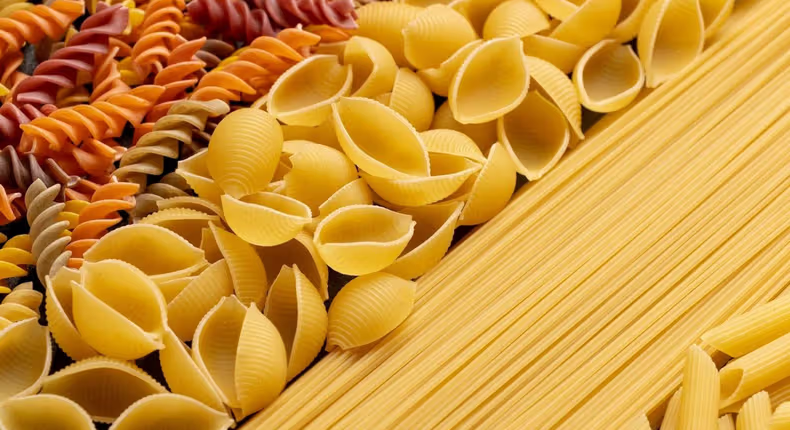
The government of Ghana has taken a decisive step to protect local food manufacturing by banning the import of pasta through land borders, a policy move aimed at curbing smuggling and supporting domestic industry.
According to reports monitored by the Accra Street Journal (ASJ), the measure comes shortly after the inauguration of Ghana’s first domestic pasta processing plant, operated by Olam Agri.

The new policy signals a broader shift toward industrial protection and import substitution, as Ghana seeks to reduce dependence on imported food products while encouraging local manufacturing.
📢 GET A DETAILED ARTICLES + JOBS
Join ASJ's WhatsApp Channel and never miss a post or opportunity.

Protecting Local Manufacturing
Authorities say the ban is primarily intended to combat cross-border smuggling and protect government tax revenues.
Officials also hope the policy will create a more favorable environment for domestic food processing businesses that have historically struggled to compete with cheaper imported goods.

Beyond pasta, the government has also announced additional import restrictions on several products including:
-
Rice
-
Sugar
-
Textiles
-
Frozen foods
These restrictions aim to limit the influx of goods entering through informal trade routes, which often bypass customs duties and undermine local producers.
Ghana’s First Pasta Processing Plant
The import ban comes just days after Ghana inaugurated its first pasta processing facility, operated by Olam Agri.
The new plant has the capacity to produce approximately 40,000 tonnes of wheat-based pasta annually, which is expected to cover around 40% of Ghana’s domestic demand.
The facility is also projected to create about 300 direct and indirect jobs across various sectors including:
-
Engineering and operations
-
Supply chain management
-
Distribution and logistics
-
Technical support services
For the Accra Street Journal, the plant represents a major step toward strengthening Ghana’s food manufacturing sector, which remains heavily dependent on imports.
Ghana’s High Pasta Consumption
Ghana is one of the largest pasta markets in Africa.
Between 2021 and 2024, the country imported approximately $140 million worth of pasta, making it Africa’s second-largest importer and consumer of pasta.
This strong demand is partly driven by Ghanaian food culture, where pasta—commonly referred to locally as “talia”—is frequently served alongside the popular dish Waakye.

Waakye, a traditional rice-and-beans meal widely eaten for breakfast or lunch, often includes pasta as a side ingredient, which has helped fuel consistent demand across urban and rural markets.
Policy Context and Economic Strategy
President John Mahama highlighted the need to protect the new local industry during the inauguration ceremony of the pasta plant.
He emphasized that allowing cheaper smuggled pasta to enter the country—particularly through eastern border routes—could undermine Ghana’s efforts to develop domestic food manufacturing capacity.
The government therefore views the land-import ban as both an anti-smuggling measure and an industrial policy tool.
Import Substitution and Economic Implications
Economists say the policy fits within a broader trend across Africa, where governments are increasingly encouraging local manufacturing to reduce import dependence.
However, analysts also note that Ghana’s new pasta factory still relies heavily on imported wheat, meaning the country’s foreign exchange savings may initially be limited.
Even so, the investment could strengthen the local value chain, generate employment and improve food-processing capacity.
For the Accra Street Journal, Ghana’s decision reflects a growing effort by policymakers to align agricultural consumption patterns with domestic industrial production.
A Strategic Bet on Food Processing
As urban populations grow and consumer demand for processed foods rises, Africa’s food manufacturing industry is becoming an increasingly strategic sector.
Ghana’s move to protect its first pasta processing facility therefore represents more than a trade restriction—it signals an attempt to build long-term industrial capacity in the country’s food economy.
If successful, the policy could reduce smuggling, strengthen local production and encourage further investment in Ghana’s growing agro-processing sector.

Source: Accra Street Journal
Last Updated on March 14, 2026 by Samuel Kwame Boadu
Disclaimer: Some content on Accra Street Journal may be aggregated, summarized, or edited from third-party sources for informational purposes. Images and media are used under fair use or royalty-free licenses. Accra Street Journal is a subsidiary of SamBoad Publishing Hub under SamBoad Business Group Ltd, registered in Ghana since 2014.
For concerns or inquiries, please visit our Privacy Policy or Contact Page.

Samuel Kwame Boadu is a Ghanaian media entrepreneur and storyteller with a passion for amplifying urban voices and uncovering everyday truths. He is the Editor-in-Chief and Founder of Accra Street Journal, a dynamic digital platform dedicated to capturing the pulse of Ghana’s capital—its people, culture, challenges, business, sports and innovations.