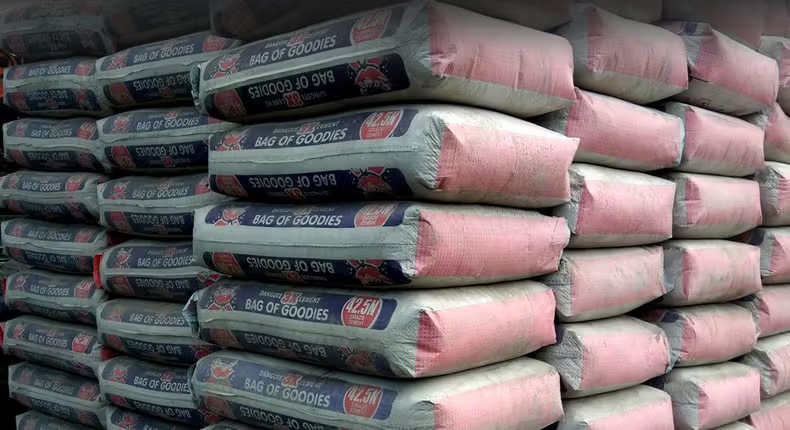
Africa’s largest cement producer, Dangote Cement, experienced a significant setback in Cameroon during 2025 as political tensions and economic uncertainty weighed heavily on construction demand.
According to financial results reviewed by the Accra Street Journal (ASJ), the company’s cement sales in Cameroon declined 14.1% year-on-year, falling to 1.2 million tonnes in 2025 from approximately 1.4 million tonnes in 2024.

The drop reflects the broader economic slowdown triggered by post-election unrest following the country’s October 2025 presidential election.
📢 GET A DETAILED ARTICLES + JOBS
Join ASJ's WhatsApp Channel and never miss a post or opportunity.

Political Unrest Hits Construction Activity
The company’s production facility in Douala—which has an annual capacity of 1.5 million tonnes—saw reduced sales as economic activity slowed across major urban centers.
According to market reports, political tensions following the election disrupted business operations, transport logistics and infrastructure projects, particularly in Douala and other commercial hubs.

These disruptions contributed to the roughly 200,000-ton decline in cement sales recorded during the year.
For construction-heavy industries such as cement manufacturing, political instability can quickly affect demand because infrastructure projects, real estate development and private construction often pause during periods of uncertainty.
Impact on Dangote’s Pan-African Performance
The slowdown in Cameroon also contributed to weaker performance across Dangote Cement’s broader African operations.
Across its pan-African markets, the company reported:
-
1.6% decline in total cement volumes, falling to 11 million tonnes
-
14.8% drop in pan-African EBITDA, which fell to about 294.1 billion naira
Profitability also weakened as operating margins declined from 23.3% to 20.2%.
Industry observers say these figures illustrate how regional political and economic instability can ripple across multinational operations.
Several other African markets also experienced challenges during the year, including Senegal, Ethiopia, Ghana and South Africa, where election cycles and liquidity constraints slowed infrastructure spending and private construction activity.
Dangote’s Presence in Cameroon
Dangote Cement entered the Cameroonian market in 2015, breaking a 48-year monopoly previously held by Cimencam.
Cimencam is a subsidiary of LafargeHolcim Maroc Afrique and had long dominated the country’s cement industry.

The entry of Dangote Cement introduced competition into the sector and helped expand production capacity in the country.
Despite the recent sales decline, the company remains optimistic about long-term demand driven by ongoing infrastructure development.
Infrastructure Projects Support Future Growth
Cameroon continues to pursue several large infrastructure initiatives expected to boost cement consumption in the coming years.
Among the most significant is the construction of the Douala–Yaoundé highway, along with a series of road and bridge projects aimed at strengthening national transport networks.
These projects could help stimulate cement demand once political stability and economic activity normalize.
Expansion Plans Still Under Review
Dangote Cement is also evaluating potential expansion strategies in Cameroon as part of a broader continental growth plan.
On February 28, 2026, Aliko Dangote signed a $1 billion engineering agreement with Sinoma Engineering to support capacity expansion projects across several African countries.
In Cameroon specifically, the company is considering two strategic options:
-
Expanding the existing Douala plant
-
Reviving plans to build a 1.5-million-ton cement facility in Nomayos, near Yaoundé.
The final decision will likely depend on market stability and long-term demand projections.
Balancing Expansion and Risk
For the Accra Street Journal (ASJ), Dangote Cement’s performance in Cameroon highlights the complex balance between opportunity and risk facing multinational companies operating across Africa.
The continent’s infrastructure needs continue to drive strong demand for cement and construction materials.

However, political transitions, currency pressures and economic uncertainty can quickly affect short-term market performance.
Despite these challenges, Dangote Cement’s continued investment across Nigeria and other African markets signals confidence in the long-term growth potential of Africa’s construction and infrastructure sectors.
Source: Accra Street Journal
Last Updated on March 11, 2026 by Samuel Kwame Boadu
Disclaimer: Some content on Accra Street Journal may be aggregated, summarized, or edited from third-party sources for informational purposes. Images and media are used under fair use or royalty-free licenses. Accra Street Journal is a subsidiary of SamBoad Publishing Hub under SamBoad Business Group Ltd, registered in Ghana since 2014.
For concerns or inquiries, please visit our Privacy Policy or Contact Page.

Samuel Kwame Boadu is a Ghanaian media entrepreneur and storyteller with a passion for amplifying urban voices and uncovering everyday truths. He is the Editor-in-Chief and Founder of Accra Street Journal, a dynamic digital platform dedicated to capturing the pulse of Ghana’s capital—its people, culture, challenges, business, sports and innovations.