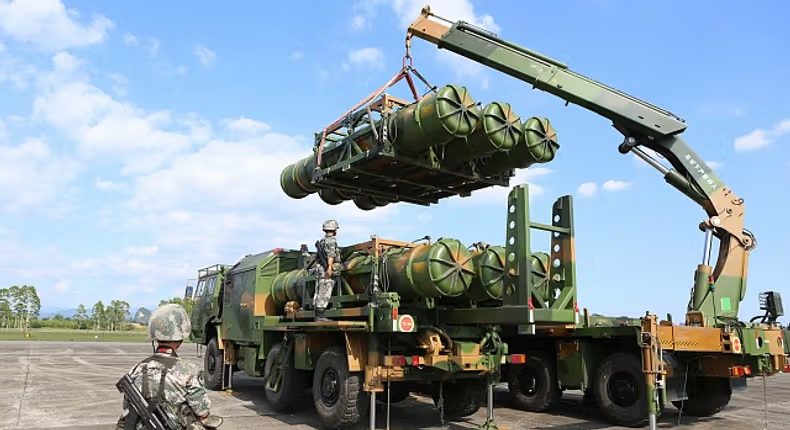
Defence spending across Africa is undergoing a noticeable shift as governments respond to insurgencies, terrorism and rising regional instability. New data shows that sub-Saharan Africa is increasing military procurement, even as overall arms imports across the continent decline.
According to the Stockholm International Peace Research Institute (SIPRI), arms imports into sub-Saharan Africa rose by 13% between the periods 2016–2020 and 2021–2025.

The increase highlights a growing focus on internal security and counter-insurgency operations, particularly in countries facing extremist violence and cross-border threats.
📢 GET A DETAILED ARTICLES + JOBS
Join ASJ's WhatsApp Channel and never miss a post or opportunity.

Reports monitored by the Accra Street Journal (ASJ) indicate that Nigeria, Senegal and Mali have emerged as the largest arms importers in sub-Saharan Africa, reflecting the region’s evolving security priorities.
Nigeria Expands Its Military Capabilities
Nigeria has become the data-start=”1150″ data-end=”1197″>largest arms importer in sub-Saharan Africa, accounting for about 16% of the region’s total imports, according to SIPRI data.

The country has significantly expanded defence procurement in response to security threats including insurgency, banditry and maritime insecurity.
Recently, the United States Department of State approved a $346 million arms package for Nigeria, including precision-guided bombs and rockets.
The agreement involves major defence manufacturers such as:
-
Lockheed Martin
-
RTX Corporation
-
BAE Systems
Nigeria is also strengthening its air force through a €1.2 billion deal with Leonardo, which includes the purchase of 24 M-346FA fighter aircraft.
Additional acquisitions include:
-
AH-1Z Viper attack helicopters from the United States
-
AW-109 Trekker helicopters from Italy
Nigeria has also deployed Bayraktar TB2 drones from Türkiye in counter-insurgency operations.
Senegal Strengthens Defence and Maritime Security
Senegal has emerged as the second-largest arms importer in sub-Saharan Africa, accounting for approximately 8.8% of regional imports.
Authorities in Dakar have increased defence spending as part of efforts to modernise the country’s armed forces and respond to instability in the Sahel region.
Recent acquisitions include:

-
Puma M36 armoured personnel carriers from South Africa
-
Three offshore patrol vessels—Walo, Niani and Cayor—to enhance maritime security and protect offshore energy infrastructure.
In 2025, Senegal also approved a €317 million defence agreement with a Turkish supplier aimed at strengthening operational readiness.
In a strategic move to support local industry, Senegal has launched its first military vehicle assembly plant in Diamniadio, signaling an interest in developing domestic defence manufacturing capacity.
Mali Diversifies Its Military Partnerships
Mali ranks as the third-largest arms importer in sub-Saharan Africa, accounting for about 8% of regional imports.
The country has expanded military cooperation with several partners, particularly Russia and China.
Russian military support has reportedly included:
-
Sukhoi Su‑25 jets
-
Mi‑35M helicopters
-
Mi‑8 aircraft
-
T‑72 tanks
Reports indicate that a convoy of more than 100 military vehicles arrived in Bamako in early 2025.
Mali has also received mine-resistant armoured vehicles from Chinese defence manufacturer Norinco.
In addition, the country has expanded its aerial surveillance capabilities using Bayraktar TB2 drones and reportedly acquired Akinci long-range combat drones from Türkiye.
Conflicts Driving Military Procurement
Several ongoing conflicts have contributed to rising demand for weapons across Africa.
One of the most significant is the Sudan Civil War, which has intensified arms flows into the region.
The conflict between the Sudanese Armed Forces and the Rapid Support Forces (RSF) has drawn military support from various international actors.

Reports indicate that both sides have received drones, artillery systems and armoured vehicles from multiple suppliers, though many of these transactions remain difficult to track due to the secrecy surrounding arms deals.
China Becomes Africa’s Largest Arms Supplier
The SIPRI data also highlights shifting global influence in Africa’s defence markets.
According to the institute, China has become the largest arms supplier to sub-Saharan Africa, accounting for about 22% of the region’s imports.
China is followed by:
-
Russia with 12%
-
Türkiye with 11%
The figures illustrate how global powers are increasingly competing for defence partnerships across Africa.
Security Pressures Reshape Africa’s Defence Landscape
For the Accra Street Journal (ASJ), the rise in arms imports across sub-Saharan Africa reflects a region grappling with complex security challenges.
From insurgencies in the Sahel to maritime threats in the Gulf of Guinea, governments are investing heavily in military capabilities to protect territorial stability and economic infrastructure.
While defence spending is rising, analysts note that balancing security investments with economic development will remain one of the region’s key policy challenges in the coming decade.
Source: Accra Street Journal
Last Updated on March 14, 2026 by Samuel Kwame Boadu
Disclaimer: Some content on Accra Street Journal may be aggregated, summarized, or edited from third-party sources for informational purposes. Images and media are used under fair use or royalty-free licenses. Accra Street Journal is a subsidiary of SamBoad Publishing Hub under SamBoad Business Group Ltd, registered in Ghana since 2014.
For concerns or inquiries, please visit our Privacy Policy or Contact Page.

Samuel Kwame Boadu is a Ghanaian media entrepreneur and storyteller with a passion for amplifying urban voices and uncovering everyday truths. He is the Editor-in-Chief and Founder of Accra Street Journal, a dynamic digital platform dedicated to capturing the pulse of Ghana’s capital—its people, culture, challenges, business, sports and innovations.