








4 min read
Ghana’s merchandise export earnings reached US$30.42 billion in the first ten months of 2026, but gold’s dominance at 68.8 per cent of the total is raising questions about the resilience of the country’s external trade position — particularly as reserves have fallen despite a US$13 billion trade surplus.
Ghana’s merchandise export earnings reached US$30.42 billion in the first ten months of 2026, but the growing concentration of export revenue in gold is raising questions about the resilience and diversification of the country’s external trade position.
Key Takeaways
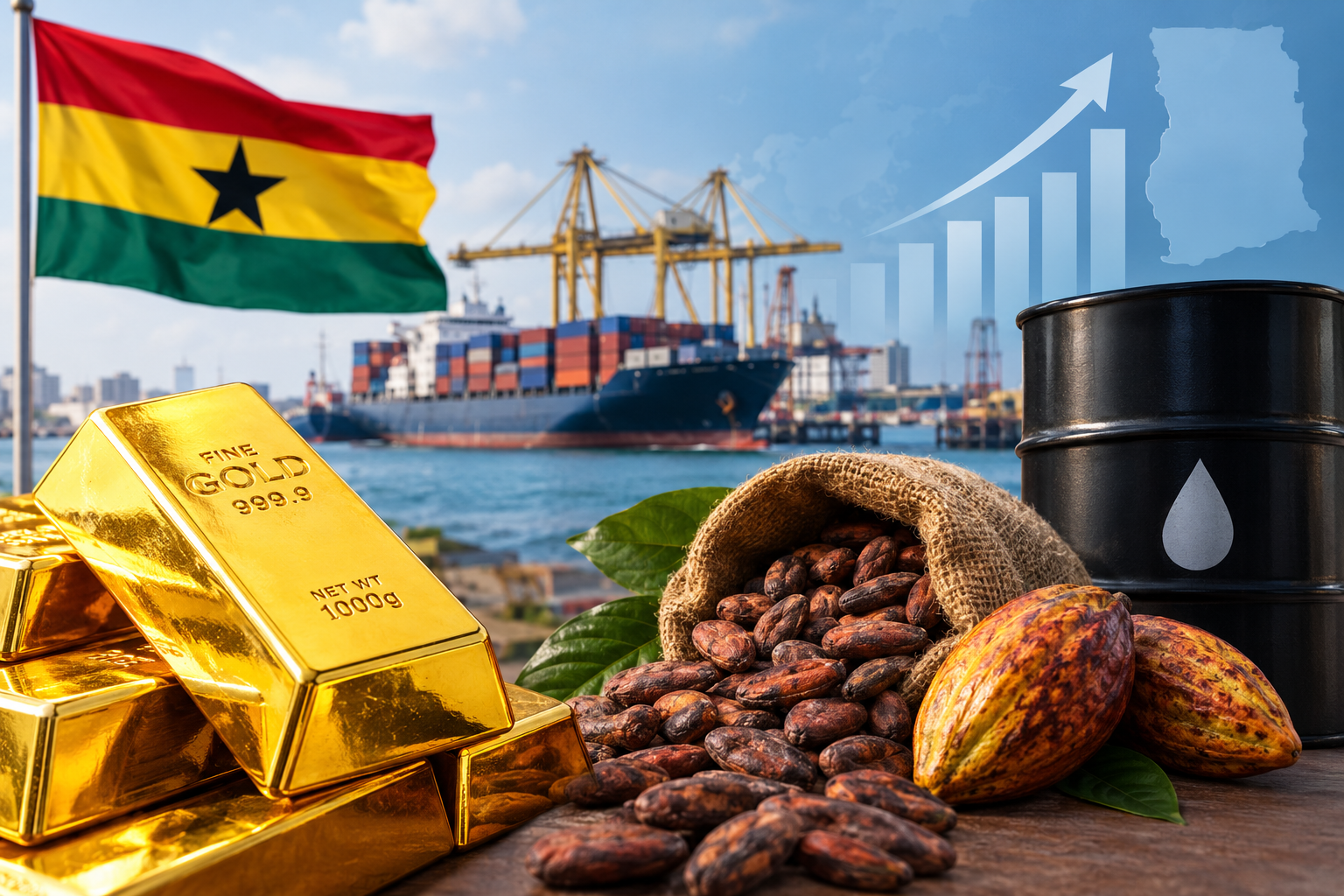
- Data from the Bank of Ghana's November 2026 Summary of Economic and Financial Data show that gold exports generated US$20.92 billion between January and October, representing approximately 68.8% of total export earnings.
- Cocoa exports contributed US$3.17 billion**, while **crude oil exports accounted for US$3.28 billion.
- The Bank of Ghana's data show that gross international reserves declined from US$13.83 billion in December 2025 to US$11.90 billion in October 2026.
Data from the Bank of Ghana’s November 2026 Summary of Economic and Financial Data show that gold exports generated US$20.92 billion between January and October, representing approximately 68.8% of total export earnings.
Cocoa exports contributed US$3.17 billion**, while **crude oil exports accounted for US$3.28 billion. Other exports generated US$3.04 billion over the same period.
The figures highlight Ghana’s increasing reliance on gold as its dominant source of foreign exchange earnings, with the commodity generating substantially more export revenue than cocoa, oil and other exports combined.
The Trade Surplus
Total exports of US$30.42 billion** exceeded imports of **US$17.39 billion, resulting in a merchandise trade surplus of US$13.02 billion by October 2026.
The surplus, equivalent to 9.8% of Gross Domestic Product (GDP), represents an improvement from US$8.69 billion recorded in June** and **US$8.89 billion in August.
The Reserves Puzzle
However, the strong trade position has not translated into a corresponding increase in gross international reserves.
The Bank of Ghana’s data show that gross international reserves declined from US$13.83 billion in December 2025 to US$11.90 billion in October 2026.
The reserves position provided 4.4 months of import cover in October, compared with 5.7 months in December 2025.
That divergence is the central economic puzzle in the data. A country running a trade surplus of nearly 10 per cent of GDP would ordinarily accumulate reserves; Ghana’s reserves have fallen by almost US$2 billion over the same period. The gap points to offsetting outflows — external debt service, portfolio exits, central bank forex sales, or capital flight — that are absorbing the export windfall before it reaches the reserve account.

What It Means for Business
Beyond the performance of gold, the relatively smaller contributions from cocoa, oil and other exports highlight the importance of expanding non-traditional exports and strengthening domestic production capacity.
For businesses, particularly those dependent on imported machinery, raw materials and intermediate goods, the sustainability of foreign exchange availability remains critical to investment planning and operating costs.

The figures also reinforce the need to maximise domestic value addition in the mining and agricultural sectors so that export growth generates broader industrial and economic benefits.
The Diversification Question
Ghana’s export performance is therefore increasingly strong, but the longer-term challenge will be ensuring that the gains extend beyond gold and translate into a more diversified and resilient external sector.
The concentration carries specific risks. Gold prices have traded above US$4,500 per ounce through much of 2026, supported by central bank buying and geopolitical risk. A correction to US$3,500 would reduce export earnings by roughly US$4.5 billion annually at current volumes — enough to halve the trade surplus and reverse the reserves trajectory.
Cocoa, meanwhile, contributed just US$3.17 billion despite record global prices, reflecting volume constraints from disease and aging tree stock. Oil at US$3.28 billion reflects plateaued production from mature fields.
Quick Facts
Ghana recorded US$30.42 billion in merchandise exports** between January and October 2026, of which **gold contributed US$20.92 billion (68.8%), cocoa US$3.17 billion**, **crude oil US$3.28 billion and other exports US$3.04 billion, according to the Bank of Ghana’s November 2026 Summary of Economic and Financial Data.
Imports of US$17.39 billion** produced a **trade surplus of US$13.02 billion, equal to 9.8% of GDP and up from US$8.69 billion in June** and **US$8.89 billion in August.
Despite the surplus, gross international reserves fell from US$13.83 billion in December 2025 to US$11.90 billion in October 2026, with import cover declining from 5.7 months to 4.4 months — raising questions about how export earnings are being converted into sustainable foreign exchange buffers and reinforcing the case for non-traditional exports and domestic value addition.
Source: Accra Street Journal
Last Updated on November 19, 2026 by Samuel Kwame Boadu
Ghana Market Watch
Track Ghana’s economy and financial markets with exchange rates, bank rates, fuel prices, food and commodity prices, economic indicators and financial market updates.

Disclaimer: Some content on Accra Street Journal may be aggregated, summarized, or edited from third-party sources for informational purposes. Images and media are used under fair use or royalty-free licenses. Accra Street Journal is a subsidiary of SamBoad Publishing Hub under SamBoad Business Group Ltd, registered in Ghana since 2014.
For concerns or inquiries, please visit our Privacy Policy or Contact Page.

Samuel Kwame Boadu is a Ghanaian media entrepreneur and storyteller with a passion for amplifying urban voices and uncovering everyday truths. He is the Editor-in-Chief and Founder of Accra Street Journal, a dynamic digital platform dedicated to capturing the pulse of Ghana’s capital—its people, culture, challenges, business, sports and innovations.
Use the following reference when citing or referencing this article.
Your feedback helps us improve our journalism.
Report an Error
Help us maintain accuracy. Let our editorial team know if you spot an issue in this article.
Report a problem with this article