










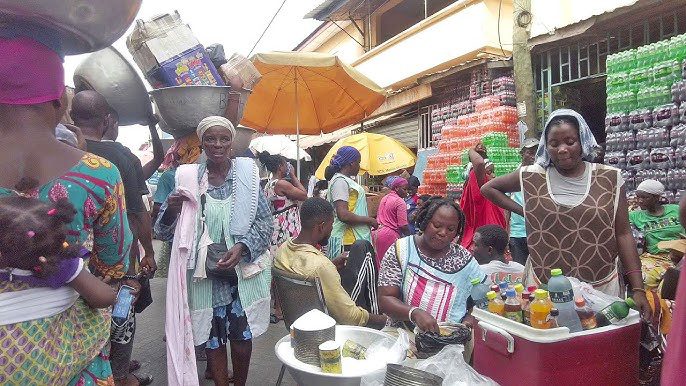
Accra’s markets are vibrant, fast-moving, and constantly alive with commercial activity. From dawn until late evening, goods flow in and out of stalls, buyers negotiate prices, transporters weave through narrow paths, and traders restock at remarkable speed.
To the average shopper, it appears organic — almost chaotic. But beneath the noise and movement lies a highly organized, informal logistics system that keeps the city’s commerce functioning.

Behind every crate of tomatoes, every bale of clothing, and every bag of rice sold in Accra’s major trading hubs such as Makola Market, Kaneshie Market, and Madina Market is a network of suppliers, transport operators, head porters, warehouse keepers, and financiers.
📢 GET A DETAILED ARTICLES + JOBS
Join ASJ's WhatsApp Channel and never miss a post or opportunity.

This is the hidden logistics engine that powers Accra’s busy markets — an ecosystem built not on formal supply-chain software, but on trust, timing, and long-standing commercial relationships.
The Early Morning Supply Chain
Accra’s market logistics system begins long before most residents wake up.

Between midnight and 5:00 a.m., trucks from farming communities and regional trading centers arrive in the capital. Perishable goods — tomatoes, onions, plantain, cassava, peppers, and leafy vegetables — must move quickly.
Many of these goods travel from farming belts across Ghana. The transport network is coordinated informally:
-
Drivers communicate with traders in advance.
-
Orders are confirmed by phone.
-
Payment terms are agreed before arrival.
-
Market unloading spaces are pre-arranged.
By sunrise, bulk goods are already being redistributed within the market.
Speed is critical. Fresh produce loses value quickly. The hidden logistics system thrives on timing precision.
The Role of Market Queens and Commodity Leaders
One of the most important but often overlooked pillars of this logistics structure is the role of commodity leaders — sometimes referred to as “market queens.”
These leaders:
-
Coordinate bulk purchasing
-
Control supplier relationships
-
Set pricing benchmarks
-
Allocate space within sections
-
Manage dispute resolution
They operate as supply-chain coordinators within specific product categories such as tomatoes, fish, or grains.
Through these networks, large volumes of goods are distributed efficiently to smaller traders who then sell to end consumers.
Without centralized coordination at this level, supply volatility would increase dramatically.

Informal Warehousing and Storage
Unlike modern retail chains that rely on centralized distribution centers, Accra’s markets depend on decentralized, informal storage systems.
Warehousing takes several forms:
-
Backroom stall storage
-
Rented container units
-
Shared bulk storage facilities
-
Temporary roadside stock holding
Storage decisions depend on product type, perishability, and cash flow.
For non-perishables such as rice, flour, canned goods, and textiles, traders often hold inventory in small rented warehouses near the market area. These spaces serve as mini distribution hubs feeding multiple stalls.
This decentralized structure reduces congestion in the main trading corridors while allowing rapid restocking.
The Crucial Role of Head Porters and Transport Hands
No discussion of market logistics in Accra is complete without acknowledging the head porters — commonly seen balancing heavy loads through crowded pathways.
They serve as micro-distribution agents within the market.
Their functions include:
-
Moving bulk goods from trucks to stalls
-
Redistributing stock between sections
-
Delivering purchases to customers’ vehicles
-
Assisting in storage transfers
Without them, congestion would halt commercial activity.
They are the physical connectors between supply and retail. In many ways, they represent the last-mile delivery system inside the market.
Credit Systems and Trade Financing
Cash flow drives logistics efficiency.
Many traders operate on rotating credit arrangements:
-
Suppliers deliver goods on partial credit.
-
Payment is made after goods are sold.
-
Long-term relationships reduce transaction risk.
-
Informal guarantors provide trust reinforcement.
This trade credit system keeps goods moving even when immediate cash is limited.
Formal banking penetration in market logistics remains limited, but informal financing mechanisms are highly sophisticated.
The hidden logistics system is supported not just by transport — but by financial trust networks.
Regional and Cross-Border Supply Links
Accra’s markets are not isolated. They are connected to regional and sometimes cross-border trade routes.
Goods may originate from:
-
Northern Ghana agricultural zones
-
Coastal fishing communities
-
Neighboring West African markets
These links require coordination between transport operators, clearing agents, middlemen, and wholesale traders.
The system is flexible and adapts quickly to supply shocks, price changes, and seasonal shifts.
When certain goods become scarce, alternative supply routes are activated through existing relationships.
Demand Forecasting Without Data Software
Large retail chains rely on data analytics to predict demand. Accra’s market traders rely on experience.
Forecasting methods include:
-
Seasonal knowledge
-
Festival calendars
-
Weather patterns
-
Political event timing
Veteran traders can estimate demand spikes with remarkable accuracy.
For example:
-
Festive seasons increase meat and textile demand.
-
Rainy seasons affect vegetable pricing.
The system operates on collective commercial memory rather than digital dashboards.
Competition and Cooperative Balance
Though markets appear highly competitive, cooperation plays a central role in sustaining logistics.
Traders often:
-
Share transport arrangements
-
Split bulk purchases
-
Refer customers to neighboring stalls
-
Share price information
This cooperative competition stabilizes supply and pricing.
Market ecosystems survive because individual actors understand that systemic breakdown harms everyone.
Urban Congestion and Adaptive Logistics
Accra’s traffic congestion presents major logistical challenges.
To cope, traders and transport operators:
-
Schedule early-morning deliveries
-
Use smaller vehicles for inner-market access
-
Rely on hand-carried transport inside tight corridors
-
Adjust pricing based on fuel fluctuations
Adaptation is constant.
The system evolves as the city grows.
Technology’s Gradual Influence
While informal systems dominate, technology is slowly integrating into market logistics.
Examples include:
-
Mobile money payments for bulk purchases
-
Phone-based supplier coordination
-
Social media sales announcements
-
Digital inventory tracking by younger traders
However, technology supplements rather than replaces the existing structure.
Trust and relationships remain foundational.
Resilience During Economic Shocks
One of the most impressive aspects of Accra’s hidden logistics system is its resilience.
During economic disruptions, supply-chain pressures, or currency fluctuations, markets rarely shut down entirely.
Instead, they adjust:
-
Prices are recalibrated.
-
Quantities are modified.
-
Supply routes are diversified.
-
Credit terms are renegotiated.
Flexibility ensures survival.
The system may be informal, but it is remarkably durable.
The Economic Significance
Accra’s markets are not just trading centers. They are employment generators and distribution hubs.
They support:
-
Farmers
-
Transport operators
-
Warehouse owners
-
Porters
-
Retail traders
-
Food vendors
-
Artisans
Thousands of livelihoods depend on the smooth functioning of this logistics ecosystem.
Without it, urban food security and daily commerce would be severely disrupted.
Frequently Asked Questions (FAQs)
1. How do goods arrive at Accra’s major markets?
Most goods are transported by trucks from farming communities and regional trading hubs, often arriving before dawn.
2. Who coordinates bulk supply within markets?
Commodity leaders and experienced traders often manage supplier relationships and distribution coordination.
3. How do traders finance bulk purchases?
Through a mix of cash payments and informal credit arrangements built on long-standing relationships.
4. Why do markets remain resilient during economic shocks?
Flexible supply routes, adaptive pricing, and cooperative trade relationships help maintain stability.
5. Is technology replacing informal logistics systems?
Not entirely. Technology supports communication and payments, but trust-based networks remain central.
Conclusion From ASJ
Accra’s busy markets operate on more than visible hustle. Beneath the noise and movement lies a complex logistics system built on coordination, trust, timing, and adaptation.
It is decentralized yet organized. Informal yet structured. Traditional yet evolving.
This hidden supply network feeds the city daily, stabilizes prices, and sustains thousands of livelihoods.
In many ways, Accra’s markets represent one of the most efficient informal logistics ecosystems in West Africa — proof that structured commerce does not always require formal systems.
It requires relationships, resilience, and rhythm.
Source: Accra Street Journal
Last Updated on March 14, 2026 by Samuel Kwame Boadu
Disclaimer: Some content on Accra Street Journal may be aggregated, summarized, or edited from third-party sources for informational purposes. Images and media are used under fair use or royalty-free licenses. Accra Street Journal is a subsidiary of SamBoad Publishing Hub under SamBoad Business Group Ltd, registered in Ghana since 2014.
For concerns or inquiries, please visit our Privacy Policy or Contact Page.

Samuel Kwame Boadu is a Ghanaian media entrepreneur and storyteller with a passion for amplifying urban voices and uncovering everyday truths. He is the Editor-in-Chief and Founder of Accra Street Journal, a dynamic digital platform dedicated to capturing the pulse of Ghana’s capital—its people, culture, challenges, business, sports and innovations.





