From a 2016 entry that broke the Ghacem-Dangote duopoly to a 2023 expansion that doubled its capacity to 2.3 million tonnes, the Moroccan-backed manufacturer has executed one of the most aggressive growth strategies in Ghana‘s industrial sector. With a grinding plant in the Tema Free Zones Enclave, three GSA-certified product lines, and a nationwide distribution network built on a popular 25kg bag and a price advantage, CIMAF has become the cement industry‘s most formidable challenger—proving that African industrial capital can compete with European and Nigerian giants on their own turf.
Executive Introduction
In Ghana‘s cement industry—a market long defined by the duopoly of Ghacem (European-backed) and Dangote (Nigerian-backed)—the most disruptive force of the past decade has come from neither Europe nor West Africa‘s giant, but from North Africa. CIMAF (Ciments de l‘Afrique), a subsidiary of the Moroccan conglomerate Groupe CIMAF founded by Anas Sefrioui, entered the Ghanaian market in 2016 with a single grinding plant in Tema . Eight years later, it has grown into a 2.3 million-tonne-per-annum producer, one of the largest cement manufacturers in the country .

The company‘s ascent is a testament to strategic patience, aggressive capacity expansion, and a deep understanding of the price-sensitive Ghanaian consumer. While Ghacem markets trust and heritage, and Dangote markets pan-African scale, CIMAF has competed on a simpler proposition: a smaller, cheaper bag that makes quality cement accessible to the ordinary Ghanaian.
📢 GET A DETAILED ARTICLES + JOBS
Join ASJ's WhatsApp Channel and never miss a post or opportunity.

In February 2025, reports from the Upper West Region confirmed that CIMAF‘s 25kg bag was selling for GH¢85—significantly cheaper than competing 50kg bags—creating such high demand that the product was experiencing shortages . This is not an accident; it is the logical outcome of a deliberate strategy to serve the mass market.
Today, CIMAF Ghana operates with three certified product lines: CIMAF Smart Ultimate Plus (CEM II/B-L 42.5R), CIMAF Smart Ultimate (CEM II/B-L 42.5N), and CIMAF Smart (CEM II/C-M 32.5N) . It is an active member of the Chamber of Cement Manufacturers, Ghana (COCMAG) and is fully compliant with Ghana Standards Authority (GSA) regulations . The company has also forged partnerships with the Institute of Research, Innovation and Development (IRID) at Kumasi Technical University, focusing on the professionalisation of artisans, cement grade surveys, and student training programmes .

For construction executives, cement retailers, and industry analysts, CIMAF represents a case study in Moroccan industrial ambition, capacity-led growth, and strategic market segmentation. This profile examines the company‘s 2016 entry, its 2023 expansion to 2.3 million tonnes, its product portfolio and GSA certifications, its partnership with KsTU IRID, its distribution network and pricing strategy, its ownership under Groupe CIMAF (founded 2011, present in 13 African countries), and the critical question: Can CIMAF translate its capacity advantage and price appeal into sustained market share growth against the entrenched giants of Ghana‘s cement industry?
Company Overview: The Moroccan Challenger
The Genesis: Groupe CIMAF and the 2016 Ghana Entry
CIMAF (Ciments de l‘Afrique) is a subsidiary of Groupe CIMAF, a Moroccan industrial conglomerate founded by Mr. Anas Sefrioui in 2011 . The group was created following the successful construction of two cement plants in Morocco, and Sefrioui‘s strategic vision extended beyond North Africa‘s borders into Sub-Saharan Africa.
CIMAF‘s ambition is clear: to be a recognized operator in a strategic sector for the development of Africa, and a professional, competitive player contributing to the diversification of supply and the strengthening of the continental industrial fabric . The group currently operates cement plants in 13 African countries, with Ghana as a key market .
The Ghana subsidiary was commissioned in 2016, establishing a grinding and bagging plant in the Tema Free Zones Enclave . The location was strategic: proximity to the Tema Port for efficient import of clinker, and access to the Greater Accra market—Ghana‘s largest cement-consuming region.
Ownership and Group Structure
| Item | Details |
|---|---|
| Parent Company | Groupe CIMAF (Morocco) |
| Parent Founded | 2011 |
| Parent Founder | Anas Sefrioui |
| Group Presence | 13 African countries |
| Ghana Subsidiary Name | Ciments De L‘Afrique (GH) Limited |
| Ghana Established | 2016 |
| Plant Location | Free Zones Enclave, Tema, Greater Accra Region |
| Plant Coordinates | 5.704645, 0.017442 |
| Plant Type | Grinding plant (clinker imported) |
| Current Capacity | 2.3 million tonnes per annum |
| GSA Registration Number | GSA-PCM-A-831 |
| Industry Association | Chamber of Cement Manufacturers, Ghana (COCMAG) |
Leadership: The Country Manager
Mr. Mohammed Bennis serves as the Country Manager of CIMAF Ghana . He has represented the company in key partnerships, including the agreement with Kumasi Technical University‘s IRID, and has been instrumental in the company‘s expansion and community engagement.
Key Leadership Engagement:
In discussions with the Institute of Research, Innovation and Development (IRID) at KsTU, Mr. Bennis and his team provided inputs for a memorandum of understanding focusing on artisan professionalisation, cement grade surveys, and training programmes .
Key Operational Metrics (2025-2026)
| Metric | Value |
|---|---|
| Year Established (Ghana) | 2016 |
| Initial Plant Commissioning | 2016 |
| Capacity (Post-2023 Expansion) | 2.3 million metric tonnes per annum |
| Plant Type | Grinding plant |
| Location | Free Zones Enclave, Tema, Greater Accra Region |
| GSA Certifications | 3 products (CEM II/B-L 42.5R, CEM II/B-L 42.5N, CEM II/C-M 32.5N) |
| Key Product Grades | 42.5R (Smart Ultimate Plus), 42.5N (Smart Ultimate), 32.5N (Smart) |
| Key Packaging | Popular 25kg bag |
| Distribution Reach | Nationwide (including Upper West Region) |
| Industry Affiliation | Chamber of Cement Manufacturers, Ghana (COCMAG) |
| Regulator | Ghana Standards Authority (GSA) |
The Free Zones Advantage
CIMAF operates within the Free Zones Enclave in Tema . This status provides several benefits:
| Advantage | Explanation |
|---|---|
| Tax Incentives | Duty-free import of machinery and raw materials (including clinker) |
| Reduced Production Costs | Lower tax burden allows competitive pricing |
| Export Facilitation | Simplified procedures for exporting to neighbouring countries |
This Free Zones status is a critical component of CIMAF‘s ability to offer competitive prices, particularly for its popular 25kg bag .

The 2023 Expansion: From 1 Million to 2.3 Million Tonnes
The Commissioning of Phase 2
In November 2022, Deputy Minister for Trade and Industries, Michael Okyere Baafi, commissioned the second phase of CIMAF‘s expansion at the Tema Free Zones Enclave . The expansion added an additional 1 million tonnes to the plant‘s production capacity, taking it to 2 million tonnes per annum .
Speaking at the commissioning, the Deputy Minister reaffirmed the government‘s commitment to industrialisation, noting that when industries abound, employment is created . The expansion was aimed at dealing with the high demand for quality cement products in the market.
By 2023, the company‘s capacity had increased further to 2.3 million metric tonnes, according to CIMAF‘s official website . This growth trajectory—from entry in 2016 to 2.3 million tonnes by 2023—positions CIMAF as one of the largest cement producers in Ghana.
Capacity Comparison: CIMAF vs. Competitors
| Company | Capacity (Million Tonnes/Annum) | Market Position |
|---|---|---|
| CIMAF Ghana | 2.3 | Major player |
| Ghacem (Tema + Takoradi) | ~2.4 | Market leader |
| Dangote Cement | Terminal operation | Major challenger |
| Bright Cement | 0.9 | Emerging challenger |
CIMAF‘s capacity now rivals that of Ghacem, the long-standing market leader. This capacity expansion, combined with the company‘s Free Zones cost advantages, makes CIMAF a formidable competitor.
Technology and Standards
CIMAF has opted for a European supplier of international renown for its plant installations, constituting a guarantee of respect for deadlines and the quality of the installations . The plant was designed using the latest available technologies, making it possible to meet the most demanding national and international standards, both in terms of process and energy saving, and in terms of environmental protection .
The company‘s commitment to quality is reflected in its GSA certifications, renewed annually, with the current certification valid until 27th January 2026 .
The Product Portfolio: Three GSA-Certified Lines
CIMAF Ghana‘s product portfolio is certified by the Ghana Standards Authority (GSA) under registration number GSA-PCM-A-831. The company markets three distinct cement products under the ‘CIMAF Smart‘ brand family .
Certified Products (as of 2025)
| No. | Product Name | Grade | Standard | GSA Registration |
|---|---|---|---|---|
| 1 | Cimaf Smart Ultimate Plus | Portland Limestone Cement CEM II/B-L 42.5R | GS 1118-1: 2024 | GSA-PCM-L-A-831-004 |
| 2 | Cimaf Smart Ultimate | Portland Limestone Cement CEM II/B-L 42.5N | GS 1118-1: 2024 | GSA-PCM-L-A-831-001 |
| 3 | Cimaf Smart | Portland Composite Cement CEM II/C-M 32.5N | GS 1118-2: 2024 | GSA-PCM-L-A-831-007 |
Source: The High Street Business
Product Specifications Explained
CIMAF Smart Ultimate Plus (42.5R):
The highest-strength product in the range, with a 42.5 grade and ‘R‘ (Rapid) designation. This product achieves early strength quickly, making it suitable for projects requiring fast formwork turnover, such as precast concrete, high-rise buildings, bridges, and road construction.
CIMAF Smart Ultimate (42.5N):

A high-strength cement with a 42.5 grade and ‘N‘ (Normal) designation. It offers good strength development without the accelerated set time of the ‘R‘ variant. Suitable for general construction, foundations, slabs, columns, and reinforced concrete works.
CIMAF Smart (32.5N):
A 32.5 grade general-purpose cement, suitable for masonry, plastering, block making, flooring, and low-rise residential construction. This is likely the product sold in the popular 25kg bag targeting the mass market .
The Popular 25kg Bag Strategy
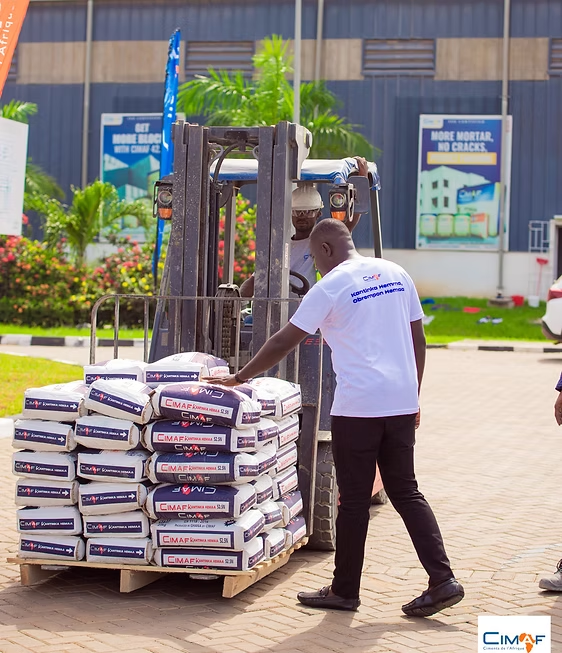
CIMAF‘s most visible product in the retail market is its 25kg bag, which has become popular due to its affordable price. In February 2025, reports from the Upper West Region indicated that CIMAF 25kg cement was selling for GH¢85, while competing 50kg brands were selling for GH¢105–110 .
Price Comparison (February 2025, Upper West Region):
| Brand | Bag Size | Price (GH¢) | Price per kg (GH¢) |
|---|---|---|---|
| CIMAF | 25kg | 85 | 3.40 |
| KGM Cement | 50kg | 105–110 | 2.10–2.20 |
| Safe Cement | 50kg | 108 | 2.16 |
The 25kg bag strategy serves multiple purposes:
| Objective | Explanation |
|---|---|
| Lower Entry Price | A GH¢85 bag is more accessible to low-income consumers and small-scale builders |
| Reduced Waste | Small-scale projects can use smaller quantities without leftover cement |
| Handling Ease | 25kg bags are easier to transport and handle than 50kg bags |
| Market Segmentation | Captures the segment of the market that is price-sensitive and volume-constrained |
The high demand for CIMAF 25kg cement has, at times, led to shortages, indicating that the product is outselling supply .
The KsTU IRID Partnership: Research and Artisanal Development
In a significant move beyond pure manufacturing, CIMAF Ghana entered into a four-year partnership agreement (2022–2025) with the Institute of Research, Innovation and Development (IRID) at Kumasi Technical University (KsTU) .
Key Areas of Collaboration
| Area | Description |
|---|---|
| Professionalisation of Artisans | Training programmes for masons, builders, and other artisans who use cement |
| Cement Grade Usage Survey | A nationwide survey on the percentage usage of different cement grades |
| Training and Internships | Opportunities for KsTU students and staff at CIMAF plants in Ghana and Morocco |
| Research Consultancy | IRID to provide research consultancy and artisanal training |
| National Advocacy Platform | Creation of a national-level platform for advocacy on the use of cement (concrete) in road construction |
Source: The High Street Business
The Role of CIMAF Management
The Country Manager of CIMAF Ghana, Mr. Mohammed Bennis, and his team provided inputs for the memorandum of understanding. Mr. Karim Bensalah, Director of Corporate Communications for CIMAF Morocco, assured IRID that the company was ready to accept students and staff of the Chemical Engineering Department for training and internship opportunities both in Ghana and Morocco .
Dr. Smart Sarpong, Director of IRID, assured CIMAF of the Institute‘s sincere dedication and commitment, pledging to commit all required expertise and resources to make the collaboration successful .
Strategic Significance
This partnership is unique among cement manufacturers in Ghana. By investing in artisan training and research, CIMAF is building a pipeline of skilled workers who will be familiar with and loyal to the CIMAF brand. The focus on correct cement usage also reduces the risk of structural failures, indirectly benefiting the entire construction industry.
The partnership also supports the government‘s industrialisation agenda, which the Deputy Minister of Trade highlighted during the commissioning of CIMAF‘s phase two expansion .
Regulatory Compliance and Industry Standing
GSA Certification (2025-2026)
CIMAF Ghana‘s products are certified by the Ghana Standards Authority (GSA) under registration number GSA-PCM-A-831. The current certification, listed in the GSA‘s Certified Products List for the period 28th January 2025 to 27th January 2026, covers three product lines .
The certification details for each product include:
-
Product Name: CIMAF Smart Ultimate Plus / CIMAF Smart Ultimate / CIMAF Smart
-
Grade: CEM II/B-L 42.5R / CEM II/B-L 42.5N / CEM II/C-M 32.5N
-
Standard: GS 1118-1: 2024 or GS 1118-2: 2024
-
Maximum Bag Weight (kg): 23.51
-
Registration Number: GSA-PCM-L-A-831-004 / 001 / 007
-
Location: Freezone Enclave Tema, GA/R
-
Certification Period: 2025-01-28 to 2026-01-27
Source: The High Street Business
Chamber of Cement Manufacturers (COCMAG)
CIMAF Ghana is an active member of the Chamber of Cement Manufacturers, Ghana (COCMAG) . The Chamber represents the collective interests of cement producers in Ghana and engages with the government on pricing, standardization, and regulatory matters.
In July 2025, the Minister for Trade, Agribusiness and Industry, Hon. Elizabeth Ofosu-Adjare, met with COCMAG members, including CIMAF, to discuss pricing and standardisation. The Minister appealed to cement producers to allow consumers to benefit from the appreciation of the cedi. Representatives from CIMAF, Ghacem, CBI, Diamond, Dangote, Dzata, and Empire cement lauded the engagement, pledging to work to ensure price reduction in the coming months and adhere to strict standardisation processes .
Distribution and Market Presence
Nationwide Reach
CIMAF has established a nationwide distribution network. Reports from the Upper West Region confirm that CIMAF cement is available in Wa and surrounding areas . This indicates that the company‘s reach extends far beyond its Tema base into the northern sectors of the country.
Retailer and Agent Feedback
Agents in the Upper West Region confirmed that the demand for CIMAF 25kg cement was directed towards its affordable price of GH¢85 . The shortage created by high demand suggests that the product is well-received by consumers and that the company may need to increase supply to meet market needs.
Competing Brands in the Market
The Upper West Media report notes that other brands in the market at the time included:
-
KGM Cement (GH¢105–110 per 50kg bag)
-
Safe Cement (GH¢108 per 50kg bag)
Source: The High Street Business
Comparison to Other Challenger Brands
CIMAF faces competition from several other cement manufacturers in Ghana. The 2025 GSA Certified Products List includes the following cement producers :
| Company | Product |
|---|---|
| Continental Blue Investment Ghana Limited | Limestone Calcined Clay Cement LC3 32.5N (Supastar) |
| Ciments De L‘Afrique (GH) Limited | CIMAF Smart Ultimate Plus, Ultimate, Smart |
| GHACEM Limited | Limestone Calcined Clay Cement LC3 32.5N (GHACEM Eco Cool) |
| Unicem Cement Ghana Limited | Portland Limestone Cement CEM II/B-L 32.5R (Unicem Super Strong) |
CIMAF‘s three-product portfolio gives it a broader range than some competitors, allowing it to serve multiple market segments from a single production facility.
Competitive Landscape: CIMAF vs. The Market
The Major Players in Ghana‘s Cement Market
| Company | Ownership | Capacity (MTA) | Key Strengths |
|---|---|---|---|
| Ghacem | HeidelbergCement (93.1%) | ~2.4 | Market leader, brand heritage, ISO certifications |
| CIMAF | Moroccan (Groupe CIMAF) | 2.3 | Competitive pricing, 25kg bag, Free Zones cost advantage, GSA-certified |
| Dangote Cement | Nigerian multinational | Terminal operation | Pan-African scale, aggressive pricing |
| Diamond Cement | WACEM | — | Strong presence in Volta Region |
Source: The High Street Business
CIMAF‘s Competitive Advantages
1. Capacity Scale (2.3 Million Tonnes):
CIMAF‘s capacity now rivals that of Ghacem, the long-standing market leader. This scale allows the company to achieve economies of scale and compete on price.
2. Free Zones Cost Advantage:
Operating within the Tema Free Zones Enclave provides tax incentives and duty-free import of raw materials, reducing production costs .
3. Affordable 25kg Bag Strategy:
The GH¢85 25kg bag has proven to be highly popular, creating demand that sometimes outstrips supply . This product targets the price-sensitive mass market.
4. Three GSA-Certified Product Lines:
CIMAF offers a range of grades (32.5N, 42.5N, 42.5R) under a single brand family, covering general construction, high-strength applications, and rapid-strength requirements .
5. Research and Artisanal Partnerships:
The partnership with KsTU IRID positions CIMAF as a thought leader invested in the professionalisation of the construction industry .
6. Moroccan Parentage and Pan-African Network:
As part of a group operating in 13 African countries, CIMAF Ghana has access to technical expertise, supply chain best practices, and potential cross-border synergies .
Competitive Disadvantages
1. Clinker Import Dependency:
Like all cement manufacturers in Ghana, CIMAF depends on imported clinker. Global supply disruptions and shipping cost volatility directly affect production costs.
2. Brand Recognition Lagging Ghacem:
Ghacem has been in Ghana since 1967, creating multi-generational brand loyalty that CIMAF cannot match.
3. Limited Vertical Integration:
Unlike integrated plants that produce their own clinker, CIMAF is a grinding plant reliant on imported clinker. This makes it more vulnerable to supply chain shocks.
4. Dangote‘s Aggressive Pricing:
Dangote Cement has a terminal at Tema Port and can engage in aggressive price competition, squeezing margins for all competitors.
Challenges and Risks
No analysis of CIMAF Ghana is complete without acknowledging the headwinds it faces.
Risk 1: Clinker Import Dependency
Ghana does not produce clinker domestically. All cement manufacturers, including CIMAF, rely on imported clinker. Global supply disruptions, rising shipping costs, and currency depreciation directly affect production costs.
Mitigation: CIMAF‘s Free Zones status reduces import duties, but it does not eliminate the underlying dependency.
Risk 2: Currency Volatility
CIMAF‘s costs are partly denominated in foreign currencies (for imported clinker and equipment), while revenue is in Ghana cedis. The cedi‘s volatility compresses margins when local currency depreciates.
Mitigation: The company adjusts prices in response to cost movements and maintains efficiency improvements.
Risk 3: Intense Competition
Ghacem has decades of brand loyalty. Dangote Cement has aggressive pricing and pan-African scale. Diamond Cement has a strong regional presence. CIMAF must compete for market share in a crowded field.
Mitigation: The 25kg bag strategy and price advantage are CIMAF‘s primary competitive weapons.
Risk 4: Capacity Underutilisation
With a capacity of 2.3 million tonnes, CIMAF must maintain high utilisation rates to achieve economies of scale. Low demand or supply disruptions could leave the plant underutilised.
Mitigation: The company‘s exports to neighbouring countries may provide additional demand.
Risk 5: Free Zones Regulatory Risk
The Free Zones Enclave status provides significant tax benefits. Any change in government policy regarding Free Zones incentives could affect CIMAF‘s cost structure.
Mitigation: The Free Zones regime has been stable, but policy risk remains.
Risk 6: Price Wars
Cement is a commodity. Price competition is intense. Competitors may lower prices to squeeze margins, forcing CIMAF to choose between maintaining price and losing market share.
Mitigation: The 25kg bag targets a distinct market segment that may be less sensitive to price wars in the 50kg segment.
Risk 7: Supply Chain Disruptions
The company‘s operations are heavily dependent on a reliable supply of imported clinker. Geopolitical events, shipping delays, or port congestion could disrupt production.
Mitigation: Diversification of clinker sources and strategic inventory management.
Economic and Industry Impact
Employment and Local Content
CIMAF‘s expansion created employment opportunities during the construction phase and continues to employ Ghanaians in its operations. The company‘s presence in the Tema Free Zones Enclave contributes to the local economy through wages, taxes (where applicable), and procurement of local services.
Support for Affordable Housing
The affordable 25kg bag at GH¢85 makes cement accessible to low-income households and small-scale builders, supporting the government‘s affordable housing agenda.
Partnership with Technical Education
The partnership with Kumasi Technical University‘s IRID supports the development of technical skills in the construction industry, including training for artisans who use cement and research on cement grade usage .
Contribution to Industrialisation
Deputy Minister Michael Okyere Baafi noted that when industries abound, employment is created . CIMAF‘s expansion aligns with the government‘s industrialisation drive.
Market Competition and Consumer Choice
CIMAF‘s entry and expansion have increased competition in Ghana‘s cement market, giving consumers more choices and putting downward pressure on prices.
Future Outlook
As of June 2026, CIMAF Ghana is in a consolidation and market penetration phase. The company has achieved its capacity expansion to 2.3 million tonnes and must now focus on increasing market share and brand recognition.
The Immediate Agenda (2026-2027)
-
Utilise Expanded Capacity: Ensure the 2.3 million-tonne plant operates at or near full capacity.
-
Expand 25kg Bag Distribution: Increase supply of the popular 25kg bag to meet demand and prevent shortages .
-
Deepen KsTU IRID Partnership: Implement the training and internship programmes for students and artisans.
-
Strengthen Distribution Network: Expand reach into underserved regions and ensure consistent supply.
-
Maintain Regulatory Compliance: Continue GSA certification and COCMAG engagement .
-
Export to Neighbouring Countries: Leverage Free Zones status for exports to Burkina Faso, Togo, and Côte d‘Ivoire.
The Bull Case (Optimistic)
-
Capacity Fully Utilised: The 2.3 million-tonne plant operates at 90%+ capacity. CIMAF captures 25%+ market share.
-
25kg Bag Dominates Mass Market: The GH¢85 bag becomes the default choice for low-income households and small-scale builders. CIMAF becomes synonymous with affordable cement.
-
Artisanal Training Programme Scales: The KsTU IRID partnership trains thousands of masons and builders across Ghana, building loyalty to the CIMAF brand.
-
Exports to West Africa Materialise: CIMAF exports to Burkina Faso, Togo, and Côte d‘Ivoire, diversifying revenue and reducing dependence on the Ghanaian market.
-
Parent Group Investment Continues: Groupe CIMAF invests further in Ghana, potentially adding a clinker production facility to reduce import dependency.
The Bear Case (Pessimistic)
-
Clinker Shortage Persists: Global supply disruptions limit production. Customers switch to competitors with more reliable supply.
-
Price War Intensifies: Dangote or Ghacem lower prices aggressively. CIMAF‘s price advantage erodes.
-
25kg Bag Shortages Continue: The company fails to scale production of the popular 25kg bag. Customers switch to alternative brands.
-
Currency Crisis: The cedi depreciates sharply. Imported clinker costs spike. CIMAF raises prices, losing its price advantage.
-
Free Zones Policy Changes: Government revises Free Zones incentives, increasing CIMAF‘s cost base.
The Verdict
CIMAF Ghana is the most aggressive and successful challenger in Ghana‘s cement industry. Since its entry in 2016, the Moroccan-backed manufacturer has grown from a single grinding plant to a 2.3 million-tonne-per-annum producer, rivaling the capacity of the long-standing market leader Ghacem . Its expansion to 2.3 million tonnes was commissioned in 2022, adding 1 million tonnes to meet high demand for quality cement products .
The company‘s strategy is clear and effective. The 25kg bag, selling at an affordable GH¢85, has created a loyal customer base in the price-sensitive mass market . The three GSA-certified product lines—Smart Ultimate Plus (42.5R), Smart Ultimate (42.5N), and Smart (32.5N)—cover the full range of construction needs, from rapid-strength applications to general-purpose masonry . The partnership with KsTU IRID is unique among cement manufacturers, investing in the professionalisation of artisans and the development of technical skills .
The company is led by Country Manager Mohammed Bennis, who has represented CIMAF in key partnerships . The parent company, Groupe CIMAF, founded in 2011 by Anas Sefrioui, operates in 13 African countries, providing cross-border synergies and technical expertise . The Tema plant, with coordinates 5.704645, 0.017442, is a modern facility using European technology and meeting high environmental and quality standards .
The risks are real: clinker import dependency, currency volatility, intense competition, and supply chain vulnerabilities. But CIMAF has demonstrated a capacity to expand rapidly and compete effectively. The expansion to 2.3 million tonnes was completed within seven years of entry —a remarkable pace for a foreign entrant in a capital-intensive industry.
For the Ghanaian builder seeking an affordable, high-quality cement, CIMAF offers the popular 25kg bag and a range of certified products. For the Ghanaian economy, CIMAF contributes to employment, industrialisation, and competition. For the cement industry, CIMAF is the challenger that has forced every player to improve.
CIMAF is not trying to be the most trusted cement in Ghana—Ghacem holds that crown. It is trying to be the most accessible, the most affordable, and the most responsive to the needs of the ordinary Ghanaian. With a 2.3 million-tonne capacity, a popular 25kg bag, and a parent group committed to Africa, it is well-positioned to achieve that goal.
Last Updated on June 9, 2026 by Samuel Kwame Boadu
Disclaimer: Some content on Accra Street Journal may be aggregated, summarized, or edited from third-party sources for informational purposes. Images and media are used under fair use or royalty-free licenses. Accra Street Journal is a subsidiary of SamBoad Publishing Hub under SamBoad Business Group Ltd, registered in Ghana since 2014.
For concerns or inquiries, please visit our Privacy Policy or Contact Page.

Samuel Kwame Boadu is a Ghanaian media entrepreneur and storyteller with a passion for amplifying urban voices and uncovering everyday truths. He is the Editor-in-Chief and Founder of Accra Street Journal, a dynamic digital platform dedicated to capturing the pulse of Ghana’s capital—its people, culture, challenges, business, sports and innovations.