






14 min read
Introduction
Ghana’s education system is changing. Not just in the classrooms, but in the way companies, development partners, and institutions are putting money and effort into skills development. The old model—where government built schools and companies occasionally donated textbooks—is giving way to something more deliberate. Mining companies are funding university scholarships. Banks are building digital learning centres. International organisations are equipping technical institutes with solar panels and drones. And agribusinesses are pooling their own money to fund agricultural education.
The numbers tell part of the story. The government has allocated GH¢33.3 billion to the Ministry of Education for 2026, plus GH¢9.9 billion for GETFund . But the story is not just about government spending. It is about a growing recognition that the skills gap between what schools teach and what employers need is a problem that everyone has to solve.
Key Takeaways
- In August 2026, five Ghanaian agribusinesses—Farmerline Consult, New Age Agric Solutions, Tradeline Consult, Grow For Me, and AgriSolve—pooled GH¢3.5 million as seed funding for the Ghana Agricultural Education Transformation Fund.
- The Mauritius-Africa Scholarship Scheme offers Ghanaian students the opportunity to study at public higher education institutions in Mauritius for the 2026/2027 academic year.
- Ecobank Ghana has built seven digital learning centres between 2023 and 2026.
This article looks at how companies and institutions are investing in education and skills development in Ghana. It covers corporate scholarships, digital learning initiatives, TVET partnerships, agricultural education funds, and the policy shifts shaping the sector. It is written for anyone who wants to understand where the money is going and whether it is making a difference.
Corporate Investment: Mining, Banking, and Beyond
AngloGold Ashanti Obuasi Mine
AngloGold Ashanti’s Obuasi Mine has been quietly building a scholarship programme that targets students in its host communities. In October 2026, the mine awarded scholarships to 30 additional students under its Community Scholarship Support Scheme, bringing the total number of beneficiaries to 50 since the programme began . The support covers tuition for the duration of each student’s programme, and recipients also receive laptops and backpacks.
The scheme is part of the mine’s 10-year Socio-Economic Development Plan, which prioritises education and skills development. It also complements the mine’s role in establishing the KNUST Obuasi Campus, which brought tertiary education closer to students in the area . The Director of Sustainability Management, Edmund Oduro Agyei, described education as a critical component of the mine’s development agenda. This is corporate investment in education that goes beyond a one-off donation. It is a sustained commitment tied to the company’s long-term presence in the community.
Ecobank Ghana
Ecobank Ghana has taken a different approach. In October 2026, the bank commissioned a refurbished digital learning centre for the 4 Garrison Education Center in Kumasi. The centre includes 26 computers and accessories, modern furniture, and equipment designed to support learning in coding, web development, animation, robotics, and artificial intelligence.
The initiative was part of Ecobank Day 2026, themed “Building Tomorrow’s Skills Today.” Fred Amegashie, Zonal Head for Ecobank Ghana, noted that Ecobank affiliates across Africa have built or refurbished 66 IT laboratories over three years, helping more than 46,000 children and young people acquire digital skills. In Ghana, the 4 Garrison centre brings the total number of digital learning centres established by Ecobank Ghana to seven between 2023 and 2026 .
This is a model of corporate investment that focuses on infrastructure and access. The bank is not paying school fees; it is building the physical and technological environment where digital skills can be learned. For a country where many schools lack basic computer facilities, this kind of investment matters.
International Partnerships: Skills for the Green and Digital Economy
ILO and EU Solar Skills Training
In November 2026, the International Labour Organization and the European Union launched a Solar Photovoltaic Training Facility at Wa Technical Institute in the Upper West Region. The facility allows students to install, configure, test, maintain, and troubleshoot solar systems using modern equipment, rather than relying on textbooks and outdated gear .
The project trained 15 facilitators, including two women, through a three-week Training of Trainers programme. Approximately 100 electrical trainees are expected to benefit in 2026, with future cohorts continuing to access the facility. The four-year project, funded by the EU and implemented by the ILO, supports green skills development across the Upper West, Savannah, and Volta regions, focusing on renewable energy, agriculture, and construction .

Dr. Vanessa Phala of the ILO Country Office emphasised the connection between energy investment and human capital: “Investment in renewable energy must therefore go hand in hand with investment in people” . This is a different kind of skills development from a scholarship. It is about building the technical capacity for an industry that is growing in Ghana, and doing it through the institutions that already exist.
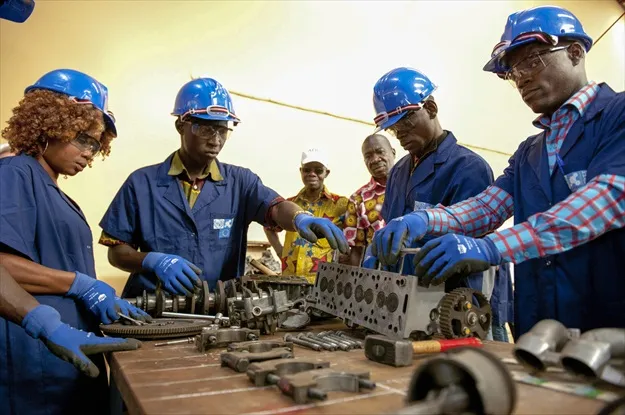
Hyundai and KOICA Automotive Technician Training
Hyundai Motor Company and Korea International Cooperation Agency (KOICA) launched the “Hyundai-KOICA NextGen” programme in Accra in September 2026. The initiative aims to improve automotive maintenance education in Ghana and expand employment and entrepreneurship opportunities for young people. The two organisations will jointly invest 5 billion Korean won (approximately $3.7 million) over five years, with a 50-50 matching arrangement .

The programme will establish and operate two automotive maintenance training centres, with construction starting in late 2026 and completion targeted for 2027. It will also update curricula to include hybrid and electric vehicle maintenance, provide scholarships and internships, and hold annual job fairs. A total of 405 young people and teachers are expected to benefit .
This is a sector-specific intervention tied to Hyundai’s business interests in Ghana. The company needs trained technicians to support its vehicles, and it is investing in the pipeline of talent that will provide them. It is a model that aligns corporate self-interest with national skills development.
World Bank Secondary Education Transformation
The government secured $300 million in World Bank financing to overhaul secondary education and eliminate the double-track system. Announced in July 2026, the project includes 210 major infrastructure interventions: 10 new secondary schools, rehabilitation of 150 existing schools, and upgrades to 50 schools. Upon completion, it is expected to benefit approximately 2.3 million students, over 100,000 teachers, and about 2,000 school leaders .
The project also aims to improve learning outcomes in Mathematics and Science, expand female participation in STEM and TVET, and equip students with digital, technical, and green skills. The ten new schools will be distributed across underserved regions, including the Western, Western North, Greater Accra, Volta, Oti, Northern, Upper East, Upper West, Savannah, and Central Regions.
This is the largest single investment in secondary education in recent years. It addresses the infrastructure deficit that has forced the double-track system, but it also signals a shift toward skills that are relevant to the modern economy.
KOICA, WFP and Digital Agriculture
In September 2026, the Ministry of Food and Agriculture, the World Food Programme, and KOICA handed over advanced agricultural technology equipment to five Agricultural Colleges: Kwadaso, Wenchi, Ejura, Damongo, and Ohawu. The equipment included soil testers, moisture meters, greenhouse environmental control kits, IoT sensor kits, weather stations, GPS devices, computers, 15 mini drones, drone flight simulators, and agricultural data-processing software .
The initiative is part of the Strengthening Digital Agriculture Skills Initiative, which aims to integrate modern technology and practical digital skills into agricultural education. A competency-based Digital Agriculture Training Programme has been developed, covering smart agriculture, digital literacy, data-driven decision-making, precision agriculture, and digital agribusiness. A five-day Training of Trainers will prepare instructors to use the equipment .
This is a direct response to the skills gap in agriculture. Farming in Ghana is increasingly technology-driven, but the colleges that train future agricultural professionals have often lacked the tools to teach modern methods. This investment closes that gap.
Private Sector-Led Funds and TVET Partnerships
Ghana Agricultural Education Transformation Fund (GAFET)
In August 2026, five Ghanaian agribusinesses—Farmerline Consult, New Age Agric Solutions, Tradeline Consult, Grow For Me, and AgriSolve—pooled GH¢3.5 million as seed funding for the Ghana Agricultural Education Transformation Fund. The fund targets GH¢10 million by December 2026 and GH¢100 million by the end of 2028. Agricultural education institutions face an estimated annual funding gap of GH¢12 million .
The Minister of Food and Agriculture, Eric Opoku, described the fund as a demonstration of what public-private partnership can achieve. “The future we desire will not be built by the government alone,” he said . The five companies are not the largest corporations in Ghana. They are medium-sized enterprises that have built their businesses in agriculture and now see the value in investing in the institutions that train the next generation of farmers and agribusiness professionals.

CTVET and Private Sector Engagement in TVET
The Commission for Technical and Vocational Education and Training (CTVET) has been pushing for deeper private sector involvement in TVET. At the 3rd National Roundtable on Private Sector Engagement in TVET in February 2026, the Director General outlined areas for collaboration: Competency-Based Training, Workplace Experience Learning, apprenticeship models, industry-led curriculum development, and strengthening Sector Skills Bodies .
CTVET proposed several policy recommendations, including the establishment of a National TVET Dialogue Platform as a structured mechanism for continuous public-private engagement, and mechanisms to encourage companies to invest in training and take on workplace trainees. The Commission also recommended scaling up workplace learning opportunities supported by insurance schemes and co-financing models to reduce risk for participating companies .
This is not a funding announcement. It is an attempt to change how the TVET system works, by making industry a co-owner of the training agenda rather than a passive consumer of its graduates.
ACTIVATE Project
The ACTIVATE Project, a five-year initiative (2024–2028) implemented by the World University Service of Canada with Mastercard Foundation, is transforming agricultural TVET in Ghana. The programme aims to reach more than 80,000 young Ghanaians between 15 and 35. By September 2026, it had reached 58,942 young people through training and outreach, with 81 percent being young women. It had also supported 34,638 participants to transition into employment and enterprise .
The Minister of Education, Haruna Iddrisu, used the ACTIVATE Learning Forum to call for stronger collaboration between government, private institutions, industry, and development partners. He noted that private institutions are often better positioned to respond quickly to labour-market changes through flexible curricula and industry-oriented training .
Scholarships and Access to Higher Education
Beyond institutional partnerships, there are direct scholarship schemes that support individual students.
The Educational Pathways International (EPI) Scholarship is a four-year scholarship for brilliant but financially needy students at KNUST and the University for Development Studies. It targets first and second-year students and requires strong academic performance (a minimum CWA of 67 at KNUST, or CGPA of 3.6 at UDS) and demonstrated financial need. Recipients must commit to working in Ghana for at least two years after graduation .
The Mauritius-Africa Scholarship Scheme offers Ghanaian students the opportunity to study at public higher education institutions in Mauritius for the 2026/2027 academic year. It covers undergraduate and postgraduate programmes and is administered through the Ghana Scholarships Secretariat .
These schemes are smaller in scale than the corporate and institutional investments, but for the individual students who receive them, they are life-changing. They also signal that Ghana’s education partnerships extend beyond its borders.
The Government’s Spending
The 2026 Budget allocated significant resources to education. Beyond the GH¢33.3 billion to the Ministry of Education and GH¢9.9 billion for GETFund, specific allocations include GH¢4.2 billion for Free Secondary Education, GH¢1.1 billion to end the double-track system, GH¢170 million for the National Apprenticeship Programme, and GH¢100 million for the National Coders Programme .
The National Coders Programme is particularly significant because it is being integrated into university curricula. Eleven universities, including the University of Ghana, KNUST, UENR, GCTU, and UCC, have signed Memoranda of Understanding to integrate OMCP certifications into degree and diploma programmes. At KNUST, more than 1,000 students have enrolled across four centres. Cybersecurity currently leads enrolment with 8,570 learners, followed by data analytics, AI Essentials, and project management .
This is the government using its convening power to embed digital skills into the formal education system, rather than running a parallel programme outside it.
Why It Matters
The investments described here are not just about money. They are about the kind of workforce Ghana is building.
For young people, these initiatives offer pathways that did not exist a decade ago. A student at Wa Technical Institute can now train on real solar equipment. A young woman in Kumasi can learn coding at a digital learning centre built by Ecobank. A student at Kwadaso Agricultural College can learn to fly drones and analyse soil data. An apprentice in the National Apprenticeship Programme can gain skills that lead to a job.
For employers, these investments address a problem they have complained about for years: graduates who have certificates but cannot do the work. When companies invest in training, they are shaping the curriculum to match their needs. When they offer internships and workplace learning, they are getting early access to talent.
For the economy, the stakes are high. Ghana’s population is young, and every year hundreds of thousands of young people enter the labour market. If they have skills that employers need, they find work and contribute to growth. If they do not, the consequences are unemployment, underemployment, and the social pressures that come with them.
There are still gaps. The funding for agricultural education remains below what is needed. The TVET system is still working out how to bring industry fully into the fold. The digital divide means that some schools and students benefit far more than others. And the coordination between government, development partners, and the private sector is not always seamless.
But the direction is clear. Education and skills development in Ghana is no longer seen as the sole responsibility of government. Companies, international organisations, and industry groups are investing, partnering, and shaping the agenda. The question is whether these efforts will add up to a system that works for the majority of young Ghanaians, or just for those lucky enough to be in the right programme at the right time.
Quick Facts
Topic: Education and Skills Development Investment in Ghana
Government Education Allocation (2026): GH¢33.3 billion (Ministry of Education) + GH¢9.9 billion (GETFund)
World Bank Secondary Education Funding: $300 million
AGA Obuasi Scholarships: 50 beneficiaries since launch
Ecobank Digital Learning Centres: 7 in Ghana (2023–2026)
GAFET Seed Fund: GH¢3.5 million, targeting GH¢100 million by 2028
National Coders Programme: Integrated into 11 universities
ACTIVATE Project Reach: 58,942 young people (81% women)
Hyundai-KOICA Investment: 5 billion KRW over 5 years
Key Challenge: Skills gap between education and labour market needs
Key Opportunity: Private sector co-ownership of TVET and agricultural education
FAQ Section
1. Which companies are investing in education in Ghana?
AngloGold Ashanti Obuasi Mine funds university scholarships for students in its host communities. Ecobank Ghana builds digital learning centres. Hyundai and KOICA are funding automotive technician training. Five agribusinesses pooled GH¢3.5 million to launch GAFET .
2. What is GAFET?
The Ghana Agricultural Education Transformation Fund is a private-sector-led fund that supports agricultural education institutions. It was launched in August 2026 with GH¢3.5 million in seed funding from five agribusinesses, targeting GH¢100 million by 2028 .
3. How is the government funding education in 2026?
The 2026 Budget allocates GH¢33.3 billion to the Ministry of Education, GH¢9.9 billion to GETFund, GH¢4.2 billion for Free Secondary Education, and GH¢1.1 billion to end the double-track system. The National Coders Programme gets GH¢100 million .
4. What is the National Coders Programme?
A government initiative to train Ghanaians in digital skills. Eleven universities have integrated its certifications into their degree and diploma programmes. At KNUST, over 1,000 students have enrolled .
5. How is Ecobank contributing to education in Ghana?
Ecobank Ghana has built seven digital learning centres between 2023 and 2026. The latest, at 4 Garrison Education Center in Kumasi, includes 26 computers and supports learning in coding, robotics, and AI .
6. What is the ILO and EU doing for skills in Ghana?
They launched a Solar Photovoltaic Training Facility at Wa Technical Institute in November 2026, equipping students with practical renewable energy skills. About 100 electrical trainees will benefit in 2026 .
7. What is the World Bank’s $300 million education project?
It aims to transform secondary education and eliminate the double-track system by building 10 new schools, rehabilitating 150, and upgrading 50. It is expected to benefit 2.3 million students .
8. What is the ACTIVATE Project?
A five-year initiative (2024–2028) by WUSC and Mastercard Foundation to transform agricultural TVET. It has reached 58,942 young people, 81% of them women, and supported 34,638 into employment or enterprise .
9. Are there scholarships for Ghanaian students?
Yes. The EPI Scholarship supports brilliant but needy students at KNUST and UDS. The Mauritius-Africa Scholarship Scheme offers undergraduate and postgraduate study in Mauritius .
10. What is CTVET doing to involve the private sector in TVET?
CTVET is pushing for deeper industry involvement through Competency-Based Training, workplace learning, apprenticeships, and industry-led curriculum development. It has proposed a National TVET Dialogue Platform to formalise public-private engagement .
Source: Accra Street Journal
Last Updated on November 26, 2026 by Samuel Kwame Boadu
Disclaimer: Some content on Accra Street Journal may be aggregated, summarized, or edited from third-party sources for informational purposes. Images and media are used under fair use or royalty-free licenses. Accra Street Journal is a subsidiary of SamBoad Publishing Hub under SamBoad Business Group Ltd, registered in Ghana since 2014.
For concerns or inquiries, please visit our Privacy Policy or Contact Page.

Samuel Kwame Boadu is a Ghanaian media entrepreneur and storyteller with a passion for amplifying urban voices and uncovering everyday truths. He is the Editor-in-Chief and Founder of Accra Street Journal, a dynamic digital platform dedicated to capturing the pulse of Ghana’s capital—its people, culture, challenges, business, sports and innovations.
Use the following reference when citing or referencing this article.
Your feedback helps us improve our journalism.
Report an Error
Help us maintain accuracy. Let our editorial team know if you spot an issue in this article.
Report a problem with this article