
13 min read
EXECUTIVE INTRODUCTION
For generations, the Ghanaian relationship with the sky was defined by two distant, and deeply contrasting, realities. High above, in the thin, cold air, flew the rare, expensive, and almost mythical machines of the aviation age—the passenger jets that connected the wealthy and the powerful to the world, and the military aircraft that represented the distant, unaccountable power of the state. Down on the ground, the farmer and the security guard plied their ancient, earthbound trades, their knowledge limited by the horizon, their vision constrained by the height of a tree or the length of a wall. The sky was not a tool for the ordinary citizen; it was a place of transit and power, not a place of work.
That boundary is now dissolving. A quiet, powerful, and profoundly practical technological revolution has brought the power of the aerial view down to earth. The drone, an unmanned, remotely-piloted, and increasingly intelligent and affordable flying machine, is now beginning to serve the most grounded and essential of Ghanaian professions. The farmer, once limited by the sweat of his brow and the guesswork of his eye, can now survey his entire field from above in minutes. The security manager, once reliant on a few, tired, and fallible human guards, can now deploy a tireless, unblinking, and rapidly deployable eye in the sky. This Accra Street Journal analysis is a ground-level examination of the specific, practical, and increasingly accessible ways in which this technology is transforming two of the nation’s most vital sectors. This is not a story of a futuristic, jet-powered fantasy. It is a story of the quiet, sensible, and deeply practical application of a powerful new tool to solve old, intractable problems: the problem of the farmer who cannot see the disease spreading in the far corner of his field, and the problem of the security manager who cannot be everywhere at once. The eye in the sky is no longer a symbol of distant, unreachable power; it is becoming a humble, powerful, and indispensable tool for the Ghanaian farmer and the Ghanaian guardian.
Key Takeaways
- The drone, an unmanned, remotely-piloted, and increasingly intelligent and affordable flying machine, is now beginning to serve the most grounded and essential of Ghanaian professions.
- The security manager, once reliant on a few, tired, and fallible human guards, can now deploy a tireless, unblinking, and rapidly deployable eye in the sky.
- The modern security drone is not just a flying camera; it is a highly intelligent, autonomous, and rapidly deployable aerial sentinel.
THE AERIAL AGRONOMIST: PRECISION FARMING AND THE END OF THE BLIND WALK
The first, and perhaps most transformative, application of drone technology is in the field of agriculture, a sector that remains the silent, resilient backbone of the Ghanaian economy, employing a vast portion of the population and underpinning the nation’s fundamental food security. The traditional method of crop management was a slow, laborious, and profoundly inefficient exercise in partial blindness. The farmer, or the agricultural extension officer, would walk the boundaries of the field, peering at the plants on the edge, or venture, with difficulty, a few rows deep into the dense, often shoulder-high growth. Their assessment was, by necessity, an educated guess, a partial, fragmented, and often inaccurate picture of the true, overall health of the crop. A pest infestation that was silently destroying the harvest in a far, unreachable corner of the field would go undetected until it had spread, catastrophically, to the entire farm. A localised nutrient deficiency, a hidden patch of drought stress, a broken irrigation channel—these critical problems were often discovered too late, or not at all, their cost measured in lost yield and diminished income.
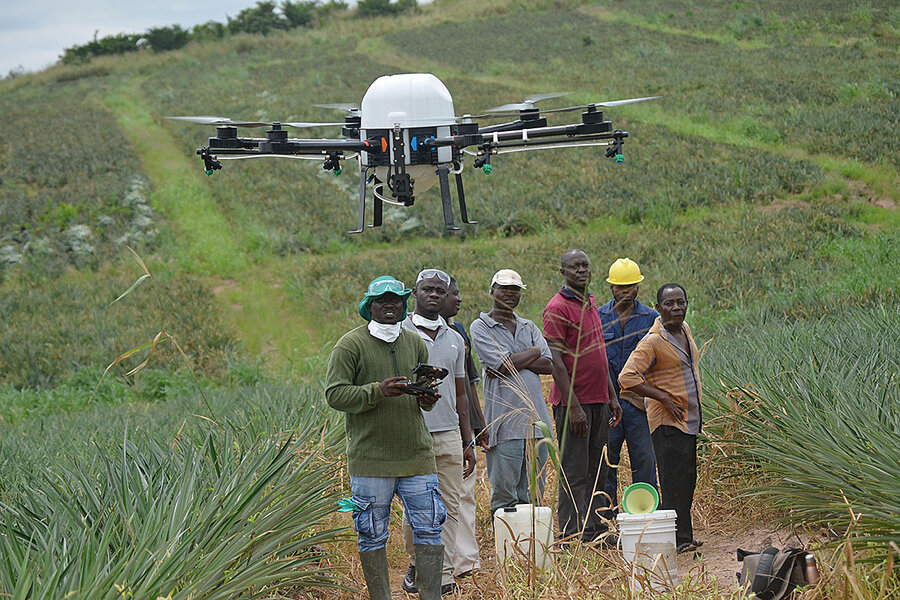
The drone, equipped with a simple, high-resolution camera, has fundamentally changed this ancient, frustrating, and costly game of the blind guess. In a single, pre-programmed, and autonomous flight, the farmer can now survey an entire field, regardless of its size, in a matter of minutes. The bird’s-eye view, captured in a series of overlapping, high-definition photographs, provides a complete, accurate, and up-to-the-minute visual record of the crop’s condition. The technology has evolved far beyond the simple camera. The latest generation of agricultural drones can be fitted with sophisticated, multispectral and thermal imaging sensors. These powerful, and increasingly affordable, tools can see far beyond the narrow, limited spectrum of visible light. They can detect, with remarkable precision, subtle variations in the health of the vegetation that are completely invisible to the unaided human eye. A patch of plants that is under early, invisible water stress will show up, clearly and unmistakably, on the thermal image. A section of the field suffering from a specific, nutrient deficiency will have a subtly different spectral signature, a unique, identifiable colour on the multispectral map. This is the quiet, powerful arrival of precision agriculture in Ghana. The farmer can now see the exact, specific location of the problem, and can target their intervention—the application of water, the spraying of a specific, localised pesticide, the addition of a precise dose of fertiliser—with a laser-like accuracy. The result is a dramatic reduction in the waste of expensive inputs, a significant increase in the health and the yield of the crop, and a profound, practical empowerment of the farmer, who is finally, after generations of guesswork, able to see the whole, clear picture of his own field.
THE TIRELESS SENTINEL: DRONES FOR SECURITY AND RAPID RESPONSE
The second, and equally compelling, application of the drone is in the field of security, a domain of deep, primal, and ever-present concern for both private businesses and public institutions across Ghana. The traditional model of security, built on the human guard, the physical fence, and the fixed CCTV camera, has profound, inherent, and well-understood limitations. The human guard is expensive, his vigilance is, by nature, human and fallible, limited by the need for sleep, the span of his own attention, and the reach of his physical patrol. The fence can be scaled, and the fixed camera can be easily bypassed, its blind spots known and exploited by the skilled intruder. The great, vulnerable gaps in this old, analog system are the vast, dark, and unwatched spaces in between the fixed points. The perimeter of a large factory at night, the sprawling, complex grounds of a mining concession, the long, dark, and remote stretch of an oil and gas pipeline, and the vast, often dangerous, and difficult-to-reach terrain of a national park. These are the spaces where the old system fails, and where the drone is now proving its immense, practical, and deeply reassuring value.
The modern security drone is not just a flying camera; it is a highly intelligent, autonomous, and rapidly deployable aerial sentinel. It can be programmed to fly a precise, pre-determined patrol route along a vulnerable perimeter, its powerful, high-definition camera, equipped with thermal night vision, scanning the darkness for the subtle, tell-tale heat signature of a human intruder. When it detects an anomaly, it does not just passively record; it actively alerts. The live video feed is instantly transmitted to a security operator in a command centre, who can assess the threat in real-time. The drone can then be commanded to break from its patrol, to pursue and track the intruder, its powerful, built-in floodlight illuminating the target, its loudspeaker issuing a clear, authoritative warning: “You are being watched. Security has been alerted. Leave the area immediately.” The psychological impact of this sudden, aerial confrontation is immense, and deeply deterring. The drone is not just a surveillance tool; it is a powerful, active, and rapid-response force, a tireless, unblinking, and un-ignorable guardian that can be deployed to any point on a property in moments, long before a human guard could ever reach the scene. For the security manager, the drone is not a replacement for the human team, but a powerful, force-multiplying tool, an aerial eye that extends the reach, the speed, and the intimidating authority of the security operation into the very dark, remote, and vulnerable spaces that were previously, and quietly, unprotected.
THE EARLY WARNING SYSTEM: DISASTER RESPONSE AND HUMANITARIAN AID
Beyond the direct, commercial applications of agriculture and security, the drone is also, quietly and powerfully, emerging as a critical tool for disaster response and humanitarian aid. The Ghanaian environment, as we have repeatedly documented, is one of profound, unpredictable, and often devastating volatility. The sudden, torrential rains that turn the streets of Accra into rivers, the annual flooding that displaces communities and destroys livelihoods, the long, slow, and creeping crisis of coastal erosion, and the ever-present, terrifying potential of a major fire or an industrial accident. In the crucial, chaotic, and often life-saving hours immediately following such a disaster, the single most valuable, and most difficult, thing to obtain is an accurate, rapid, and comprehensive assessment of the situation on the ground. Where are the worst-affected areas? Which communities are trapped? Which roads and bridges are still passable? Where is the fire spreading, and who is in its path?
The drone is now providing the answer to this ancient, urgent, and life-or-death question with a speed and a clarity that was previously unimaginable. A small, robust, and rapidly deployable aerial platform, launched in minutes, can fly safely and efficiently over a flooded district, a burning industrial zone, or a collapsed bridge, its high-resolution camera and thermal sensors transmitting a live, streaming, and deeply informative picture directly to the emergency command centre. The disaster response coordinators are no longer flying blind, making critical, life-saving decisions based on fragmented, second-hand reports and desperate phone calls. They can see, with their own eyes, the precise, real-time reality of the crisis, and they can direct their scarce, precious resources—the rescue teams, the medical supplies, the pumps, and the fire engines—to exactly the right place, at exactly the right time. The drone is not just a tool of commerce; it is a quiet, powerful, and deeply humane instrument of mercy, a flying eye that can pierce the chaos and the confusion of a disaster, and bring the calm, clear, and life-saving light of knowledge to the darkest, most terrifying, and most desperate of moments.
QUICK FACTS BOX: HOW DRONES ARE CHANGING AGRICULTURE AND SECURITY
-
The Aerial Agronomist: Drones equipped with cameras and multispectral sensors provide farmers with a rapid, complete, and objective view of crop health, enabling the precise, targeted, and waste-reducing application of water, fertiliser, and pesticides.
-
The Tireless Sentinel: The modern security drone is an autonomous, rapidly deployable, and intelligent aerial patrol, capable of detecting human intruders in the dark, tracking them, and actively deterring them with floodlights and loudspeakers.
-
The Early Warning System: In the chaos of a flood or a fire, the drone provides emergency response coordinators with a real-time, bird’s-eye view of the crisis, enabling the rapid, accurate, and life-saving deployment of scarce resources.
-
The Core Shift: The fundamental transformation is from a limited, earthbound, and often-blind perspective to a powerful, aerial, and data-rich one, empowering the farmer and the security manager with the power of clear sight.
-
The Persistent Challenge: The long-term, commercial viability of the sector depends on the development of a clear, efficient, and accessible regulatory framework for drone operation, a critical piece of the puzzle that is still being written.
FAQ SECTION
1. What is a drone, in simple, practical terms?
It is a small, flying machine that is controlled remotely, either by a human using a joystick or by an onboard computer following a pre-programmed flight path. It carries a camera and, often, a range of other sensors, giving it the ability to provide a detailed, bird’s-eye view of a large area quickly and cheaply.
2. How can a drone help a farmer whose field is too large to walk and inspect every day?
It gives the farmer a superpower: the ability to see the whole field at once, in minutes. It can reveal a pest problem in a far corner, or a patch of dry soil, long before it would be visible to someone walking on the ground. This allows for early, targeted, and less costly intervention.

3. Are these agricultural drones only for huge, commercial farms, or can a smallholder benefit?
The technology is becoming increasingly accessible. While a smallholder farmer will likely not buy their own sophisticated drone, they can access the benefits through a new generation of local, affordable drone services, often offered by young entrepreneurs and agricultural cooperatives, that will survey their field for a modest fee.
4. Can a drone really replace the need for human security guards around my property?
It is not a replacement, but a powerful force-multiplier. It extends the reach of the security team, giving them an eye in the sky that can patrol a dark perimeter, spot an intruder, and track them, far more effectively and safely than a guard on foot. The human team is still needed for the physical response, but the drone gives them a crucial advantage.

5. I run a small factory with a large, fenced compound. Is a security drone too expensive for me?
The cost of professional, enterprise-grade drone systems has fallen dramatically. For many businesses with a significant perimeter to protect, the investment in a drone system is now comparable to, or even cheaper than, the annual cost of one or two extra human security guards, while providing a far more comprehensive and tireless level of surveillance.
6. Are there laws in Ghana about who can fly a drone and where?
Yes, the Ghana Civil Aviation Authority is the regulator, and there are specific rules about registering drones, obtaining the proper operating permits, and flying in restricted areas. It is a developing but important regulatory space, and a responsible operator must ensure they are fully compliant before flying.
7. Could the police or the military use this technology to spy on ordinary, law-abiding citizens?
This is a serious and valid concern, and it is why the legal and regulatory framework is so important. The same powerful technology that can protect a farm or a factory can be misused for unwarranted surveillance. A transparent, rights-respecting legal framework, with strong oversight and clear privacy protections, is essential.
8. What kind of training do I need to become a professional drone pilot in Ghana?
It is increasingly becoming a respected, professional career path. There are now formal training courses and certification programs that teach not just the practical skills of flying, but also the critical knowledge of aviation law, airspace safety, data privacy, and the specific, technical skills required for different applications like agriculture and security.
9. What will the drone of the future, five or ten years from now, be able to do?
They will be more intelligent and more autonomous. They will have longer flight times, better, more powerful sensors, and the ability to process the data they collect onboard, in real-time, using artificial intelligence. They will be able to identify a specific, diseased plant on their own, or recognise the face of an authorised person from the air, all without a human pilot directing their every move.
10. What is the single, most important thing that will determine if Ghana can fully benefit from this drone revolution?
The rules of the sky. The future of the industry depends, above all, on the Ghana Civil Aviation Authority building a regulatory framework that is safe, clear, and efficient. It must protect the public and the national airspace, but it must also be agile and accessible enough to allow the brilliant, local entrepreneurs who are building this exciting new industry to innovate, to operate, and to scale their solutions.
Source: Accra Street Journal
Last Updated on August 13, 2026 by Samuel Kwame Boadu
Disclaimer: Some content on Accra Street Journal may be aggregated, summarized, or edited from third-party sources for informational purposes. Images and media are used under fair use or royalty-free licenses. Accra Street Journal is a subsidiary of SamBoad Publishing Hub under SamBoad Business Group Ltd, registered in Ghana since 2014.

For concerns or inquiries, please visit our Privacy Policy or Contact Page.

Samuel Kwame Boadu is a Ghanaian media entrepreneur and storyteller with a passion for amplifying urban voices and uncovering everyday truths. He is the Editor-in-Chief and Founder of Accra Street Journal, a dynamic digital platform dedicated to capturing the pulse of Ghana’s capital—its people, culture, challenges, business, sports and innovations.
Use the following reference when citing or referencing this article.
Your feedback helps us improve our journalism.
Report an Error
Help us maintain accuracy. Let our editorial team know if you spot an issue in this article.
Report a problem with this article