From the pedestrian’s paradox to the automobile’s triumph — why Accra is becoming unwalkable despite its walkers
Executive Introduction
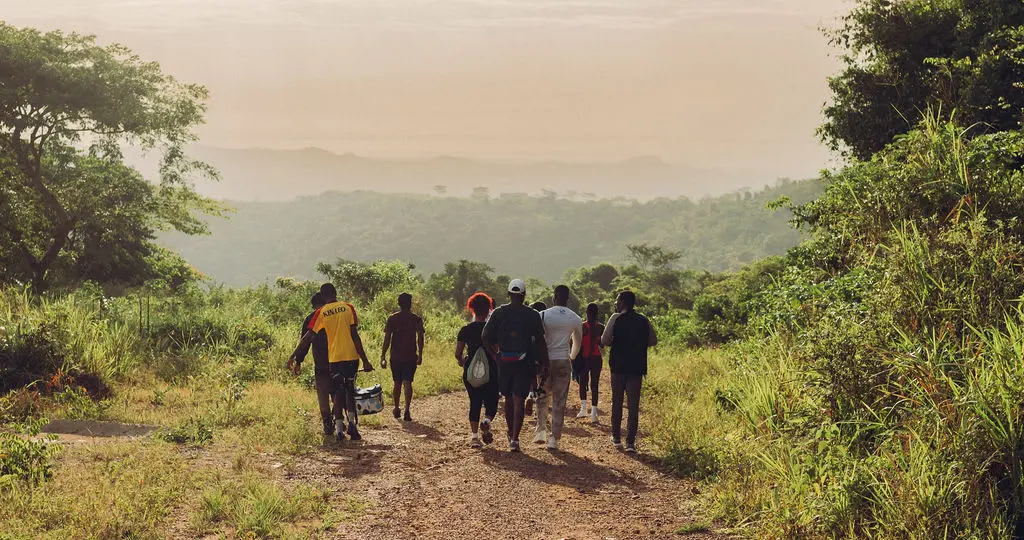
Accra has a paradox at its heart. Over three-quarters of Ghanaians make up to ten daily trips on foot . In the Central Business District, peak-hour pedestrian volumes range from 250 to 600 persons per hour . By any measure, Accra is a walking city. Yet it is also one of the most unwelcoming places to walk. Sidewalks are narrow, uneven, and obstructed . Drainage grates are missing, creating hazards that can swallow a pedestrian’s foot . Pedestrians account for 42% of all road fatalities in Ghana — a figure that has remained stubbornly high for years .
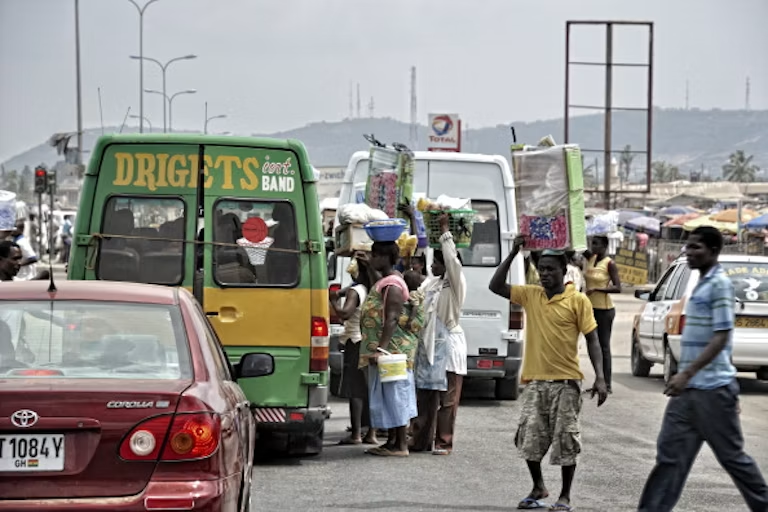
This is not a failure of policy. Ghana’s National Transport Policy explicitly calls for “dedicated, safe, reliable and appropriate facilities for NMT users across all transport modes . The disconnect is between policy and reality. A 2025 study found “significant incongruities” between what policies promise and what residents actually experience . A municipal official quoted in the research captured the frustration: “Look at the streets: Motorists, street vendors, school children on the same street space. There is encroachment, reckless driving, illegally parked cars on road shoulders. School children and the disabled face constant risks. But the plan aims to make the neighborhoods walkable. Just words as always” .

This ASJ report examines why Accra’s walking culture is fading: the physical erosion of pedestrian infrastructure, the prioritisation of automobility in planning, the human cost of walking in an unwalkable city, and the glimmers of action that could reverse the trend.
📢 GET A DETAILED ARTICLES + JOBS
Join ASJ's WhatsApp Channel and never miss a post or opportunity.

Part 1: The Physical Decay — What Walkers Actually Face
The evidence of Accra’s decline as a walkable city is visible on every street.
The State of Sidewalks and Drainage
A detailed study of walkability in Accra’s Central Business District documented a grim reality :

-
Sidewalks were often narrow, uneven, and obstructed
-
Poor drainage and lighting compounded safety risks
-
Accessibility features for persons with disabilities were largely absent
-
A significant percentage of pedestrian crossings lacked proper markings or signals
The study identified three dimensions shaping walkability: (i) crossing, safety, and navigability; (ii) sidewalk condition and maintenance; and (iii) infrastructural inclusivity . Each dimension was found to be inadequate.
In July 2025, the Accra Metropolitan Assembly began replacing stolen and rusted drain gratings across the city — a direct acknowledgment that these hazards had become a public safety crisis . The Head of Public Affairs noted that “the open drains not only create hazards for passersby but also contribute to sanitation challenges and flooding when clogged with waste” . Fifty metal gratings were scheduled for replacement on key streets, including Kojo Thompson Road, Guggisberg Avenue, and Asafoatse Nettey Road .
The “Policy-Reality Gap”
The disconnect between policy and reality is so pronounced that researchers have given it a name: the “policy-reality gap” . A 2025 study in the Journal of Urban Affairs found that municipal development plans gave limited attention to the pleasurability dimensions of walking . National policy mentions non-motorised transport, but “this important subject of walking often gets subsumed within the broader discourses about NMT, traffic safety, and transport Planning. It thus gradually becomes a ‘leftover’ issue for policy and planning” .
A resident quoted in the study captured the daily reality: “The roads are not only in poor condition but they have no sidewalks. It is not hard to assume that these were built for car owners, not pedestrians’ everyday use” .
Part 2: The Automobility Paradigm — Why Walking Loses
The decline of walking culture in Accra is not an accident. It is the product of a planning paradigm that prioritises cars over people.
The Captive Walker
In African cities, the predominance of walking does not equate to preference. Walking is often the only means of mobility for the deprived majority . A 2025 study frames this in stark terms: most pedestrians are “captive walkers” — those with no alternatives besides walking .
This is reflected in how people talk about walking. A community leader in Accra described the experience: “Flooding and poor sanitation create an unpleasant walking environment. Clogged waste, poor drains, and rubbish along streets and alleyways are a problem. There is nothing pleasant about walking: the smell, the dust, the noise and the heat. You walk because you have no choice” .
The Cultural Shift
Walking has become stigmatised. In many African cities, walking is regarded as a mode of transport for the poor . The desire to own a car and use it as a sign of social mobility has increased the risks associated with regular walking . Each new car purchased reinforces the perception that walking is a sign of failure — a relic of a less prosperous past.
The Tipping Point
A 2024 study on policy-reality gaps in African walking cities found that urban planning in Accra has historically prioritised automobility . Research shows that “infrastructure investments are focused on network development and automobility for efficient mobility that enables economic development . The walking experience has become an afterthought.

Part 3: The Human Cost — What Walkers Lose
The fade of walking culture in Accra is not just an urban planning issue. It is a public health crisis, a safety crisis, and a dignity crisis.
The Safety Crisis
Pedestrians in Accra face constant danger. A crash analysis found that nearly half of incidents occurred during road crossings, with most crashes clustered during weekday peak periods . Pedestrians account for 42% of all road fatalities in Ghana — a figure that has remained persistently high.
A municipal official told researchers: “Look at the streets: Motorists, street vendors, school children on the same street space. There is encroachment, reckless driving, illegally parked cars on road shoulders. School children and the disabled face constant risks. But the plan aims to make the neighborhoods walkable. Just words as always” .
The Health Cost
Walking is one of the cheapest, most accessible forms of physical activity. When the environment discourages walking, health suffers. A 2026 study of 631 adults across twelve Accra neighbourhoods found that built environmental characteristics showed significant differences in all subscales of walkability . The study noted that “improving the characteristics of built environments such as footpaths (provision and quality), safety (from traffic and crime) and aesthetics (clean, litter- and graffiti-free streets, presence of plants and trees) can potentially increase transport-related physical activity and has been considered a low-cost and effective way to improve health” .
The health stakes are high. In Ghana, half of women (50%) are either overweight or obese, up from 3.4% in 1993 . While many factors drive this trend, the decline of walkable environments is a significant contributor.
The Dignity Cost
Perhaps the most overlooked cost is the erosion of dignity. Walking in Accra is not a pleasure — it is a burden. A resident described the experience: “There is nothing pleasant about walking: the smell, the dust, the noise and the heat. You walk because you have no choice” .
Part 4: Self-Built Solutions — When Communities Step In
One of the most revealing findings from recent research is that residents are not waiting for the government to fix walking conditions. They are building their own solutions.
The Prevalence of Self-Built Infrastructure
A 2025 study of Accra New Town found widespread presence of self-built infrastructure that adapts public spaces to navigate the risks and limitations of the built environment . Some interventions address the need for basic pedestrian infrastructure, such as speed bumps or streetlights . Others are temporary adaptations to cover drainages or create shade .
Safety as the Priority
The research found that self-built interventions are significantly related to the safety dimensions of the walking experience . Pedestrians’ most pressing challenge is safety . The connection to enjoyment and accessibility requires further research, but the message is clear: residents are taking matters into their own hands to make walking safer.
The Policy Opportunity
The researchers argue that “acknowledging self-built modifications could guide policies attuned to localized needs, reinforcing long-term equitable infrastructural development” . Rather than ignoring or removing these informal interventions, urban planners could learn from them — and partner with communities to build more durable, inclusive infrastructure.
Conclusion: The Choice Ahead
Accra’s walking culture is not gone. Over 75% of Ghanaians still walk daily . But it is being eroded — not by a single policy, but by decades of neglect, by infrastructure that prioritises cars over people, and by a social stigma that equates walking with poverty.

The choice is not between walking and automobility. The choice is between a city that works for all its residents and a city that works only for those who can afford a car. Pedestrians are already the majority. They will remain the majority. The question is whether Accra will make walking safe, accessible, and dignified — or whether it will continue to treat walkers as an inconvenience to be managed.
As one researcher concluded, “action-oriented collaborative strategies like workshops that consider communities as partners can transition African urban residents from captive walkers to walkers who enjoy it” . The path is clear. The question is whether planners and policymakers will take it.
Quick Reference: Walking in Accra
| Indicator | Value |
|---|---|
| Ghanaians making daily trips on foot | 75.3% (up to 10 trips/day) |
| Pedestrians as share of road fatalities | 42% |
| Peak-hour pedestrian volumes (CBD) | 250–600 persons/hour |
| Road crash locations (CBD) | Nearly half during crossings |
| Accessibility features for disabled | Largely absent |
| Drain gratings replaced (2025) | 50 on key roads |
| Residents with no alternative to walking | Majority |
| Walking infrastructure priority | Low (marginalised in planning) |
| Walking as a “captive” mode | Primary driver of walking behaviour |
Source: Accra Street Journal
Last Updated on July 21, 2026 by Samuel Kwame Boadu
Disclaimer: Some content on Accra Street Journal may be aggregated, summarized, or edited from third-party sources for informational purposes. Images and media are used under fair use or royalty-free licenses. Accra Street Journal is a subsidiary of SamBoad Publishing Hub under SamBoad Business Group Ltd, registered in Ghana since 2014.
For concerns or inquiries, please visit our Privacy Policy or Contact Page.

Samuel Kwame Boadu is a Ghanaian media entrepreneur and storyteller with a passion for amplifying urban voices and uncovering everyday truths. He is the Editor-in-Chief and Founder of Accra Street Journal, a dynamic digital platform dedicated to capturing the pulse of Ghana’s capital—its people, culture, challenges, business, sports and innovations.