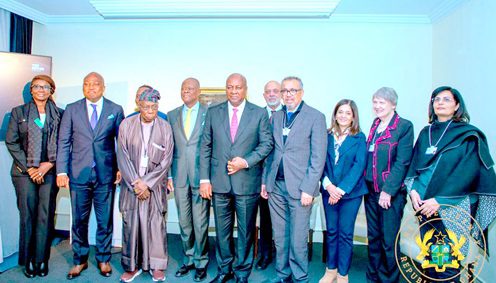
President John Dramani Mahama has used the global stage at the World Economic Forum in Davos to deliver a blunt message: Africa can no longer afford to build its future on aid dependency and debt-fuelled development. With global humanitarian budgets shrinking and the multilateral system under strain, Mahama warned that the continent must urgently take responsibility for its own economic destiny.
Speaking at a high-level Accra Reset side event sighted by Accra Street Journal, the Ghanaian leader argued that the post-war global development architecture—long relied upon by African states—is fragmenting rapidly, leaving limited room for delay or denial.
A Global Order in Retreat
Donor fatigue and shifting priorities
Mahama noted that traditional donor countries are increasingly cutting overseas development assistance, redirecting scarce resources toward defence, security, and domestic political priorities. As a result, Africa’s long-standing reliance on external funding for health, education, and economic transformation is becoming increasingly untenable.
📢 GET A DETAILED ARTICLES + JOBS
Join ASJ's WhatsApp Channel and never miss a post or opportunity.
📲 Join ASJ Channel Now
A shrinking safety net
According to Mahama, the implications are clear: Africa must prepare for a world where concessional finance and humanitarian support are no longer guaranteed, regardless of need.
Ghana’s Attempt at a Different Path
Stabilising a debt-distressed economy
Mahama pointed to Ghana’s recent economic experience as a case study in difficult but necessary reform. Upon returning to office, he said his administration moved quickly to stabilise a heavily indebted economy by cutting public spending and renegotiating debt obligations.
A key signal, he noted, was the reduction of government size to 58 ministers, aimed at curbing excess and restoring fiscal discipline.
Inflation, currency and business confidence
President Mahama highlighted Ghana’s return to single-digit inflation, improved currency stability, and renewed business confidence as early indicators that disciplined policy choices can restore macroeconomic balance, even in challenging global conditions.
The Accra Reset Initiative
From national reform to continental framework
Launched at the United Nations in September, the Accra Reset Initiative seeks to extend Ghana’s reform logic beyond its borders. Mahama described the initiative not as a political declaration, but as a practical framework for coordinated reform across Africa and the Global South.
Focus on sovereignty and execution
The initiative aims to help countries mobilise domestic and private investment, strengthen economic sovereignty, and align reforms across fiscal, governance, and industrial policy.
Africa’s “Triple Dependency” Trap
Aid, security and commodities
Mahama warned that Africa remains caught in what he termed a “triple dependency”—overreliance on donor funding for health and education, dependence on foreign security support, and vulnerability to commodity export cycles.
With development finance tightening globally, he cautioned that failure to act decisively could worsen poverty, inequality, and unemployment, particularly among Africa’s rapidly growing youth population.
Governance as the New Investment Signal
Accountability before ambition
While Africa’s digital, industrial, and demographic potential remains strong, Mahama stressed that opportunity alone is not enough. Execution, accountability, and governance reform, he argued, are now non-negotiable prerequisites for attracting long-term capital.
Public finance discipline matters
Disciplined public finance management, transparent institutions, and credible policy implementation are increasingly central to investor confidence in a more risk-sensitive global economy.
Building Momentum Beyond Davos
Mahama said engagements around the Accra Reset Initiative will continue at upcoming forums, including the African Union summit in Addis Ababa, as Ghana seeks broader continental and international buy-in.
The message from Davos was unmistakable: Africa’s development challenge can no longer be outsourced. In a world of tightening budgets and fragmented multilateralism, the continent’s future will depend less on aid flows and more on its willingness to reform, coordinate, and invest in itself.