









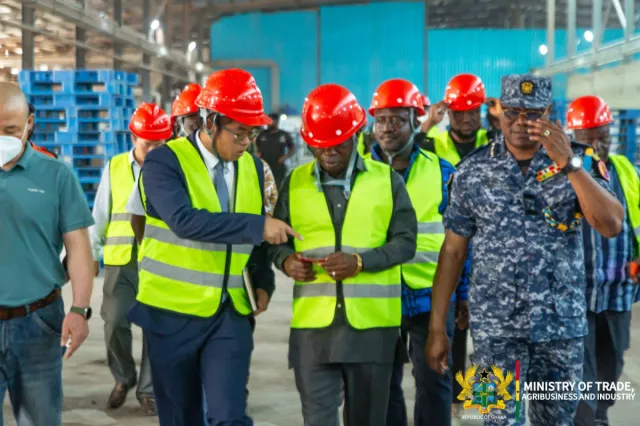

Ghana’s industrial story is quietly changing, not through slogans or policy declarations, but through factories, production lines, and long-term capital commitments. The latest signal comes from KEDA (Ghana) Ceramics Company Ltd., whose nearly $300 million investment since 2017 and plans for deeper export expansion reflect a broader shift in how manufacturing is being re-imagined in the Ghanaian economy.

As reported by Accra Street Journal, KEDA is not only consolidating its domestic dominance but actively positioning Ghana as an export production base for international building materials markets. That shift matters. It signals a move away from consumption-driven industrialisation toward production-led competitiveness.

From Import Substitution to Export Capacity
Manufacturing as a Trade Strategy
KEDA’s consideration of a second-phase sanitary ware production line, potentially attracting $200 million to $500 million in new investment, is not just corporate expansion—it is economic repositioning. Ghana is no longer simply trying to replace imports with local production; it is increasingly attempting to produce for external markets.
📢 GET A DETAILED ARTICLES + JOBS
Join ASJ's WhatsApp Channel and never miss a post or opportunity.
This is a fundamental transition. Import substitution stabilises balance-of-payments pressures. Export manufacturing, however, creates foreign exchange inflows, currency resilience, and long-term industrial sustainability.
By targeting markets in Europe and the Americas, KEDA is aligning Ghanaian production with global demand cycles rather than domestic consumption limits.

Local Value Chains as Economic Insurance
99% Local Sourcing as a Strategic Asset
KEDA’s claim that 99% of its raw materials are sourced domestically is perhaps more important than its market share. In an economy exposed to exchange rate volatility and import inflation, local sourcing becomes a form of macroeconomic insurance.
Why this matters
-
Reduced foreign exchange pressure
-
Lower import exposure
-
Stronger domestic supplier ecosystems
-
More predictable production costs
Its efforts to localise the production of glazes and industrial chemicals further deepen this insulation, moving Ghanaian manufacturing away from dependency on imported industrial inputs.
This is how industrial sovereignty is built—not through rhetoric, but through supply-chain architecture.
Skills as Industrial Infrastructure
Human Capital, Not Just Capital Investment
One of the quiet strengths of the KEDA model lies in its skills transfer strategy. Collaboration with the University of Cape Coast, in-house training programmes, and technical exposure for Ghanaian staff in China point to a deliberate effort to build industrial human capital, not just factories.
This matters because:
-
Automation requires skilled operators
-
Export standards demand technical precision
-
Long-term competitiveness depends on domestic expertise
Factories depreciate. Skills compound.
By integrating workforce development into its investment model, KEDA is effectively treating human capital as industrial infrastructure.
Market Dominance and Industrial Power
45% Market Share Is Not Just Commercial Success
Controlling about 45% of Ghana’s ceramics market is not merely a business milestone—it is an industrial signal. It reflects the capacity of large-scale manufacturing investment to displace imports in sectors once dominated by foreign supply.
This is what real industrialisation looks like:
-
Scale
-
Cost efficiency
-
Supply reliability
-
Domestic production dominance
-
Export readiness
Not fragmented small-scale production, but integrated industrial systems.
The GIPC Signal: Policy Meets Practice
GIPC’s description of KEDA as a model investor is not symbolic—it reflects a policy alignment. Ghana’s industrialisation agenda increasingly favours:
-
Deep capital investment
-
Local sourcing
-
Export orientation
-
Technology transfer
This is a shift away from enclave investment models toward embedded industrial investment.
The Bigger Economic Meaning
KEDA’s expansion strategy reveals a deeper truth about Ghana’s development path:
Growth will no longer come from consumption expansion alone.
Stability will not come from services alone.
Resilience will not come from raw exports alone.
It will come from manufacturing systems that integrate capital, skills, supply chains, and exports.
What KEDA represents is not just a ceramics company, but a prototype of a new industrial logic:
-
Local value creation
-
Export competitiveness
-
Domestic capacity building
-
Industrial resilience
This is how economies move from vulnerability to durability.
Conclusion: The Quiet Industrial Shift
Ghana’s industrial transformation is not happening loudly. It is happening incrementally, structurally, and strategically.
KEDA’s investment trajectory shows that the future of Ghana’s economy will be shaped less by speeches and more by factories, logistics networks, training centres, export contracts, and supply chains.
As Accra Street Journal reporting illustrates, this is the new frontier of Ghanaian development—where industrialisation is not a policy slogan, but a production reality.
And if replicated across sectors, it may prove to be the most durable economic shift Ghana has made in decades.
Source: Accra Street Journal
Last Updated on January 25, 2026 by Samuel Kwame Boadu
Disclaimer: Some content on Accra Street Journal may be aggregated, summarized, or edited from third-party sources for informational purposes. Images and media are used under fair use or royalty-free licenses. Accra Street Journal is a subsidiary of SamBoad Publishing Hub under SamBoad Business Group Ltd, registered in Ghana since 2014.
For concerns or inquiries, please visit our Privacy Policy or Contact Page.

Samuel Kwame Boadu is a Ghanaian media entrepreneur and storyteller with a passion for amplifying urban voices and uncovering everyday truths. He is the Editor-in-Chief and Founder of Accra Street Journal, a dynamic digital platform dedicated to capturing the pulse of Ghana’s capital—its people, culture, challenges, business, sports and innovations.