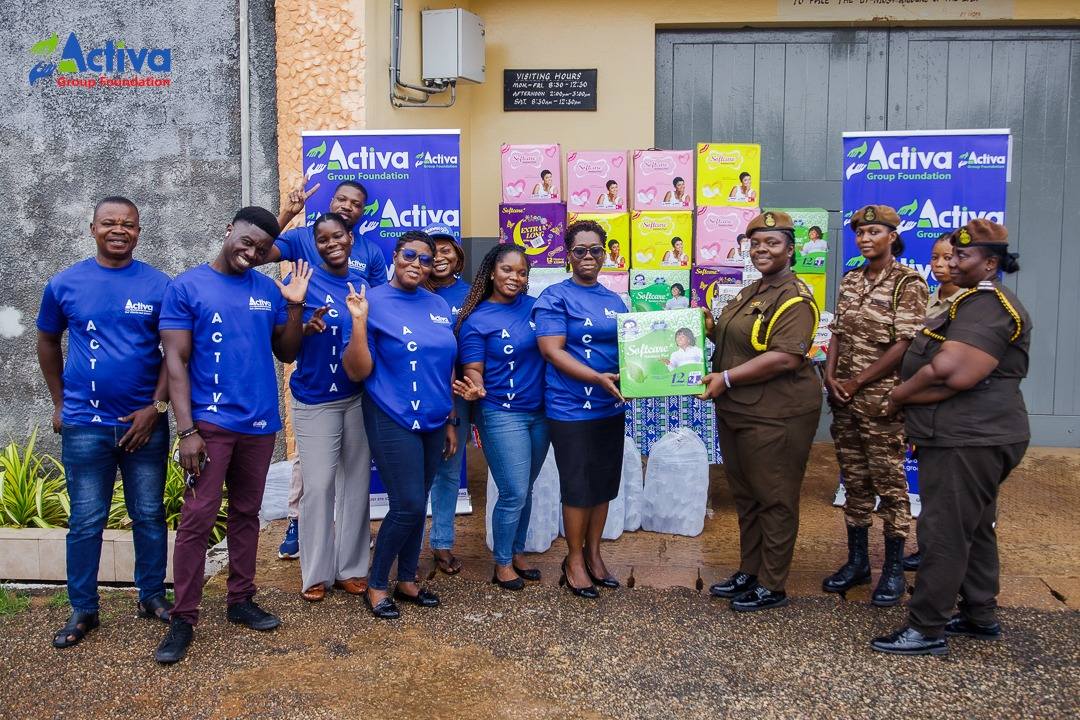
On 28th May 2026, Menstrual Hygiene Month, the Activa Group Foundation visited the Nsawam Female Prison with a simple mission: to donate menstrual hygiene products and other essential supplies to the female inmates. Sanitary pads. Soap. Basic toiletries. For a woman behind bars, these items are not small at all. They are dignity. They are health. They are the difference between feeling human and feeling forgotten.
The Nsawam Prison complex became operational in 1960, built to hold around 850 inmates. The female section was added in 1970. By 2012, the entire facility held over 3,500 detainees. The female prison, however, tells a different story. Built to hold 200 inmates, it had only about 70 inmates as of 2022.

That is not congestion. That is neglect by volume. The government has acknowledged the need for prison reform, with Interior Minister Alhaji Mohammed Mubarak Muntaka recently reaffirming commitment to completing the abandoned Nsawam Remand Prison project and raising the prisoners’ daily feeding rate to GH¢5. But more help is needed. Much more.
📢 GET A DETAILED ARTICLES + JOBS
Join ASJ's WhatsApp Channel and never miss a post or opportunity.

A History of Neglect: Nsawam Female Prison’s Quiet Crisis
The Nsawam Female Prison is not overcrowded. That is the problem. A facility built to hold 200 women currently houses approximately 70. The empty cells are not a sign of efficiency; they are a sign of underfunding, understaffing, and under-prioritization. When a prison is not full, it does not attract attention. It does not generate headlines. It becomes invisible.
The government has taken steps. The feeding rate has been increased to GH¢5 per prisoner per day. Health insurance cards are being issued. The abandoned Nsawam Remand Prison project, stalled for over eight years, has been revisited. These are genuine achievements. But they do not solve the everyday crisis of menstrual hygiene.

Sanitary pads are not a luxury. They are a biological necessity. A woman who menstruates without access to pads faces infection, humiliation, and psychological distress. In prison, where movement is restricted and privacy is limited, the inability to manage menstruation with dignity compounds the punishment of incarceration.
The prison runs vocational training programmes—NVTI courses, distance education, skills training—to help inmates become self-sufficient after release. The Deputy Director of Prisons in charge of the facility, Victoria Adzewodah, has appealed to corporate bodies and philanthropists for more support. The prison is doing what it can with what it has. But what it has is not enough.
What Activa Group Foundation Has Done Before: A Pattern of Showing Up
This is not Activa’s first time stepping up. The Activa Group Foundation has a consistent track record of finding forgotten places and showing up.
In December 2025, they donated a fully equipped eight-seater ICT laboratory to the Korle Gonno Community Library, complete with GES-approved educational materials. Over 5,600 school-going children in the community now have access to digital literacy and STEM resources. Earlier in 2025, they provided a 50,000-litre water storage system to Breman Jamara in the Central Region, solving a long-standing potable water crisis. In 2019, Activa Ladies donated food items to the Accra Psychiatric Hospital, bringing Christmas relief to patients who had “not taken soft drinks for a long time.
The pattern is consistent. Activa finds the forgotten places—libraries without computers, villages without clean water, psychiatric hospitals without comforts, prisons without dignity—and shows up.
The visit to Nsawam Female Prison fits this pattern. The supplies were not extravagant: sanitary pads, soap, toiletries. But for a woman who has gone months without new supplies, these items are transformative. They are not just hygiene products; they are a message: you are not forgotten.
The Words That Matter: Dignity, Not Charity
When asked why this particular visit mattered, Genevieve Tachie, Deputy Managing Director of Activa International Insurance Ghana, responded directly:
“When we talk about women’s health and dignity, we cannot pick and choose who deserves it. A woman in prison is still a woman. She still menstruates. She still deserves to manage her cycle with cleanliness and respect. This is not charity. This is basic human decency.”
That is the framing that matters. This is not charity. Charity implies benevolence from above. Decency implies mutual respect. The women at Nsawam are not objects of pity; they are citizens who made mistakes and are paying for them. But they should not pay with their dignity.

The female prison officer who received the donations spoke briefly but powerfully: “Today, you have reminded us that we are not alone. The women here sometimes go months without new supplies. What you have brought will carry them through. On behalf of the officers and the inmates, we say thank you.”
She did not exaggerate. She did not perform. She just thanked them. And her voice cracked when she said it.
The Moment That Broke Everyone: Humanity Behind Bars
The Activa team, led by Belinda Ofori, did not just drop the supplies and leave. They engaged the inmates. They spoke to them about hygiene. They listened.
And then it happened. One of the Activa staff members, a woman who had been quietly helping unload the boxes, suddenly broke down when they entered the yard. She could not stop crying. She had to be led out by a prison officer who held her arm and whispered something calming. The officer brought her outside, sat her down, and stayed with her until she could compose herself.
What triggered it? She did not say. Maybe it was a face that reminded her of a relative. Maybe it was the weight of seeing so many women in one place, all of them someone’s daughter, someone’s sister. Maybe it was simply too much humanity to process at once.
That is the thing about places like Nsawam. You can read about overcrowding and recidivism and rehabilitation programmes. But when you stand there, when you look into the eyes of women who have made mistakes and are paying for them, the statistics become faces. And faces break you.
What the Government Is Doing: Steps Forward, But Not Enough
To be fair, the government is not absent. The Ministry of Gender, Children and Social Protection has visited Nsawam Female Prison. In October 2025, they launched a breast cancer awareness and screening exercise at the facility, donating sanitary pads, food, and beverages. The Minister, Dr Agnes Naa Momo Lartey, made a point that stuck: “The people behind bars are equal citizens as we are. It’s one situation or the other that has brought them here. When we talk about service to the nation, we don’t leave them out.
That is the right attitude. The government has also raised the prisoners’ daily feeding rate to GH¢5 and is issuing health insurance cards to inmates. These are steps in the right direction.
But steps are not the destination. Seventy inmates may not sound like a crisis. But seventy women without consistent access to sanitary pads is a crisis. Seventy women who rely on donations for basic hygiene is a crisis. Seventy women whose rehabilitation depends on underfunded programmes is a crisis.
The government has announced plans to complete the abandoned Nsawam Remand Prison project. The feeding rate has been increased. Health insurance cards are being issued. These are good things. But good things are not enough when the gap is this wide.
The Way Forward: Corporate Ghana Must Do More
Corporate Ghana must do more. Not once a year. Not when the cameras are rolling. Consistently. Quietly. Relentlessly. Activa Foundation has shown up. Others must follow.
The prison is doing what it can with what it has. The Deputy Director of Prisons, Victoria Adzewodah, has appealed to corporate bodies and philanthropists for more support. That appeal should not go unanswered.
The Activa International Insurance Ghana team left Nsawam that afternoon with heavy hearts but lighter consciences. They had done what they came to do. The supplies were distributed. The hygiene talk was delivered. The inmates felt seen.
But one staff member had to be consoled. And that staff member represents all of us who pretend that prisons are someone else’s problem. They are not. The women at Nsawam are Ghanaian women. They are mothers, daughters, sisters. They made mistakes. They are paying for them. But they should not pay with their dignity.
Activa Group Foundation understood that. On Menstrual Hygiene Month, 28.05.2026, they acted. Now it is your turn. Read this. Sit with it. And ask yourself: what can I do? You do not have to build a library or dig a borehole. You can donate. You can volunteer. You can simply remember that they exist.
Source: Accra Street Journal
Last Updated on June 2, 2026 by Samuel Kwame Boadu
Disclaimer: Some content on Accra Street Journal may be aggregated, summarized, or edited from third-party sources for informational purposes. Images and media are used under fair use or royalty-free licenses. Accra Street Journal is a subsidiary of SamBoad Publishing Hub under SamBoad Business Group Ltd, registered in Ghana since 2014.
For concerns or inquiries, please visit our Privacy Policy or Contact Page.

Samuel Kwame Boadu is a Ghanaian media entrepreneur and storyteller with a passion for amplifying urban voices and uncovering everyday truths. He is the Editor-in-Chief and Founder of Accra Street Journal, a dynamic digital platform dedicated to capturing the pulse of Ghana’s capital—its people, culture, challenges, business, sports and innovations.