








Let me tell you about the bucket.
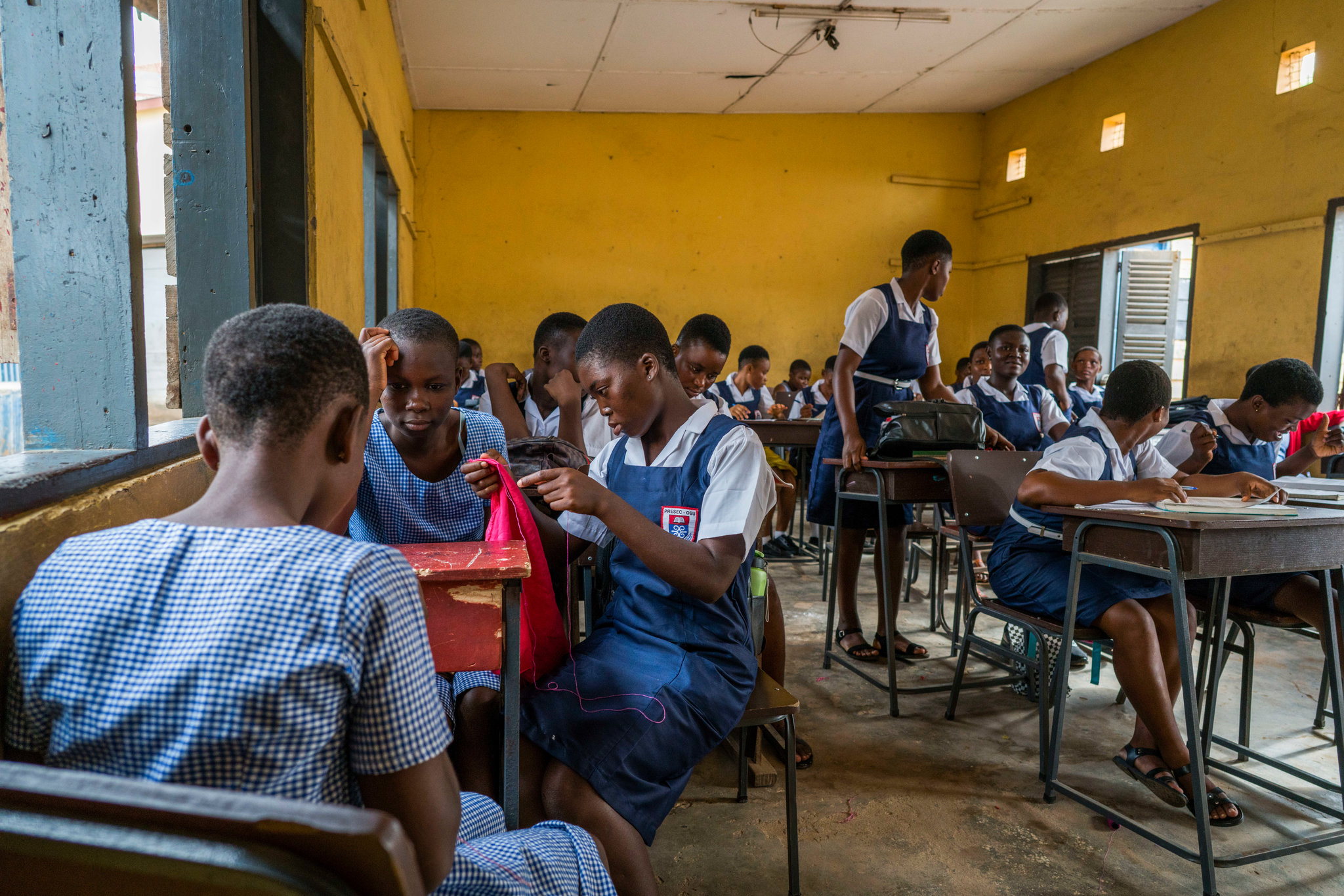
For years, students at Accra Girls Senior High School who wanted to perform a chemistry practical had to fetch water from a tap, carry it in a plastic bucket to their workstations, and use that same bucket as a mobile sink. Gas cylinders for heating? They bought those themselves, hauling them from local suppliers. Distilled water for sensitive experiments? Purchased out of pocket. The laboratory floor was not tiled. The sinks did not drain. The entire facility, according to the school’s own science department head, was “completely run down.”

This was not some rural school in the Volta Region. This was Accra Girls, a respected institution in the capital .
📢 GET A DETAILED ARTICLES + JOBS
Join ASJ's WhatsApp Channel and never miss a post or opportunity.

The story of the Accra Girls chemistry lab—recently refurbished by the 1984 and 1985 alumni groups at a cost of hundreds of thousands of cedis—is not exceptional. It is the norm. Across Accra, senior high schools are caught in a painful contradiction: they are expected to produce the next generation of doctors, engineers, and pharmacists, but the rooms where those futures are supposed to be built are crumbling.
This ASJ feature is for the parent who has asked the hard question: Where in Accra can my child actually perform a proper titration? Where are the microscopes that are not from the 1990s? Which schools take the “practical” in practical science seriously?
We have investigated the current state of science laboratories in Accra’s top secondary schools, spoken to infrastructure data, and identified the institutions where the equipment works, the gas flows, and the students are not fetching water in buckets.
Why the Laboratory Is Not a Luxury
Before we name names, let us be clear about what is at stake.
WAEC examines practical science separately from theory. The WASSCE results that unlock university admission include specific grades for Physics Practical, Chemistry Practical, and Biology Practical. A student who has never touched a microscope, never titrated an acid, never measured the acceleration of a falling object, is walking into that examination hall blind.
The education journalist’s observation: A school with a functional laboratory is not just offering better teaching. It is offering insurance. Insurance that when the WAEC practical paper lands on the desk, your child has done it before. Insurance that the difference between a B and an A—which can determine university placement—is secured by muscle memory, not just textbook diagrams.
Yet laboratory infrastructure remains the single weakest link in Ghanaian science education. Even in Accra, the capital with the highest concentration of resources, the gap between what is promised and what is delivered is vast.
The Laboratory Landscape: Who Has What?
Let us break down the current state of science facilities across Accra’s secondary schools, from the Category A giants to emerging STEM specialists.
Achimota School: The Gold Standard (When It Works)
If there is a school in Accra that has historically set the bar for science education, it is Achimota School. Founded in 1927, this mixed-gender public school has produced four Ghanaian heads of state and some of the continent’s finest scientific minds .
The school’s facility list includes fully equipped science laboratories for Physics, Chemistry, and Biology. In 2022, Achimota was named Best Science School in Greater Accra—an award that reflects consistent performance in WASSCE sciences and the National Science and Maths Quiz (which they won in 2018) .
The nuance: Achimota’s laboratories, like most public schools, face constant pressure. Over 2,000 students share these facilities. Equipment wears out. The alumni association works hard to supplement government funding, but the student-to-bunsen-burner ratio remains a challenge. A parent choosing Achimota is choosing a school where the potential for excellent science education is very real, but the reality depends on which class period your child is scheduled for.
Verdict: Outstanding reputation and track record. But ask about current equipment condition before enrolling.
Accra Academy: The Boys’ Powerhouse
At Accra Academy, located at Bubuashie near Kaneshie, the science laboratories are part of the school’s long-standing identity. Founded in 1931 as a private institution (it became government-assisted in 1950), Accra Academy runs the full General Science programme and has laboratory facilities listed as a core feature .
In 2003, the school was ranked 8th among the top 100 high schools in Africa by Africa Almanac—a ranking that considered quality of education, student engagement, and alumni strength . That ranking is old, but the infrastructure has seen consistent attention from a highly engaged alumni network.
The context: Accra Academy is a boys’ school, which means all science resources are concentrated on one gender. Some parents prefer this focus. Others prefer co-educational environments. The laboratory quality itself is solid, though, like all Category A public schools, maintenance is an ongoing struggle.
Verdict: Reliable labs with strong alumni support. Best for parents who prefer single-gender education.
Accra Girls Senior High School: A Cautionary Tale with a Happy Ending
We started this piece with the bucket story. Let us finish that narrative.
The Accra Girls chemistry laboratory was, until very recently, a disgrace. “The lab was completely run down, the floor was not tiled, there was no water or gas flow, and the sinks were not working,” Mr Victor Klevor, Head of the Science Department, told the Ghanaian Times .
But in April 2025, the 1984 and 1985 year groups of AGOSA (Accra Girls Old Students Association) handed over a fully refurbished chemistry laboratory. New tiles. Running water. Functional gas. Working sinks. The Deputy Minister of Education, Dr Clement Abas Apaak, attended the ceremony and explicitly called on other alumni groups to follow this example, noting that “the government cannot do it all” .
The takeaway for parents: Accra Girls now has one of the most modern chemistry labs in the capital—courtesy of old students, not the state. But this is a single lab. The physics and biology facilities still need attention. If your daughter attends Accra Girls, chemistry practicals will be excellent. The other sciences? Ask for a tour.
Verdict: Best-in-class chemistry lab post-renovation. Mixed performance on other sciences.
Tema Secondary School (TEMASCO): Corporate Intervention
Sometimes the private sector steps in where the government cannot.
In September 2025, Tema Lube Oil Company (TLOC) handed over a refurbished physics laboratory to Tema Secondary School (TEMASCO). The cost: GH¢400,000. The work included replacing obsolete fittings, installing modern equipment, and upgrading the entire facility .
This is significant because physics is often the most neglected science. Chemistry labs get attention because they look dramatic (coloured liquids, flames). Biology labs survive because microscopes are durable. But physics labs require oscilloscopes, circuits, and measurement tools that are expensive to maintain. TLOC’s investment directly addresses that gap.
The Headmistress, Lucy Nai, confirmed that the laboratory was “one of the key needs of the school” .
Verdict: Physics lab now excellent. Corporate backing suggests ongoing maintenance support. Strong choice for students focusing on physics or engineering pathways.
The New Players: STEM Academies and Portable Solutions
While traditional schools struggle with renovations, the government and private sector are launching entirely new models for science education.
Accra STEM Academy: The Future, Almost Ready
Located somewhere in Accra (the exact location has been kept deliberately flexible as the project develops), the Accra STEM Academy is the government’s flagship project for science education .
When completed, this institution will serve students from kindergarten through senior high school—the first of its kind in Ghana. The facility includes:
-
Dedicated laboratories for robotics
-
Artificial intelligence training spaces
-
Biotechnology research areas
-
An elevator (a small detail, but it signals serious investment)
Vice President Dr Mahamudu Bawumia inspected the project in October 2024, at which point it was approximately 85 per cent complete. Only floor tiling, window fixing, and laboratory finalisation remained .
The catch: The commissioning happened in December 2024 under President Akufo-Addo . But “commissioning” and “fully operational” are different things. Parents should verify current admission status and whether the specialised laboratories are actually running classes before enrolling.
Verdict: Potentially the best STEM facility in West Africa. But verify operational status in 2026.
The STEM Box Revolution: Laboratories That Move
Here is something entirely new, and it matters even for parents choosing secondary schools.
In December 2025, President John Dramani Mahama launched the STEM Box—a portable, digital science laboratory designed and manufactured in Ghana by Dext STEM Ltd .
This is not a toy. The STEM Box stands 6.1 feet tall and 4 feet wide, contains comprehensive science sets for physics, chemistry, and biology, and can serve up to 300 learners at once. It is curriculum-aligned and requires no specialised facility .
Why this matters for secondary school parents: The STEM Box is already being piloted in 667 public basic schools across Ghana. Over 450 private schools are using it. Even schools in the United Kingdom, through the Royal Academy of Engineering, have subscribed .
If your child’s secondary school has a weak laboratory, ask: Do you have a STEM Box? It is not a perfect replacement for a full wet lab (you cannot pour acid in a box), but for physics mechanics, electronics, and many biology experiments, it is transformative.
President Mahama described it as “a visionary effort designed, engineered and produced by our own people right here in Ghana” . For parents, it is a pragmatic solution to a long-standing problem.
Verdict: Game-changer for schools with space or budget constraints. Ask your prospective school if they have adopted it.
Private Schools and Science Labs: The Unspoken Reality
We have focused largely on public schools because that is where most Ghanaian children are educated. But for parents considering private secondary education, a word of caution.
Private schools in Accra are excellent at marketing. The brochures always show a pristine laboratory with a single student looking thoughtfully at a beaker. The reality is often different.
Because private schools are businesses, they prioritise investments that parents can see: air-conditioned classrooms, uniformed security guards, well-manicured lawns. Laboratories are expensive and yield no immediate marketing return. Consequently, many mid-tier private schools have laboratories that are theoretically present but practically under-equipped.
The investigative tip: When a private school shows you their science lab, ask three questions:
-
“How many students share this lab per class period?” (If it is more than 30, practical work is impossible.)
-
“When were these microscopes last serviced?” (If they cannot answer, the answer is “never.”)
-
“Can I see the chemical storage area?” (A lab without chemicals is a classroom with tables.)
If the admissions officer hesitates, you have your answer.
The Alumni Factor: Why Old Students Matter More Than Government
Look again at our list of schools with functioning laboratories: Achimota (alumni-supported), Accra Girls (alumni-funded), Accra Academy (alumni-supported), TEMASCO (corporate, but alumni-linked).
Notice a pattern? The government did not pay for these renovations. Old students did.
This is the hidden truth of Ghanaian education infrastructure. The state builds shells. Alumni fill them with equipment, plumbing, gas lines, and working sinks. A school’s laboratory quality is often a direct reflection of how organised, wealthy, and engaged its alumni association is.
Advice for parents: When evaluating a school, ask about the alumni association. When was their last major project? How much did they raise? What are they planning next? A school with a dormant alumni association is a school whose laboratories are slowly decaying.
The WAEC Connection: What the Exam Actually Requires
To understand why laboratories matter, parents need to understand what WAEC actually tests.
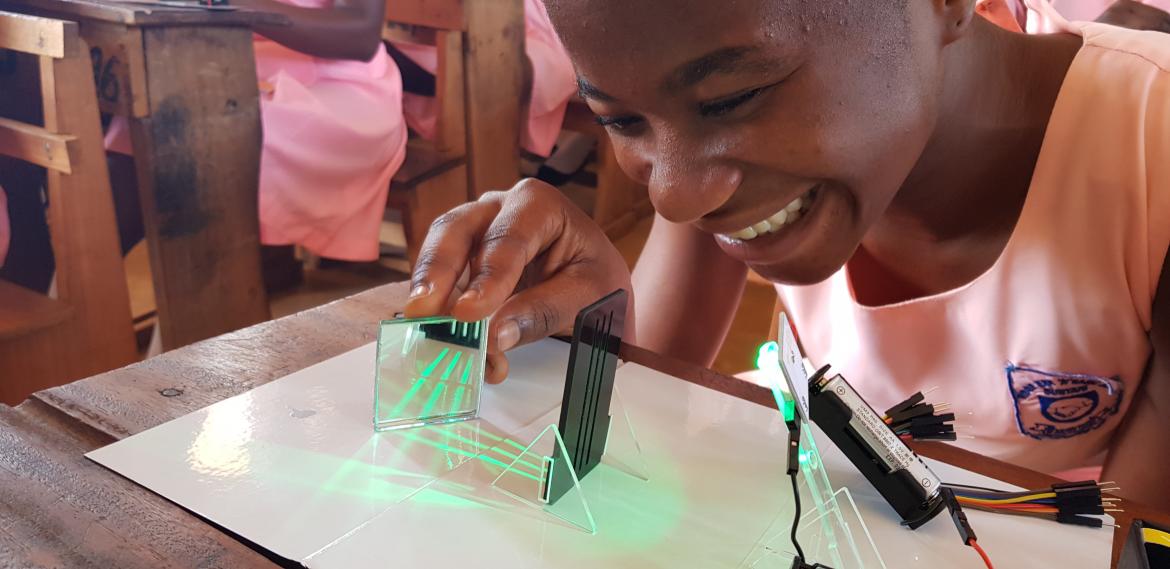
The WASSCE practical papers are not theoretical. Students are given real equipment and asked to perform real tasks. In Biology, they might be given a specimen (say, a cockroach or a flower) and asked to draw and label specific features. In Chemistry, they might be given solutions and asked to identify ions based on colour changes. In Physics, they might be given an ammeter, voltmeter, and resistors and asked to verify Ohm’s Law .
A student who has only seen diagrams of these procedures will fail. Not because they are unintelligent, but because practical science is a skill, not a memory. You cannot learn titration from a textbook any more than you can learn swimming from a lecture.
The editorial observation: Schools that treat practical science as optional are cheating their students. And too many schools in Accra do exactly that, prioritising theory because it is easier to assess and requires no equipment.
The Parental Checklist: How to Evaluate a Science Lab
Before enrolling your child, request a tour of the science laboratories. Here is what to look for:
The Non-Negotiables:
-
Running water at every workstation
-
Functional gas supply (or portable gas cylinders that are actually refilled)
-
Working electrical outlets
-
Proper waste disposal (acid waste cannot go into regular drains)
-
Adequate lighting and ventilation
The Quality Indicators:
-
Sufficient equipment for each student (not “one microscope for the whole class”)
-
Recent equipment (microscopes should not be from the 1990s)
-
A chemical store with labelled, non-expired reagents
-
A trained laboratory technician (not a teacher doubling as a technician)
-
A maintenance log showing regular servicing
The Red Flags:
-
Dust on equipment (means it is not used)
-
Broken equipment stored “for repair” that has been there for months
-
A locked laboratory that the guide “cannot find the key for”
-
Excuses about “renovations happening next term”
Do not be shy. You are paying with your child’s future.
FAQ Section: Parents’ Top Questions Answered
1. Which senior high school in Accra has the best science laboratories right now?
Based on current data, Accra Girls Senior High School has the most recently renovated chemistry lab (2025), Tema Secondary School has a newly refurbished physics lab (2025), and Achimota School has consistently strong laboratories across all sciences plus an award-winning STEM programme .
2. Is the Accra STEM Academy open for admission?
The Academy was commissioned in December 2024 . However, parents should verify operational status directly with the Ghana Education Service, as “commissioned” does not always mean “fully operational and admitting students for all year groups.
3. Are there any schools in Accra with robotics and AI laboratories?
The Accra STEM Academy is designed to include robotics and AI labs . For tertiary education, Academic City University College offers undergraduate degrees in Artificial Intelligence and Robotics Engineering .
4. What is the STEM Box, and can my child’s school get one?
The STEM Box is a portable science laboratory developed by Ghanaian startup Dext STEM Ltd. It is currently being piloted in 667 public schools and used by 450+ private schools in Ghana . Parents can advocate for their school to purchase or subscribe to the system.
5. Why do public schools struggle so much with laboratory maintenance?
Public schools face high student populations, limited government funding for consumables (chemicals, slides, bulbs), and a lack of dedicated laboratory technicians. Most functional labs in public schools are maintained by alumni associations, not the government .
6. Are private school laboratories generally better than public school ones?
Not necessarily. Some private schools have excellent labs because they can afford the investment. But many private schools cut corners on laboratories because parents rarely ask to see them during admissions tours. Always tour the lab, regardless of whether the school is public or private.
7. How does a poor laboratory affect WASSCE results?
Severely. The WASSCE practical papers account for a significant portion of the overall science grade. A student who cannot perform practical work will struggle to score above a C, limiting their university options, especially for competitive programmes like medicine and engineering.
8. Which schools have won recent science awards in Accra?
Achimota School won Best Science School in Greater Accra in 2022 . Accra Girls has produced strong science students, though their facilities only recently caught up. The National Science and Maths Quiz champions also indicate strong lab support, though NSMQ success is not solely dependent on laboratory quality.
Conclusion: Choose the School That Lets Them Touch the Science
The bucket at Accra Girls is gone. The new chemistry lab stands as proof that when communities organise, they can fix what the government cannot. But one renovated lab does not fix a national crisis.
As a parent, you cannot change the entire system. But you can choose a school where your child will not sit through three years of science classes without ever lighting a bunsen burner. You can ask the hard questions during the tour. You can follow the alumni money. You can look for the STEM Box in the corner.
The best science school in Accra is not the one with the most expensive brochure. It is the one where the laboratory doors are open, the equipment is clean, and the students have burns on their fingers from actually trying.
That is real education. Everything else is just theory.
Source: Accra Street Journal
Last Updated on May 21, 2026 by Samuel Kwame Boadu
Disclaimer: Some content on Accra Street Journal may be aggregated, summarized, or edited from third-party sources for informational purposes. Images and media are used under fair use or royalty-free licenses. Accra Street Journal is a subsidiary of SamBoad Publishing Hub under SamBoad Business Group Ltd, registered in Ghana since 2014.
For concerns or inquiries, please visit our Privacy Policy or Contact Page.

Samuel Kwame Boadu is a Ghanaian media entrepreneur and storyteller with a passion for amplifying urban voices and uncovering everyday truths. He is the Editor-in-Chief and Founder of Accra Street Journal, a dynamic digital platform dedicated to capturing the pulse of Ghana’s capital—its people, culture, challenges, business, sports and innovations.