


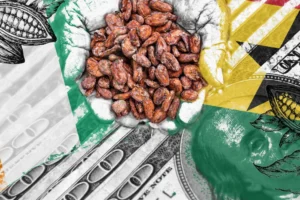





The Bank of Ghana insists there’s no shortage of dollars. Yet traders, importers, and business owners across the country are telling a different story — one marked by long delays, rising frustrations, and a persistent black market premium that suggests all is not well within the formal forex system.

Recent commentary from the Institute of Statistical, Social and Economic Research (ISSER) urged traders to avoid the black market and stick with official bank channels for their foreign exchange needs. The Bank of Ghana echoed this view, asserting that commercial banks have sufficient liquidity to meet demand — provided clients submit the right documentation.
But the lived experience of many in the private sector paints a contrasting picture. Some say banks are increasingly slow or unresponsive, making it difficult to meet tight shipping timelines. Others report inconsistent responses from bank branches, even when all paperwork is in order.
📢 GET A DETAILED ARTICLES + JOBS
Join ASJ's WhatsApp Channel and never miss a post or opportunity.
Between July 14 and 21, the Bank of Ghana’s official interbank rate moved only slightly — from ₵10.40 to ₵10.455 per dollar. In sharp contrast, the black market remained stubbornly higher, with rates between ₵11.60 and ₵11.75 per dollar. That’s a staggering 11% to 13% premium — enough to cost importers thousands of cedis on a single shipment.
This kind of spread raises more than just economic questions. It invites scrutiny into the fairness and transparency of forex distribution. Could some players be getting preferential access to low-rate dollars, only to offload them for profit on the street? There is no hard evidence of deliberate wrongdoing, but the perception alone can be damaging.
In a market like Ghana’s — where small and medium enterprises (SMEs) already face mounting costs — unpredictability in forex access can be crippling. Unable to rely on formal channels, many feel forced to use the black market, where dollars are more expensive but immediately available. This creates a vicious cycle: legitimate businesses are squeezed, government tax revenues erode, and inflationary pressures increase as the cost of imports rises.
The solution? Transparency and accountability. Stakeholders are calling for clearer communication from banks, detailed audits of forex distribution, and stronger enforcement of fair access policies. The Association of Banks is reportedly investigating the claims, which could be a step in the right direction.
The issue isn’t simply whether dollars exist — it’s who can reliably get them. Without consistent and equitable access, trust in the system falters. And when trust collapses, even the best policies lose their power.
Ghana’s economy depends on a foreign exchange system that works — for everyone, not just the well-connected.
Last Updated on July 23, 2025 by Samuel Kwame Boadu
Disclaimer: Some content on Accra Street Journal may be aggregated, summarized, or edited from third-party sources for informational purposes. Images and media are used under fair use or royalty-free licenses. Accra Street Journal is a subsidiary of SamBoad Publishing Hub under SamBoad Business Group Ltd, registered in Ghana since 2014.
For concerns or inquiries, please visit our Privacy Policy or Contact Page.

Samuel Kwame Boadu is a Ghanaian media entrepreneur and storyteller with a passion for amplifying urban voices and uncovering everyday truths. He is the Editor-in-Chief and Founder of Accra Street Journal, a dynamic digital platform dedicated to capturing the pulse of Ghana’s capital—its people, culture, challenges, business, sports and innovations.