
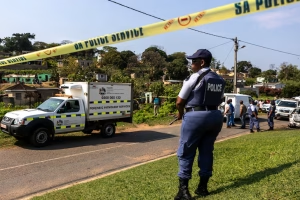



South African President Cyril Ramaphosa has announced a clean-up of high-risk areas across the country and a multidisciplinary national emergency response after the bodies of 12 women were discovered east of Johannesburg in just two months.
South Africa’s President Cyril Ramaphosa on Tuesday announced a clean-up of high-risk areas across the country, after the bodies of 12 women were discovered in an area east of Johannesburg in just two months.

The deaths sparked a national outcry about the scale of violence against women in South Africa, which has one of the highest rates of gender-based violence in the world.
📢 GET A DETAILED ARTICLES + JOBS
Join ASJ's WhatsApp Channel and never miss a post or opportunity.

National Emergency Response
Ramaphosa announced what he called a multidisciplinary, national-level emergency response to the murders, for which there have been four arrests.
He said gender-based violence “cannot be accepted as a normal part of life in South Africa” and admitted the country has “not done enough” to protect women and girls.
There has understandably been widespread fear that the discovery of these women in close proximity could indicate the work of a single perpetrator,” Ramaphosa said in an address to the nation. “At present, the police have not found evidence establishing that these killings were committed by a single perpetrator.”
Women’s Safety Audits
Admitting the government has not done enough in recent years to prevent gender-based violence, he announced a new wave of measures to help protect women and girls.
“Every municipality must begin a women’s safety audit without delay,” he said. “High-risk areas must be identified” and addressed.
These audits must identify broken streetlights, overgrown public spaces, abandoned buildings, unsafe transport routes and facilities, poorly secured parks, and other conditions that place women at risk.
Alcohol Enforcement Package
Ramaphosa also announced an “enforcement package” to reduce alcohol-related violence.
“Alcohol does not cause gender-based violence and it can never excuse it. Responsibility always lies with the perpetrator,” he said. “But harmful alcohol use is a significant aggravating factor in interpersonal violence, and it must be addressed as part of our wider prevention effort.”
Changing Attitudes
The South African president also said a deeper change, beyond policing and legislation, must take place to reduce violence against women and girls, saying it “does not begin when a fist is raised” or when a woman is raped or murdered.
“It begins much earlier,” he said. “It begins in attitudes that regard women as inferior… with the belief that a man has the right to control a woman.
“It begins when jealousy is mistaken for love, when control is mistaken for protection and coercion is mistaken for affection.
“It begins when a man refuses to accept the word no.”
He went on to call on men and boys to take the lead in ending gender-based violence.
“We have placed the burden of male violence on women,” Ramaphosa said. “That must change.”
“The solution to violence against women cannot be to make women less free.”
Stark Statistics
South Africa has one of the highest homicide rates, with 5,427 people murdered between April and June this year alone.
While South African police statistics do not differentiate victims by gender, the South African Human Rights Commission said recently that 569 women were killed and 1,052 others survived attempted murder between April and June this year.
Key Announcements at a Glance
| Measure | Detail |
|---|---|
| National Response | Multidisciplinary, national-level emergency response |
| Arrests | Four arrests made |
| Safety Audits | Every municipality to begin women’s safety audits without delay |
| Focus Areas | Broken streetlights, overgrown spaces, abandoned buildings, unsafe transport routes |
| Alcohol Package | Enforcement package to reduce alcohol-related violence |
| Call to Action | Men and boys urged to lead in ending gender-based violence |
Source: Accra Street Journal
Last Updated on September 30, 2026 by Samuel Kwame Boadu
Disclaimer: Some content on Accra Street Journal may be aggregated, summarized, or edited from third-party sources for informational purposes. Images and media are used under fair use or royalty-free licenses. Accra Street Journal is a subsidiary of SamBoad Publishing Hub under SamBoad Business Group Ltd, registered in Ghana since 2014.
For concerns or inquiries, please visit our Privacy Policy or Contact Page.

Samuel Kwame Boadu is a Ghanaian media entrepreneur and storyteller with a passion for amplifying urban voices and uncovering everyday truths. He is the Editor-in-Chief and Founder of Accra Street Journal, a dynamic digital platform dedicated to capturing the pulse of Ghana’s capital—its people, culture, challenges, business, sports and innovations.