






The GSE has delivered a spectacular run. But a portfolio built entirely on one exchange in one currency is a portfolio exposed to a single story. Here is how to widen the net.

The Concentration Problem
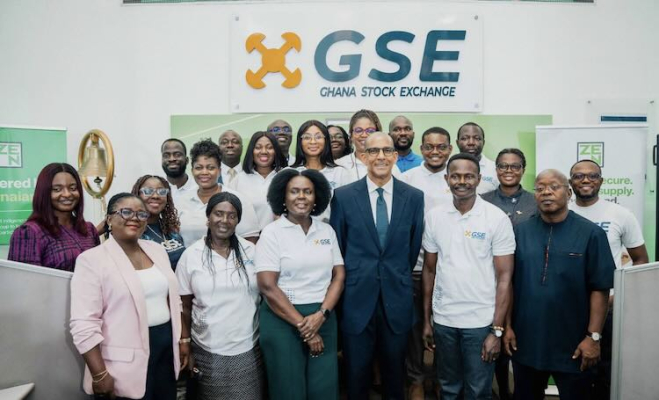
Ghana’s stock market has been one of the best-performing in the world. The GSE Composite Index returned over 62% year-to-date by late April 2026, with financial stocks surging 90%. Market capitalisation climbed to nearly GH¢279 billion .
But that success masks a structural weakness. The market is small, thinly traded, and dominated by a handful of financial and telecom stocks. In a single week in April 2026, finance and ICT accounted for nine out of every ten shares traded . When sentiment turns on those sectors, the whole market feels it.
📢 GET A DETAILED ARTICLES + JOBS
Join ASJ's WhatsApp Channel and never miss a post or opportunity.
For investors who have already captured the GSE rally—or who want to reduce their dependence on it—the question becomes: what else is available?
Private Equity and Venture Capital
The most significant development in Ghana’s domestic diversification story is the emergence of institutional vehicles that channel pension money into private markets.
The Ci-Gaba Fund of Funds reached its first close of $75 million in January 2026, with more than two-thirds anchored by Ghanaian pension funds . It is Ghana’s first domestically domiciled private fund-of-funds, designed to invest in fund managers operating across financial services, healthcare, agriculture, clean energy, education, and technology . The fund is expected to support up to 25,000 jobs .
A parallel vehicle, the Growth Investment Partners (GIP) platform backed by British International Investment, has attracted $20 million from Norfund and Axis Pension Trust . GIP provides flexible local-currency debt to Ghanaian SMEs, with an evergreen structure that recycles repaid capital rather than returning it to investors—a design that fits the cash-flow logic of pension funds far better than a traditional 10-year closed-end fund .
The policy backdrop matters here. Under Ghana’s Venture Capital and Private Equity Compact, pension and insurance funds are expected to allocate at least 5% of assets under management to alternative asset classes . With total pension AUM projected to surpass GH¢100 billion, that represents roughly $330 million of patient capital waiting to be deployed into private markets .
For individual investors, direct access to these funds is limited. They are designed for institutional LPs. But their growth signals a broader shift: Ghana’s domestic capital is beginning to diversify beyond sovereign debt and listed equities.
Fixed Income and Money Market Alternatives
The fixed income landscape has changed dramatically. Treasury bill rates have fallen sharply as inflation collapsed from a peak of 54.1% in December 2022 to 4.6% in July 2026 . The 2-year, 3-year, and 5-year bonds now trade around 11% to 12.6%, down from 20% levels a year earlier .
For investors seeking yield, this compression has made traditional fixed income less attractive. Bank fixed deposit rates remain low—Fidelity Bank’s 182-day rate for deposits over GH¢5 million stood at just 2.65% in August 2026 .
This environment has pushed investors toward money market funds and unit trusts, which offer professional management and diversification across short-term instruments. The trade-off is lower yields than the GSE has delivered, but with far lower volatility.
Real Estate
Ghana’s housing deficit—estimated at 1.8 to 2 million units—remains one of the most durable structural investment cases in the economy . Rental demand in urban centres is strong, and land values in fast-growing peripheries of Accra, Kumasi, and Takoradi have appreciated steadily as infrastructure expands .
Real estate offers three advantages that listed equities do not: it is a tangible asset, it generates rental income, and it has historically preserved value against cedi depreciation. The trade-offs are liquidity and capital intensity—property cannot be sold in a day, and the entry ticket is high.
For investors who want real estate exposure without direct ownership, REITs offer a listed alternative. But Ghana’s REIT market remains small, and the listed options are limited.
The Currency Question
Any diversification beyond the GSE raises the question of currency.
The cedi appreciated by 40.7% in 2025 and has held broadly stable into 2026 . That strength has made dollar-denominated assets less compelling in cedi terms. But the memory of the 2022 collapse—when the cedi lost 26.2% against the dollar in a single month—remains fresh .
For investors whose liabilities are in cedis, domestic diversification may be sufficient. For those with dollar-denominated goals—education abroad, overseas property, international travel—US stocks, ETFs, and dollar-denominated funds remain the natural hedge. Platforms like Bamboo and Chipper Cash have made that route accessible from as little as $1.
The Practical Blend
There is no single answer. But a framework emerges from the current environment:
Domestic equities: The GSE has delivered exceptional returns. But concentration risk is real. Investors who have benefited from the rally may want to trim exposure and lock in gains.
Private markets: The Ci-Gaba and GIP vehicles signal that Ghana’s institutional infrastructure for private equity and private debt is maturing. Access is limited for retail investors, but the trend matters.
Fixed income: With rates compressing, fixed income is less attractive than it was. It remains a tool for capital preservation, not growth.
Real estate: The structural housing deficit supports long-term appreciation and rental income. It is illiquid, but it is real.
Global assets: US stocks and ETFs offer currency diversification and access to companies that do not exist on the GSE. The platforms are regulated. The minimums are low.
The GSE is not a bad place to be. But it is one market, in one currency, dominated by one or two sectors. Diversification is not a rejection of Ghana’s growth story. It is a recognition that no single market—however well it has performed—should carry the whole portfolio.
Quick Facts
| Topic | Details |
|---|---|
| GSE YTD Return (April 2026) | 62.16% |
| Financial Stocks YTD | 90.25% |
| Ci-Gaba First Close | $75 million |
| Pension Fund Alternative Allocation Target | 5% of AUM |
| Inflation (July 2026) | 4.6% |
| Cedi Appreciation (2025) | 40.7% |
| Housing Deficit | 1.8–2 million units |
| Fixed Deposit Rate (182-day, GH¢5m+) | 2.65% |
Frequently Asked Questions
1. Why should Ghanaians diversify beyond the Ghana Stock Exchange?
The GSE is small, thinly traded, and dominated by a few financial and telecom stocks. In one week in April 2026, these two sectors accounted for nine out of every ten shares traded. A portfolio concentrated in the GSE is exposed to single-market and single-currency risk .
2. What are the main diversification options for Ghanaian investors?
Private equity and venture capital funds (through vehicles like Ci-Gaba), fixed income and money market funds, real estate, and global assets such as US stocks and ETFs .
3. How can individual investors access private equity in Ghana?
Direct access is limited—private equity is designed for institutional investors and high-net-worth individuals. However, the growth of funds like Ci-Gaba signals that Ghana’s domestic capital is diversifying. Some Ghanaian funds with private market exposure may be accessible through fund managers .
4. Is real estate a good diversification option in Ghana?
Ghana’s housing deficit of 1.8–2 million units supports long-term demand. Real estate offers rental income, value preservation against inflation, and tangible asset backing. The trade-offs are illiquidity and high capital requirements .
5. How have fixed deposit rates changed in 2026?
Rates have fallen sharply as inflation collapsed. Fidelity Bank’s 182-day rate for deposits over GH¢5 million stood at just 2.65% in August 2026, down from much higher levels in prior years .
6. Should Ghanaians invest in US stocks to diversify?
US stocks offer currency diversification and access to companies not available on the GSE. Platforms like Bamboo and Chipper Cash allow Ghanaians to invest from as little as $1. However, currency risk cuts both ways—a stronger cedi reduces the cedi value of dollar assets.
7. What is the Ci-Gaba Fund?
Ci-Gaba is Ghana’s first domestically domiciled private fund-of-funds. It reached a first close of $75 million in January 2026, with more than two-thirds anchored by Ghanaian pension funds. It invests in fund managers across financial services, healthcare, agriculture, clean energy, education, and technology.
8. What percentage of pension funds should go to alternatives?
Under Ghana’s Venture Capital and Private Equity Compact, pension and insurance funds are expected to allocate at least 5% of assets under management to alternative asset classes .
9. What is the current inflation rate in Ghana?
Inflation fell to 4.6% in July 2026, down from a peak of 54.1% in December 2022. This disinflation has been driven by tight monetary policy, cedi appreciation, and fiscal consolidation .
10. Is the cedi stronger or weaker than in 2024?
The cedi appreciated by 40.7% in 2025 and has held broadly stable into 2026. This strength reduces the cedi value of dollar-denominated assets but eases imported inflation
Source: Accra Street Journal
Last Updated on September 30, 2026 by Samuel Kwame Boadu
Disclaimer: Some content on Accra Street Journal may be aggregated, summarized, or edited from third-party sources for informational purposes. Images and media are used under fair use or royalty-free licenses. Accra Street Journal is a subsidiary of SamBoad Publishing Hub under SamBoad Business Group Ltd, registered in Ghana since 2014.
For concerns or inquiries, please visit our Privacy Policy or Contact Page.

Samuel Kwame Boadu is a Ghanaian media entrepreneur and storyteller with a passion for amplifying urban voices and uncovering everyday truths. He is the Editor-in-Chief and Founder of Accra Street Journal, a dynamic digital platform dedicated to capturing the pulse of Ghana’s capital—its people, culture, challenges, business, sports and innovations.