









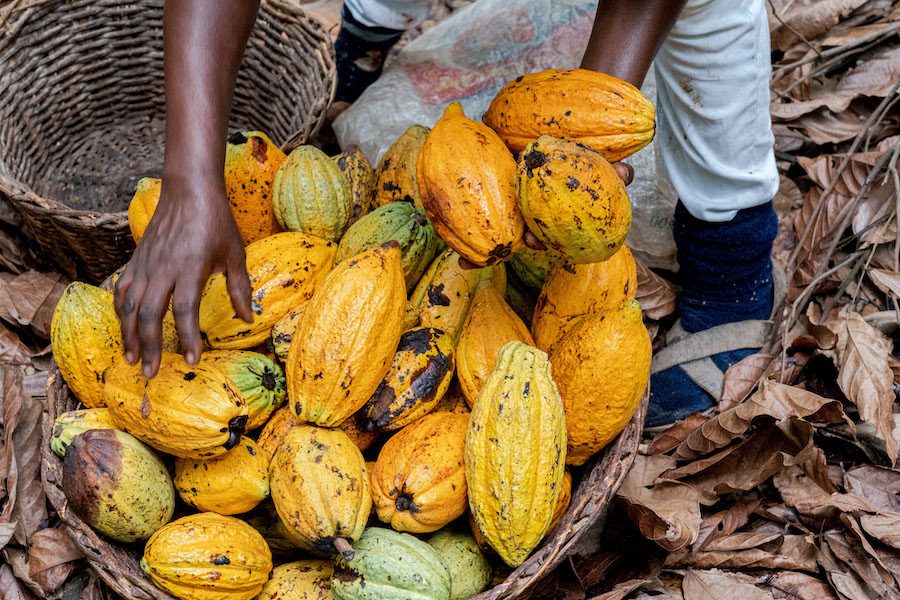

World cocoa prices have slipped below what Ghana is currently paying its farmers, opening a widening gap that could carry significant implications for COCOBOD and the broader cocoa economy.

Cocoa is now trading on the international market at around US$5,100 per tonne, equivalent to roughly GH¢54,570 at prevailing exchange rates. This is notably below the GH¢58,000 per tonne producer price Ghana fixed for farmers for the current season.
The shift places renewed pressure on COCOBOD, which in practice absorbs the difference between domestic producer prices and international market prices. With the cocoa board already operating under financial strain, the emerging gap is drawing close attention from industry watchers.
📢 GET A DETAILED ARTICLES + JOBS
Join ASJ's WhatsApp Channel and never miss a post or opportunity.
When the government announced the producer price increase in October, global cocoa prices were considerably higher, trading between US$6,000 and US$7,000 per tonne amid severe supply disruptions across West Africa. Those elevated prices created room for Ghana to raise farmgate prices while remaining broadly aligned with global market conditions.
Since then, however, international prices have eased as supply expectations adjusted and speculative pressures cooled. Ghana’s producer price, by contrast, has remained fixed for the season, in line with the country’s long-standing policy of offering farmers income stability rather than frequent price adjustments.
Authorities have so far given no indication whether the producer price will be revised downward or maintained until the end of the season. Historically, Ghana has been reluctant to cut farmgate prices mid-season, given the potential social and political implications for cocoa-growing communities.
If global prices remain below domestic prices for a prolonged period, the financial burden on COCOBOD could intensify. The cocoa board would be required to cover the gap, either through borrowing, delayed payments elsewhere in the system, or increased reliance on external support.
The development comes at a sensitive moment for the cocoa sector, as Ghana works to stabilise financing for Licensed Buying Companies, protect farmer incomes, and restore confidence in the cocoa value chain. While higher producer prices support rural livelihoods, a sustained divergence from world prices risks weakening the financial foundations of the system that sustains them.
For now, the cocoa market is entering a period of recalibration. Whether the current price gap proves temporary or becomes a longer-term challenge will depend largely on how global prices evolve in the months ahead—and how policymakers balance farmer welfare against fiscal sustainability.
Source: Accra Street Journal
Last Updated on January 20, 2026 by Samuel Kwame Boadu
Disclaimer: Some content on Accra Street Journal may be aggregated, summarized, or edited from third-party sources for informational purposes. Images and media are used under fair use or royalty-free licenses. Accra Street Journal is a subsidiary of SamBoad Publishing Hub under SamBoad Business Group Ltd, registered in Ghana since 2014.
For concerns or inquiries, please visit our Privacy Policy or Contact Page.

Samuel Kwame Boadu is a Ghanaian media entrepreneur and storyteller with a passion for amplifying urban voices and uncovering everyday truths. He is the Editor-in-Chief and Founder of Accra Street Journal, a dynamic digital platform dedicated to capturing the pulse of Ghana’s capital—its people, culture, challenges, business, sports and innovations.