








3 min read
Army-backed evacuations wind down in Ksar El Kebir as dam releases and above-average rainfall reshape Morocco’s water outlook
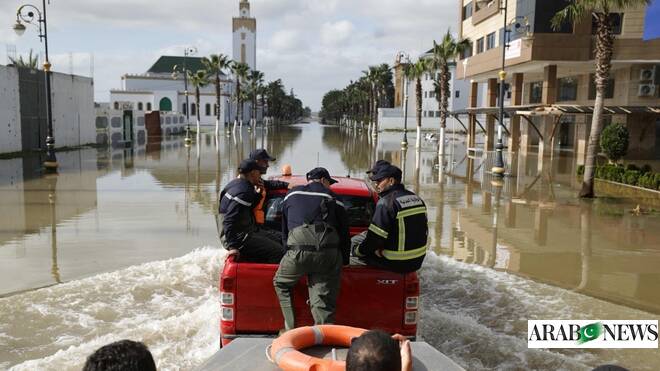
Moroccan authorities have begun a gradual return of residents to flood-hit cities in the country’s northwest, signalling a shift from emergency response to recovery after weeks of exceptional rainfall and dam overflow.
State media reported Monday that most residents of Ksar El Kebir—located about 213 kilometres north of Rabat—have been cleared to return home, except those in a handful of neighbourhoods still considered at risk.
Key Takeaways
- Since early February, authorities, backed by the Moroccan army, have evacuated approximately 188,000 people from vulnerable communities as rising river waters inundated an estimated 110,000 hectares across the northwest.
- The floods were intensified by the release of excess water from the Oued Makhazine Dam, which reached 160% of its storage capacity following exceptional inflows.
- Morocco’s government last week announced a 3 billion dirham ($330 million) recovery and infrastructure upgrade package aimed at supporting flood-affected municipalities.
Since early February, authorities, backed by the Moroccan army, have evacuated approximately 188,000 people from vulnerable communities as rising river waters inundated an estimated 110,000 hectares across the northwest.
Evacuations Ease as Transport Is Offered Free
To facilitate the return, train and bus rides have been made free for residents who had sought shelter with relatives or in temporary camps set up by authorities. The measure underscores a coordinated effort to restore normalcy while limiting further hardship for affected households.
The floods were intensified by the release of excess water from the Oued Makhazine Dam, which reached 160% of its storage capacity following exceptional inflows. Controlled downstream discharges contributed to rising water levels along the Loukous River, submerging Ksar El Kebir and surrounding agricultural plains.
$330 Million Investment Plan
Morocco’s government last week announced a 3 billion dirham ($330 million) recovery and infrastructure upgrade package aimed at supporting flood-affected municipalities. The plan includes assistance for residents, farmers and small business owners in areas officially declared disaster zones.
The investment signals a dual-track approach: immediate economic relief alongside longer-term infrastructure reinforcement to mitigate future climate shocks.
Rainfall Breaks Multi-Year Drought
The deluge marks a dramatic reversal for a country that has grappled with prolonged water stress. Official data show winter rainfall running 35% above the average recorded since the 1990s—and three times higher than last year.
Morocco’s national dam-filling rate has surged to nearly 70%, up from 27% a year earlier. Several major dams were partially emptied to absorb new inflows, reflecting both improved water reserves and the operational risks posed by sudden hydrological surges.

The rainfall effectively ends a seven-year drought that had pushed Morocco to accelerate investments in desalination and alternative water infrastructure.
A Turning Point for Water Policy?
While the immediate focus remains on resettlement and reconstruction, the broader implications are structural. After years of scarcity-driven policy, Morocco now faces the task of managing abundance without compounding flood risks.

For policymakers, the episode underscores the growing volatility of weather patterns in North Africa—where climate extremes are increasingly replacing gradual seasonal cycles.
As residents return to Ksar El Kebir and nearby towns, the challenge shifts from emergency evacuation to rebuilding livelihoods—particularly in agriculture-dependent communities where both drought and floods can erase years of fragile progress.
Source: Accra Street Journal
Last Updated on March 9, 2026 by Samuel Kwame Boadu
Disclaimer: Some content on Accra Street Journal may be aggregated, summarized, or edited from third-party sources for informational purposes. Images and media are used under fair use or royalty-free licenses. Accra Street Journal is a subsidiary of SamBoad Publishing Hub under SamBoad Business Group Ltd, registered in Ghana since 2014.
For concerns or inquiries, please visit our Privacy Policy or Contact Page.

Samuel Kwame Boadu is a Ghanaian media entrepreneur and storyteller with a passion for amplifying urban voices and uncovering everyday truths. He is the Editor-in-Chief and Founder of Accra Street Journal, a dynamic digital platform dedicated to capturing the pulse of Ghana’s capital—its people, culture, challenges, business, sports and innovations.
Use the following reference when citing or referencing this article.
Your feedback helps us improve our journalism.
Report an Error
Help us maintain accuracy. Let our editorial team know if you spot an issue in this article.

Report a problem with this article