



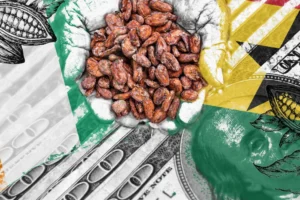





Ghana’s long-held position as the world’s second-largest cocoa producer is under threat, as rising output from Ecuador and Indonesia edges the country closer to third—or even fourth—place in the global rankings. Analysts warn that unless the Ghana Cocoa Board (Cocobod) acts decisively, Ghana could lose its competitive edge within the next two years.

Global Cocoa League Tables
According to data compiled and sighted by Accra Street Journal, Côte d’Ivoire remains the undisputed leader in global cocoa production, supplying about 1.75 million metric tons in the 2024/25 season, nearly 40% of the world’s output.
Ghana follows with an estimated 600,000 metric tons, but Ecuador is rapidly closing in, with projected production of 650,000 metric tons by 2026/27. Indonesia, too, is ramping up output, expected to reach 200,000 metric tons by the same period.
📢 GET A DETAILED ARTICLES + JOBS
Join ASJ's WhatsApp Channel and never miss a post or opportunity.
Ghana’s Struggles
Ghana’s cocoa industry has battled declining yields in recent years. Production fell from 654,000 tons in 2022/23 to 530,000 tons in 2023/24, before recovering slightly to 600,000 tons. Experts point to multiple factors behind the slump:
-
Aging plantations and poor replanting programs.
-
Cocoa swollen shoot virus disease (CSSVD), which continues to devastate farms.
-
Illegal mining (galamsey), where cocoa farms are destroyed in search of gold.
-
Unpredictable weather linked to climate change.
The economic frustrations of farmers add to the crisis. Ghanaian cocoa farmers typically receive around 70% of the global market price, compared to their peers in Ecuador, who earn up to 90%. The disparity discourages reinvestment in farms, leaving smallholders unable to afford improved seedlings, fertilizers, or modern farming practices.
Ecuador and Indonesia on the Rise
Ecuador’s cocoa renaissance has been fueled by public and private investment, higher farmgate prices, and innovative agroforestry systems, which integrate cocoa with shade trees, plantains, and other crops. This approach reduces disease risks, protects biodiversity, and delivers yields averaging 800 kilograms per hectare—well above the 500 kilograms typical in West Africa.
Indonesia, meanwhile, has steadily expanded its cocoa industry, particularly on Sulawesi Island. Output rose from 160,000 tons in 2023/24 to about 200,000 tons in 2025/26, positioning the country as a growing force in the sector.
Prices and Opportunities
Global cocoa prices spiked above $12,000 per ton last year after disease outbreaks and weak harvests in West Africa. Though prices have since dropped by about a third, they remain historically high. For Ghana, this creates both a challenge and an opportunity: higher prices could support farmers if Cocobod reforms farmgate policies, but persistent underperformance risks long-term decline.
The Way Forward
Industry experts say Ghana must take bold steps to protect its place in the global cocoa market. These include:
-
Scaling up replanting of diseased and aging farms.
-
Improving farmgate prices to incentivize production.
-
Strengthening extension services and access to inputs.
-
Cracking down on illegal mining that threatens cocoa lands.
Without such reforms, Ghana could slip behind Ecuador within two years—and may even face competition from Indonesia not far beyond. As global demand continues to rise, the stakes for Ghana’s cocoa future have never been higher.
Source: Accra Street Journal
Last Updated on March 9, 2026 by Samuel Kwame Boadu
Disclaimer: Some content on Accra Street Journal may be aggregated, summarized, or edited from third-party sources for informational purposes. Images and media are used under fair use or royalty-free licenses. Accra Street Journal is a subsidiary of SamBoad Publishing Hub under SamBoad Business Group Ltd, registered in Ghana since 2014.
For concerns or inquiries, please visit our Privacy Policy or Contact Page.

Samuel Kwame Boadu is a Ghanaian media entrepreneur and storyteller with a passion for amplifying urban voices and uncovering everyday truths. He is the Editor-in-Chief and Founder of Accra Street Journal, a dynamic digital platform dedicated to capturing the pulse of Ghana’s capital—its people, culture, challenges, business, sports and innovations.