







Introduction
Traffic in Accra is often discussed in broad terms—rush hour, congestion, gridlock—but few locations capture the reality of the city’s mobility challenges as clearly as Madina Zongo Junction. This junction is not only busy; it is predictably busy, shaped by daily routines, economic activity, and the movement of people across eastern Accra.
Understanding traffic patterns and peak hours at Madina Zongo Junction is essential for commuters, transport operators, urban planners, and businesses operating around Madina. The junction’s congestion is not random—it follows a rhythm tied closely to how Accra works.

Why Madina Zongo Junction Is a Traffic Hotspot
Madina Zongo Junction sits at the intersection of multiple high-demand routes. It connects:
📢 GET A DETAILED ARTICLES + JOBS
Join ASJ's WhatsApp Channel and never miss a post or opportunity.

-
Inner Accra to Adenta and the Eastern Corridor
-
Residential communities to commercial and educational zones
-
Informal markets to major transport lines
This makes it a convergence point for:
-
Students heading toward Legon and surrounding institutions
-
Traders transporting goods
-
Residents accessing daily services
Unlike purpose-built interchanges, Madina Zongo Junction evolved organically. As traffic volumes increased over time, the junction absorbed pressure without proportional upgrades, creating persistent congestion.

Morning Peak Hours: 5:30 AM – 9:30 AM
The morning rush is the most intense traffic period at Madina Zongo Junction.
What Happens in the Morning
-
Heavy inbound traffic toward Accra’s central business areas
-
Trotros loading and offloading simultaneously
-
High pedestrian crossings
-
School and university traffic adding pressure
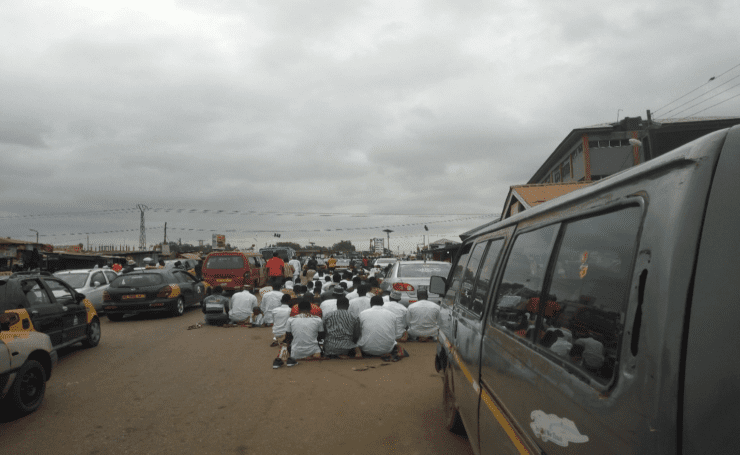
Between 6:30 AM and 8:30 AM, traffic slows significantly. Vehicles coming from Adenta and surrounding suburbs queue through the junction, while inner Madina traffic attempts to merge outward.
Key Causes
-
High commuter volume
-
Informal loading points at the junction
-
Limited lane discipline
-
Pedestrian crossings without signals
For many commuters, a journey that should take five minutes can stretch to twenty or more during this window.
Midday Traffic Flow: 10:00 AM – 2:30 PM
Midday traffic at Madina Zongo Junction is comparatively lighter but still active.
Traffic Characteristics
-
Reduced commuter pressure
-
Increased commercial activity
-
Delivery vehicles stopping near the junction
-
Traders occupying roadside space
Traffic moves more freely, but interruptions are frequent. Hawkers, parked vehicles, and short stops by taxis create intermittent slowdowns.
This period is often the most manageable for motorists who can choose flexible travel times.
Evening Peak Hours: 3:30 PM – 8:00 PM
The evening rush rivals the morning peak in volume and complexity.
What Defines the Evening Congestion
-
Outbound traffic toward Adenta and residential areas
-
Return of workers and traders
-
School dismissal traffic
-
Increased roadside trading
The heaviest congestion usually occurs between 5:00 PM and 7:00 PM. At this time, opposing traffic flows compete aggressively for limited road space, and fatigue increases driver impatience.
Even minor incidents—broken-down vehicles or sudden rain—can trigger long delays.

Night Traffic: After 8:00 PM
After 8:00 PM, traffic volumes decline sharply.
Night-Time Conditions
-
Freer vehicle movement
-
Reduced pedestrian activity
-
Continued presence of night traders and food vendors
However, poor lighting and occasional reckless driving introduce safety risks, especially for pedestrians crossing the junction.
Weekly and Monthly Traffic Variations
Traffic at Madina Zongo Junction is not static throughout the week.
Weekdays
-
Heaviest congestion due to work and school schedules
Weekends
-
Slightly reduced morning pressure
-
Increased afternoon and evening movement due to shopping, social events, and religious activities
End-of-Month Traffic
-
Increased movement tied to salary payments, shopping, and travel
Rainy days also significantly worsen congestion due to flooding and reduced road visibility.
The Role of Informal Transport Practices
A defining feature of traffic at Madina Zongo Junction is informal transport behaviour.
These include:
-
Trotros stopping anywhere to pick passengers
-
Drivers creating unofficial turning points
-
Pedestrians crossing without designated signals
While these practices support livelihoods and accessibility, they also reduce traffic efficiency and safety.
Why Traffic Persists Despite Awareness
Traffic congestion at Madina Zongo Junction persists not because it is misunderstood, but because it reflects deeper structural realities:
-
Rapid urban population growth
-
Limited road expansion
-
Dependence on informal transport systems
-
Weak enforcement of traffic regulations
Any attempt to “solve” congestion without addressing these factors is unlikely to succeed.
Economic Cost of Congestion
Traffic delays at Madina Zongo Junction have real economic consequences:
-
Lost productive hours
-
Increased fuel consumption
-
Stress and health impacts
-
Higher transport costs passed to consumers
For small traders and daily wage earners, even short delays can affect income.
Conclusion From ASJ
Traffic patterns at Madina Zongo Junction follow a predictable daily rhythm shaped by work, trade, and movement across Accra. Morning and evening peak hours remain the most congested, while midday offers relative relief.
The junction’s traffic challenges are not merely logistical—they are social and economic. Understanding these patterns is essential for commuters and policymakers alike. Any sustainable improvement must recognise how people actually use the junction, not just how it appears on traffic plans.
Madina Zongo Junction remains a powerful example of how Accra moves—and why managing that movement is one of the city’s greatest urban challenges.
Frequently Asked Questions (FAQs)
What time is traffic worst at Madina Zongo Junction?
Traffic is heaviest between 6:30–8:30 AM and 5:00–7:00 PM.
Is weekend traffic lighter at the junction?
Mornings are usually lighter, but afternoons and evenings can still be busy.
Does rain affect traffic at Madina Zongo Junction?
Yes. Rain significantly worsens congestion due to flooding and slower vehicle movement.
Why do trotros stop anywhere at the junction?
Informal transport practices prioritise passenger access but reduce traffic efficiency.
Can traffic at Madina Zongo Junction be permanently fixed?
Only through integrated solutions that balance transport flow, livelihoods, enforcement, and infrastructure.
Source: https://accrastreetjournal.com/
Last Updated on January 30, 2026 by Samuel Kwame Boadu
Disclaimer: Some content on Accra Street Journal may be aggregated, summarized, or edited from third-party sources for informational purposes. Images and media are used under fair use or royalty-free licenses. Accra Street Journal is a subsidiary of SamBoad Publishing Hub under SamBoad Business Group Ltd, registered in Ghana since 2014.
For concerns or inquiries, please visit our Privacy Policy or Contact Page.

Samuel Kwame Boadu is a Ghanaian media entrepreneur and storyteller with a passion for amplifying urban voices and uncovering everyday truths. He is the Editor-in-Chief and Founder of Accra Street Journal, a dynamic digital platform dedicated to capturing the pulse of Ghana’s capital—its people, culture, challenges, business, sports and innovations.