







4 min read
Ghana’s Minority Caucus in Parliament has introduced a Private Member’s Bill aimed at tightening fiscal discipline and reasserting the primacy of long-term development planning in the national budget process.
The proposed Public Financial Management (Amendment) Bill, 2026 seeks to recalibrate Ghana’s expenditure framework by binding annual budgets more strictly to development plans approved by the National Development Planning Commission (NDPC).
Key Takeaways
- Ghana’s Minority Caucus in Parliament has introduced a Private Member’s Bill aimed at tightening fiscal discipline and reasserting the primacy of long-term development planning in the national budget process.
- The proposed Public Financial Management (Amendment) Bill, 2026 seeks to recalibrate Ghana’s expenditure framework by binding annual budgets more strictly to development plans approved by the National Development Planning Commission (NDPC).
- Analysts say that misalignment between development plans and budget execution has historically weakened public financial management systems, creating room for ad hoc allocations and politically driven spending.
At its core, the legislation reflects a broader concern: that fiscal slippages and politically motivated spending have undermined both macroeconomic stability and investor confidence.
Aligning Budgets with National Plans
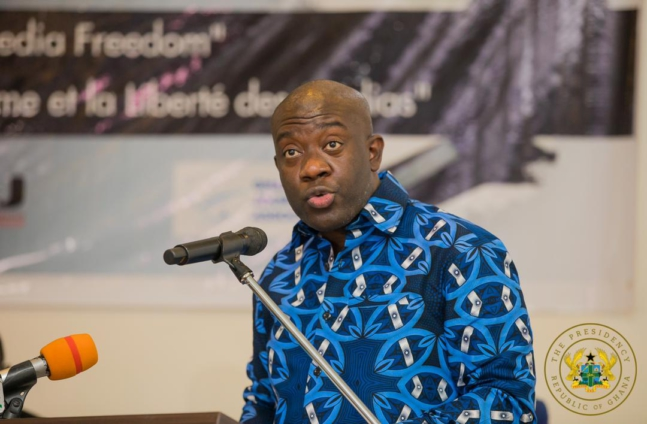
Speaking at a stakeholder engagement in Accra, Kojo Oppong Nkrumah, Ranking Member on Parliament’s Economy and Development Committee and sponsor of the Bill, argued that the amendment would restore coherence between planning and spending.
Under the proposal, the Minister for Finance — currently Cassiel Ato Forson — would be prohibited from releasing funds to Ministries, Departments and Agencies (MDAs) and Metropolitan, Municipal and District Assemblies (MMDAs) for projects not embedded in NDPC-certified development plans.
The intention, Mr. Oppong Nkrumah said, is not to stifle legitimate emergency spending, but to curb routine expenditure that bypasses established development frameworks.
“This amendment seeks to deny funding for regular programmes and projects that are not certified as part of the NDPC’s approved development plans,” he explained, emphasizing that only properly incorporated and certified projects would qualify for budget allocations.
Addressing Fiscal Credibility
The timing of the proposal is significant. Ghana continues to consolidate its fiscal position following recent debt restructuring and macroeconomic instability. In that context, expenditure discipline has become a central theme in restoring both domestic and international confidence.
Analysts say that misalignment between development plans and budget execution has historically weakened public financial management systems, creating room for ad hoc allocations and politically driven spending.
By making NDPC approval a statutory precondition for funding, the amendment aims to narrow discretionary latitude and enhance predictability in public spending.
Strengthening Transparency and Accountability
According to Camillo Pwamang, Deputy Clerk to Parliament in charge of Legislative Management Services, the amendment would introduce additional accountability mechanisms.

These include requiring the publication of annual development progress reports before expenditure warrants are issued. In practical terms, this would mean that reporting on implementation performance becomes a prerequisite for accessing new public funds.
Mr. Ebenezer Ahumah Djietror, Clerk to Parliament, also urged stakeholders to prioritize coherence between Ghana’s annual budgets and its long-term constitutional development aspirations, particularly those outlined in Chapter Six of the Constitution.

The shift would embed monitoring and evaluation more deeply within the budget cycle, reinforcing transparency and reducing opacity in fund releases.
Implications for Investors and Credit Markets
From a macroeconomic perspective, the proposed amendment carries potential implications beyond Parliament.
Greater expenditure discipline and improved alignment between planning and budgeting could enhance Ghana’s fiscal credibility — a key variable for sovereign credit assessments, donor relations and private-sector investment sentiment.
Markets tend to reward predictability. A framework that limits off-plan spending and mandates progress reporting may be interpreted as a signal of institutional strengthening.
However, legislative reform alone does not guarantee compliance. Effective enforcement and political will remain decisive factors in translating statutory controls into tangible fiscal outcomes.
Political Context and Broader Debate
The Bill arrives amid broader debate over revenue mobilization and tax policy adjustments. Critics have argued that tax rollbacks and expenditure pressures can weaken long-term fiscal sustainability if not offset by disciplined spending controls.
By focusing on the expenditure side of the equation, the Minority’s proposal seeks to address what it characterizes as structural weaknesses in budget execution.
Whether the amendment garners bipartisan support will shape its prospects. As a Private Member’s Bill, it will undergo consultations before formal debate in Parliament.
A Test of Institutional Reform
If enacted, the amendment would mark a significant recalibration of Ghana’s public financial management architecture. By tethering spending more tightly to NDPC-approved plans and conditioning fund releases on transparent reporting, the reform attempts to restore coherence between vision and execution.
For Ghana’s economy, the stakes are considerable. In an era where investor confidence hinges on fiscal credibility and governance standards, institutional reforms that reinforce accountability can influence both domestic stability and international perception.

The Bill now moves into a consultative phase. Its progress through Parliament will signal how committed Ghana’s political establishment is to embedding fiscal discipline within the architecture of economic governance.
At a time when macroeconomic recovery remains fragile, the effort to bind budgets more closely to development priorities may prove as consequential as any revenue measure.
Source: Accra Street Journal
Last Updated on March 3, 2026 by Samuel Kwame Boadu
Disclaimer: Some content on Accra Street Journal may be aggregated, summarized, or edited from third-party sources for informational purposes. Images and media are used under fair use or royalty-free licenses. Accra Street Journal is a subsidiary of SamBoad Publishing Hub under SamBoad Business Group Ltd, registered in Ghana since 2014.
For concerns or inquiries, please visit our Privacy Policy or Contact Page.

Samuel Kwame Boadu is a Ghanaian media entrepreneur and storyteller with a passion for amplifying urban voices and uncovering everyday truths. He is the Editor-in-Chief and Founder of Accra Street Journal, a dynamic digital platform dedicated to capturing the pulse of Ghana’s capital—its people, culture, challenges, business, sports and innovations.
Use the following reference when citing or referencing this article.
Your feedback helps us improve our journalism.
Report an Error
Help us maintain accuracy. Let our editorial team know if you spot an issue in this article.
Report a problem with this article