



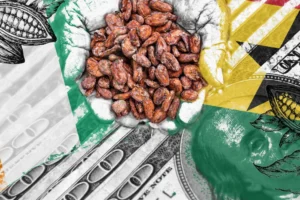



Ghana stands to lose over $1 billion in export revenue if a proposed 10% U.S. import tariff is implemented, a move analysts say would disproportionately affect Ghana’s top exporters and force a strategic reassessment of the country’s trade posture with the United States.
While the policy remains under consideration — a hallmark of the Trump administration’s renewed protectionist agenda — its mere possibility has sent ripples through Ghana’s manufacturing and export sectors. At a breakfast meeting organized by the Association of Ghana Industries (AGI), economist Dr. Abudu Abdul Ganiyu, Senior Partner at EM Advisory, warned that the long-term impact of the tariff could be “far more severe than it appears at face value.”

“If the 10 percent tariff stays, Ghana could suffer over $1 billion in losses over five years,” said Dr. Ganiyu in remarks obtained by Accra Street Journal. “It may seem marginal in macro terms, but when you zoom in on affected firms, the damage is real — and immediate.”
📢 GET A DETAILED ARTICLES + JOBS
Join ASJ's WhatsApp Channel and never miss a post or opportunity.
📲 Join ASJ Channel Now
A 10% Tariff with Outsized Effects
The proposed tariff, although comparatively modest against the broader sweep of American trade levies — some as high as 50% — would undermine the profitability of Ghanaian exporters in key sectors such as cocoa derivatives, textiles, agro-processing, and light manufacturing.
Dr. Ganiyu noted that U.S.-bound exporters could see as much as 20% in revenue decline as price sensitivity and supply chain friction impact demand. Ghana, which has historically enjoyed relatively favorable U.S. trade terms, finds itself caught in the crosswinds of a shifting geopolitical economy.
“Even a 10% price bump at U.S. retail shelves can lead to substantial customer drop-offs,” Ganiyu said. “This tariff, if enforced, could upend long-standing trade flows.”
Strategic Countermeasures: From Price Adjustments to Market Diversification
In response, Ganiyu proposed three short- and medium-term interventions for Ghanaian exporters:

-
Pre-shipment Price Cuts: Exporters could marginally lower prices at origin to buffer the effect of tariffs without compromising customer affordability in the U.S. market.
-
Burden Sharing: Companies should renegotiate supply agreements that allow shared absorption of the tariff — with exporters and U.S. importers each bearing a portion of the cost.
-
Market Diversification: With China now ramping up zero-tariff incentives for African imports, exporters should fast-track entry into alternative markets across Asia and Latin America.
“This is the moment to leverage trade ties beyond the U.S.,” Ganiyu said. “China’s zero-tariff policy opens up a critical lifeline, especially for SMEs.”
A Test for Ghana’s Trade Resilience
The timing is critical. Ghana is navigating a fragile recovery, working to rebuild buffers post-debt restructuring, and positioning itself as a value-added exporter under AfCFTA.
A hit to its U.S. market access could have spillover effects on employment, foreign exchange earnings, and investor confidence.
“It’s not just about trade,” Accra Street Journal analysis notes. “It’s about Ghana’s broader positioning in a bifurcating global economy — one where traditional allies are tightening, and new partners are incentivizing.”
Last Updated on June 19, 2025 by
Disclaimer: Some content on Accra Street Journal may be aggregated, summarized, or edited from third-party sources for informational purposes. Images and media are used under fair use or royalty-free licenses. Accra Street Journal is a subsidiary of SamBoad Publishing Hub under SamBoad Business Group Ltd, registered in Ghana since 2014.
For concerns or inquiries, please visit our Privacy Policy or Contact Page.

Samuel Kwame Boadu is a Ghanaian media entrepreneur and storyteller with a passion for amplifying urban voices and uncovering everyday truths. He is the Editor-in-Chief and Founder of Accra Street Journal, a dynamic digital platform dedicated to capturing the pulse of Ghana’s capital—its people, culture, challenges, business, sports and innovations.