
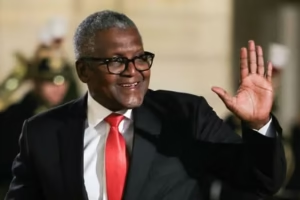



Africa’s richest man, Aliko Dangote, is expanding his empire beyond manufacturing and refining by investing billions of dollars into a fleet of electric and CNG-powered trucks. The initiative positions the Dangote Group at the center of Africa’s clean energy transition and signals a bold reimagining of logistics across Nigeria.
The announcement came during the official rollout of Compressed Natural Gas (CNG) trucks tied to the group’s $20 billion Lagos refinery. Dangote revealed that the conglomerate is preparing to import thousands of electric trucks as part of a logistics overhaul designed to cut costs, reduce emissions, and safeguard refinery operations.

“You cannot tell me to keep using these old trucks,” Dangote said. “If there is an accident, you want to come and say sorry — we have to safeguard our own investment.”
📢 GET A DETAILED ARTICLES + JOBS
Join ASJ's WhatsApp Channel and never miss a post or opportunity.
📲 Join ASJ Channel Now
From Old Fuel Trucks to Electric Fleets
Dangote has already committed ₦720 billion (approximately $480 million) toward purchasing 4,000 CNG trucks from China. Around 1,000 vehicles have already arrived, with the remainder expected in batches through early 2026.
The trucks will deliver refined products from the Lagos refinery directly to filling stations nationwide, reducing reliance on third-party transport and eliminating risks associated with outdated fleets.
The billionaire confirmed that electric trucks are next on the horizon, noting that long-term cost efficiency and safety will outweigh the challenges of Nigeria’s limited charging infrastructure.
“Things have changed, and all of us will have to keep changing because if not, you will become archaic,” Dangote emphasized.
Africa’s EV Market: Promise and Pitfalls
The electric mobility market in Africa remains nascent. According to the International Energy Agency, EVs account for less than 1% of vehicle sales on the continent, compared with 18% globally.
-
Kenya, Rwanda, and South Africa are leading adoption with electric buses and motorbikes.
-
Nigeria’s infrastructure gaps — from power shortages to charging deficits — remain significant hurdles.
-
Africa holds critical minerals like cobalt (DRC) and lithium (Zimbabwe), offering long-term advantages for EV battery supply chains.
Analysts argue that Dangote’s move could serve as a catalyst for private sector investment, pressuring governments and financiers to accelerate EV infrastructure development.
Diversification Beyond Refining
The electric truck initiative underscores Dangote’s broader diversification strategy. His portfolio already spans cement, fertilizers, sugar, salt, and oil refining. With the Lagos refinery now the crown jewel of his empire, Dangote appears determined to extend influence into transportation and clean energy.
The effort could also enhance Nigeria’s competitiveness in the global EV value chain while reducing the risks associated with an over-reliance on fuel-based logistics.
FAQs
1. What is Aliko Dangote’s new project outside manufacturing?
He is investing in a fleet of electric and CNG-powered trucks to modernize the Dangote Group’s logistics network.
2. How much has Dangote committed to this initiative?
He has allocated ₦720 billion ($480 million) for 4,000 CNG trucks, with plans to scale into electric trucks.
3. Why is Dangote replacing fuel trucks?
Outdated trucks pose safety risks to refinery operations. Dangote is upgrading to ensure reliability, efficiency, and environmental compliance.
4. Is Africa ready for electric trucks?
Infrastructure remains limited, but Dangote argues that costs and efficiency will drive adoption. He cited a European example where charging a Tesla cost just €20 for nearly 500 km of range.
5. What impact could this have on Africa’s EV market?
Dangote’s entry could act as a catalyst for large-scale investment, signaling to policymakers and financiers that EV infrastructure in Africa is commercially viable.
Source: Accra Street Journal
Last Updated on April 26, 2026 by Samuel Kwame Boadu
Disclaimer: Some content on Accra Street Journal may be aggregated, summarized, or edited from third-party sources for informational purposes. Images and media are used under fair use or royalty-free licenses. Accra Street Journal is a subsidiary of SamBoad Publishing Hub under SamBoad Business Group Ltd, registered in Ghana since 2014.
For concerns or inquiries, please visit our Privacy Policy or Contact Page.

Samuel Kwame Boadu is a Ghanaian media entrepreneur and storyteller with a passion for amplifying urban voices and uncovering everyday truths. He is the Editor-in-Chief and Founder of Accra Street Journal, a dynamic digital platform dedicated to capturing the pulse of Ghana’s capital—its people, culture, challenges, business, sports and innovations.