








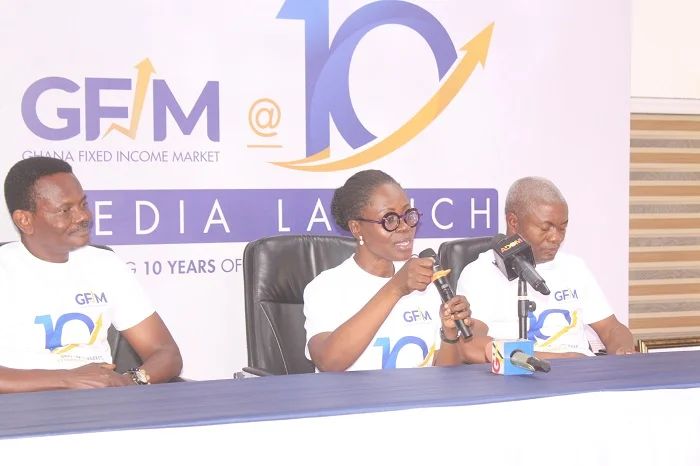

Ghana’s capital markets continue to demonstrate remarkable resilience as the Ghana Fixed Income Market (GFIM) records a landmark GH¢214 billion in trading volumes by October 2025—an achievement that has rekindled investor confidence and reaffirmed Ghana’s position as a strong emerging market hub for fixed income securities. The announcement was made by Ms Abena Amoah, Managing Director of the Ghana Stock Exchange (GSE), during the 10th Anniversary Celebration of GFIM in Accra.

The surge in activity marks a major milestone in the recovery of Ghana’s fixed income landscape following the disruptions caused by the 2023 Domestic Debt Exchange Programme (DDEP). Once the shockwaves of the DDEP subsided, investors, government institutions, policymakers, and market operators worked collectively to restore stability. Today, GFIM stands as one of the fastest-growing bond markets on the African continent.
A Decade of Growth: From GH¢5.2 Billion to GH¢214 Billion
In her address, Ms Amoah traced the growth trajectory of GFIM, which began in 2015 with a modest GH¢5.2 billion in traded volume. By 2022, volumes reached GH¢230 billion—a staggering 4,300 percent increase within seven years.
📢 GET A DETAILED ARTICLES + JOBS
Join ASJ's WhatsApp Channel and never miss a post or opportunity.
However, the momentum was disrupted in 2023 when the DDEP triggered a sharp decline to GH¢98 billion as investors reevaluated risk, liquidity, and long-term stability. Yet the drop did not mark the end of the GFIM story. The market began rebounding sharply in 2024 with a 76 percent rise to GH¢174 billion, and has now surged to GH¢214 billion by October 2025.
“This is more than recovery,” Ms Amoah emphasized. “It is a testament to strong market fundamentals and investor trust.”
She further noted that every bond traded on GFIM represents a real link to Ghana’s economic development:
“Every transaction tells a story of roads built, factories financed, and businesses sustained. Through GFIM, we are financing Ghana’s future.”
GFIM’s Growing Role in National Development
Beyond its trading numbers, the GFIM has become an indispensable platform for government financing—providing long-term capital for infrastructure, public sector investment, and debt management—as well as an essential space for private-sector funding.
GFIM supports financing across:
-
Roads, bridges, and public infrastructure
-
Corporate expansion
-
Housing development
-
Industrial and manufacturing growth
-
SME credit access
Through this ecosystem, Ghana’s fixed income market is directly tied to economic growth, job creation, and financial sector stability.
The Digital and Regulatory Reforms Driving Growth
One of the major drivers behind the renewed investor confidence has been the modernization of Ghana’s trading infrastructure. The GSE has rolled out advanced electronic trading systems that have enhanced speed, transparency, accuracy, and data integrity.
Additionally, the introduction of diversified products—including corporate bonds, commercial paper, Green and Sustainable Bonds, and structured debt products—has broadened investor options.
To reinforce the credibility of the market, regulatory oversight has also been strengthened. This includes improved disclosure requirements, enhanced reporting standards, supervised market conduct, and tighter risk management rules across all operators.
The reforms, according to Ms Amoah, have helped both domestic and foreign investors regain trust in Ghana’s markets and have attracted new institutional capital.
Calls to List Viable SOEs and Broaden Market Participation
Looking ahead, Ms Amoah believes the next step in Ghana’s capital market evolution should be the listing of viable State-Owned Enterprises (SOEs) on the GFIM and the GSE equity market.
She explained that government must give Cabinet approval for these listings, as listing SOEs could:
-
Improve corporate governance
-
Open new investment opportunities
-
Reduce fiscal pressure on government
-
Increase transparency
-
Provide long-term financing for state-owned industries
The Managing Director also advocated for several strategic reforms such as:
-
Bond-backed public-private partnerships (PPPs) for infrastructure
-
Municipal bonds for local government financing
-
Incentives for multinational companies to list on the GSE
-
Restoring zero capital gains tax on listed securities
These measures, she argued, would unlock long-term capital and strengthen Ghana’s position as an investment destination.
Government Leadership and Policy Direction
Representing the Minister for Finance, Dr Cassiel Ato Forson acknowledged the deep impact of GFIM on Ghana’s economic stability and public debt management. He emphasized that Ghana’s fixed income market remains central to:
-
Transparent borrowing
-
Liquidity management
-
Strengthening investor confidence
-
Enabling private-sector financing
-
Supporting foreign investment inflows
According to Dr Forson, the government remains committed to restoring macroeconomic stability through fiscal consolidation, sustainable revenue generation, and strict expenditure management.
He reiterated that the Ministry of Finance will continue collaborating with the GSE, Bank of Ghana, and other stakeholders to harmonize regulations with international standards, deepen financial innovation, and improve market access for investors.
Driving ESG, Climate Finance, and Product Innovation
The Finance Minister also urged regulators and operators to integrate environmental, social, and governance (ESG) principles across market operations. This includes structuring bonds that support:
-
Climate transition efforts
-
Renewable energy projects
-
Affordable housing
These sectors are expected to become major pillars of Ghana’s long-term financing strategy.
A Capital Market Positioned for Transformation
As GFIM enters its second decade, its evolution is becoming increasingly central to Ghana’s economic transformation agenda. The surge in bond trading volumes, technological advancements, diversified debt instruments, and strengthened regulations collectively represent a matured and confident market.
The strong rebound from the DDEP crisis demonstrates that Ghana’s financial system is capable of adapting, rebuilding, and accelerating even in the face of turbulence.
With investor confidence restored, new financing windows emerging, and ambitious plans to list SOEs and expand financial products, Ghana’s fixed income market is poised for sustained growth.
The journey from GH¢5.2 billion in 2015 to GH¢214 billion in 2025 is not just numerical progress—it is a story of resilience, innovation, and national development.
FAQs
1. What is GFIM and why is it important?
GFIM is Ghana’s official platform for trading government and corporate bonds. It supports government financing, private-sector investment, and long-term economic growth.
2. Why did GFIM volumes fall in 2023?
The Domestic Debt Exchange Programme disrupted investor confidence and liquidity, leading to reduced trading activity.
3. What has driven the recovery to GH¢214 billion?
Digital reforms, diversified investment products, strengthened regulatory oversight, and renewed investor trust.
4. Why is the GSE pushing for SOEs to be listed?
Listing SOEs improves transparency, strengthens corporate governance, and allows companies to raise long-term capital.
5. How is government supporting the fixed income market?
Through fiscal consolidation, improved debt management, collaboration with the GSE and BoG, and policies that align with global best practices.
6. What new products have been introduced on GFIM?
Corporate bonds, commercial paper, and Green & Sustainable Bonds.
7. How does GFIM support infrastructure financing?
By providing a platform for long-term bonds used to fund roads, energy projects, housing, and public infrastructure.
Source: Accra Street Journal
Last Updated on March 9, 2026 by Samuel Kwame Boadu
Disclaimer: Some content on Accra Street Journal may be aggregated, summarized, or edited from third-party sources for informational purposes. Images and media are used under fair use or royalty-free licenses. Accra Street Journal is a subsidiary of SamBoad Publishing Hub under SamBoad Business Group Ltd, registered in Ghana since 2014.
For concerns or inquiries, please visit our Privacy Policy or Contact Page.

Samuel Kwame Boadu is a Ghanaian media entrepreneur and storyteller with a passion for amplifying urban voices and uncovering everyday truths. He is the Editor-in-Chief and Founder of Accra Street Journal, a dynamic digital platform dedicated to capturing the pulse of Ghana’s capital—its people, culture, challenges, business, sports and innovations.