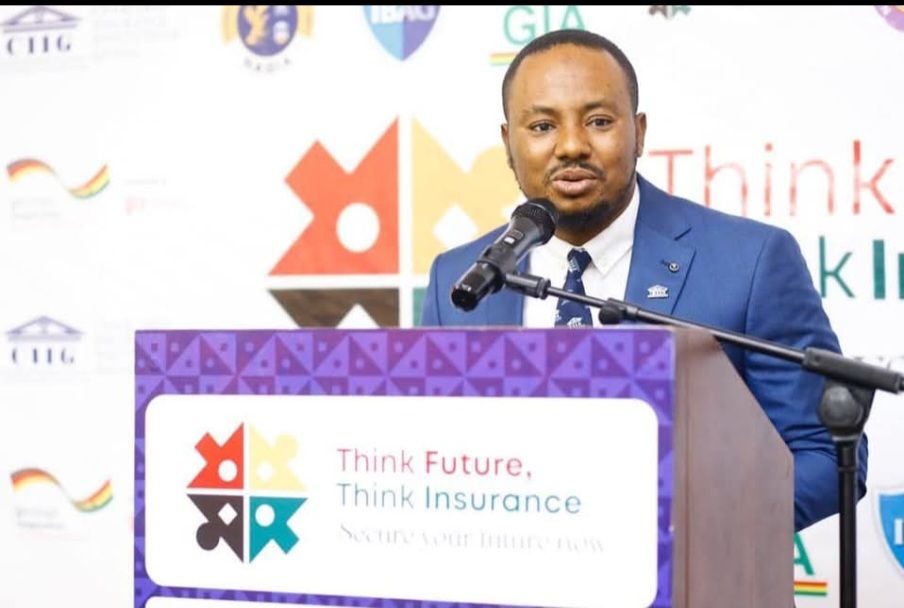
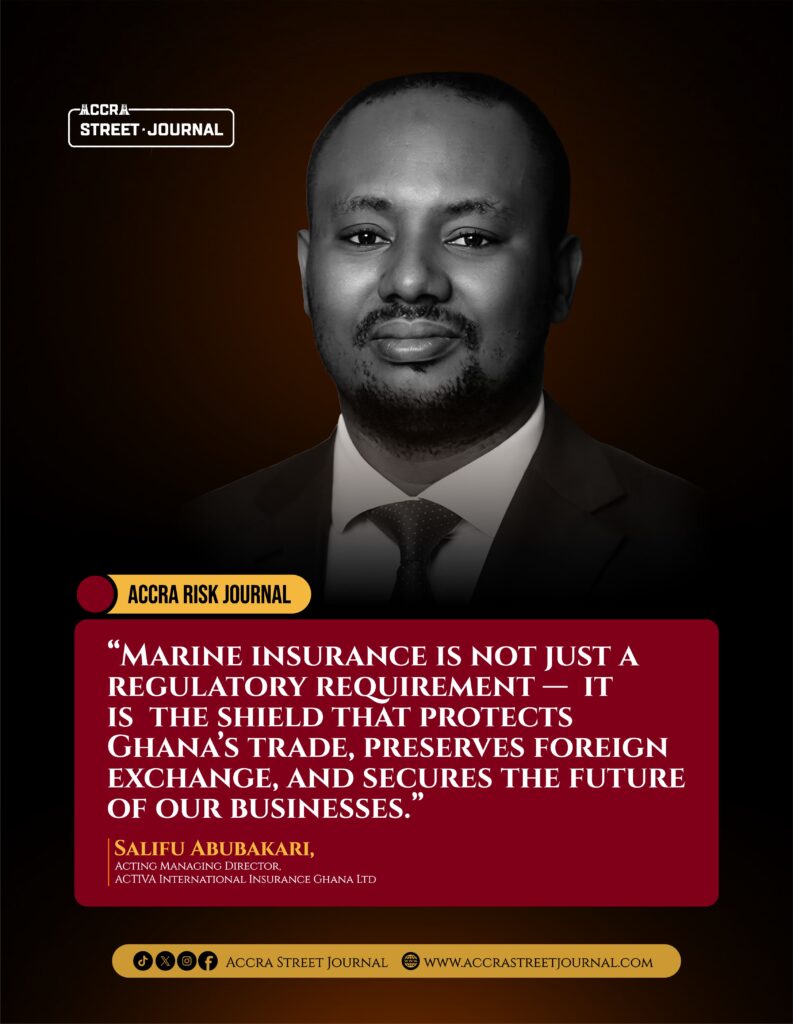
Accra — Ghana’s renewed enforcement of mandatory local marine insurance is a strategic economic reform designed to strengthen trade resilience, retain foreign exchange and deepen domestic underwriting capacity, according to Salifu Abubakari, Acting Managing Director of ACTIVA International Insurance Ghana.
In an interview with Accra Street Journal, Mr. Abubakari described the directive not as a mere compliance measure, but as a structural adjustment intended to reposition Ghana’s insurance industry as a pillar of national development.
“Marine insurance is no longer just a regulatory obligation,” he said. “It is an economic safeguard. Every container that enters Ghana represents capital, employment and business continuity. Protecting that capital locally is a matter of national interest.”
📢 GET A DETAILED ARTICLES + JOBS
Join ASJ's WhatsApp Channel and never miss a post or opportunity.
Under the policy, imports—excluding personal effects and certain humanitarian consignments—must be insured by locally licensed firms. Industry estimates suggest more than GH₵300 million in annual premiums could be retained domestically with full enforcement.
Mr. Abubakari said the implications extend beyond revenue.
“When premiums are retained locally, we build underwriting strength, create jobs, enhance technical expertise and improve claims-paying capacity. It reinforces the broader financial ecosystem.”
Marine insurance typically shields importers and exporters from risks such as fire, collision, sinking, theft and other transit-related losses—exposures that have grown more complex amid increasingly interconnected global supply chains.
Building Domestic Capacity
Marine coverage in Ghana spans cargo insurance—often structured on a warehouse-to-warehouse basis—hull insurance for vessels and machinery, and liability policies covering third-party obligations. Businesses may arrange open cover policies for recurring shipments or specific voyage policies for one-off consignments.
As enforcement tightens, some businesses have called for transitional grace periods. Mr. Abubakari acknowledged adjustment concerns but said the direction of policy is clear.
“The objective is protection, not punishment,” he said. “The framework ensures Ghana develops its own capacity rather than exporting premium income abroad.”
Mr. Abubakari argued that ACTIVA International Insurance Ghana’s multinational footprint gives it an advantage in managing cross-border exposures inherent in marine insurance.
“Shipping is international by nature,” he said. “Cargo originates in one country and terminates in another. Our presence across African markets and international partnerships strengthens our technical and reinsurance capacity.”
Strong reinsurance support, he noted, is essential given the high values often attached to marine consignments. “Clients need confidence that when losses occur, claims will be settled promptly and fully.”
Beyond Compliance
He cautioned against reducing marine insurance to a customs clearance formality.
“True marine insurance involves understanding logistics chains, clarifying Incoterms, structuring appropriate coverage and ensuring documentation integrity. It is a risk partnership, not a paper transaction.”
ACTIVA International Insurance Ghana, he said, is investing in technical training and digital systems to improve underwriting precision and claims management efficiency.
Aligning With AfCFTA Ambitions
Looking ahead, Mr. Abubakari linked marine insurance reform to Ghana’s ambitions under the African Continental Free Trade Area.
“As intra-African trade expands, marine risk exposure will increase. Building strong domestic insurance capacity now is essential for long-term resilience,” he said.
He emphasized the need for alignment among regulators, insurers, shipping operators and importers. “When oversight, protection and compliance work together, the entire economy benefits.”
Confidence Through Protection
For ACTIVA International Insurance Ghana, the reform represents both responsibility and opportunity.
“We see ourselves not simply as insurers, but as partners in Ghana’s economic stability and expansion,” Mr. Abubakari said.
As enforcement gathers pace, industry observers say the coming years may redefine the role of domestic insurers in safeguarding Ghana’s international commerce—shifting marine insurance from procedural necessity to strategic economic instrument.
Mandatory Local Marine Insurance Is Strategic Reform – Salifu Abubakari
✅ Others are getting FREE JOBS + TIPS on our WhatsApp channel. Join now!
Disclaimer: Some content on Accra Street Journal may be aggregated, summarized, or edited from third-party sources for informational purposes. Images and media are used under fair use or royalty-free licenses. Accra Street Journal is a subsidiary of SamBoad Publishing Hub under SamBoad Business Group Ltd, registered in Ghana since 2014.
Samuel Kwame Boadu is a Ghanaian media entrepreneur and storyteller with a passion for amplifying urban voices and uncovering everyday truths. He is the Editor-in-Chief and Founder of Accra Street Journal, a dynamic digital platform dedicated to capturing the pulse of Ghana’s capital—its people, culture, challenges, business, sports and innovations.