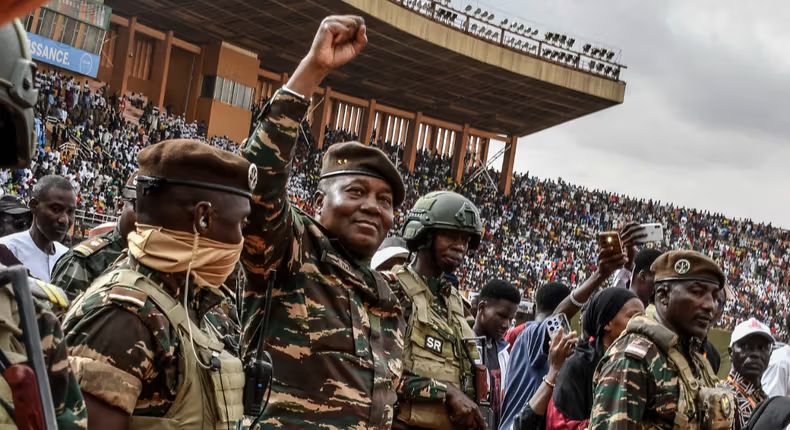
The military government of Niger has revoked gold mining concessions held by three companies as part of a broader effort to strengthen state control over the country’s natural resources following the 2023 Niger coup d’état.
According to reports reviewed by the Accra Street Journal (ASJ), the government cancelled concessions previously granted to mining firms Comini, Afrior and Ecomine, citing failure to meet contractual obligations and regulatory requirements.

Authorities said the companies had failed to fulfill key commitments, including the payment of taxes, submission of technical and financial reports, and compliance with environmental standards.
📢 GET A DETAILED ARTICLES + JOBS
Join ASJ's WhatsApp Channel and never miss a post or opportunity.

Strategic Resource Policy Shift
The decision reflects a wider policy shift under Niger’s military leadership aimed at increasing national control over strategic sectors such as mining and energy.
Since taking power in 2023, the government has moved to review agreements signed with foreign operators and increase state participation in the extractive industry.

Officials argue that many previous deals allowed international companies to extract significant value while delivering limited benefits to local communities and the national economy.
As the Accra Street Journal (ASJ) notes, the move is part of a broader trend across the Sahel where governments are reconsidering resource contracts signed during earlier periods of weaker regulatory oversight.
Nationalisation of Key Mining Assets
Niger currently operates only one major industrial gold mine — the Samira Gold Mine — which was nationalised by the government last year as part of efforts to increase state participation in the mining sector.
By revoking additional concessions, authorities appear to be tightening their grip on gold production and ensuring that new agreements align more closely with national economic priorities.
The policy direction signals that future mining projects in Niger may require stronger local partnerships or increased government ownership.
Oil Sector Dispute
The government’s resource strategy has also extended to the energy sector.
Officials recently rejected a request by Savannah energy, a British energy company, to extend its exploration and drilling licence in southeastern Niger.
Authorities claim the company failed to comply with the terms of an output-sharing contract covering several oil blocks in the Agadem Rift Basin.
The decision underscores the government’s growing willingness to challenge foreign operators in both the mining and petroleum sectors.

Balancing Sovereignty and Investment
Niger is one of West Africa’s key producers of uranium, gold and oil, and the country’s mineral wealth has long attracted international mining companies.
However, the distribution of revenue from these industries has remained a sensitive political issue.
Across the Sahel region, several governments have begun pushing for greater control over natural resources, arguing that decades of foreign-led extraction have produced limited developmental benefits.
The Accra Street Journal (ASJ) notes that these policies are increasingly framed as efforts to strengthen economic sovereignty and ensure that natural resource wealth contributes more directly to national budgets and infrastructure development.
Investor Concerns
While supporters argue that the reforms are necessary to correct imbalanced agreements, critics warn that abrupt policy shifts and concession cancellations could create uncertainty for investors.
International partners have expressed concern that stronger nationalisation policies could affect the stability of long-term mining investments across West Africa.
Despite these concerns, Niger’s authorities appear determined to continue reshaping the country’s extractive sector.
By cancelling mining concessions and tightening oversight of oil and gold projects, the government is signaling a clear policy direction: greater state control over strategic resources and a stronger focus on maximizing national economic returns.
Source: Accra Street Journal
Last Updated on March 14, 2026 by Samuel Kwame Boadu

Disclaimer: Some content on Accra Street Journal may be aggregated, summarized, or edited from third-party sources for informational purposes. Images and media are used under fair use or royalty-free licenses. Accra Street Journal is a subsidiary of SamBoad Publishing Hub under SamBoad Business Group Ltd, registered in Ghana since 2014.
For concerns or inquiries, please visit our Privacy Policy or Contact Page.

Samuel Kwame Boadu is a Ghanaian media entrepreneur and storyteller with a passion for amplifying urban voices and uncovering everyday truths. He is the Editor-in-Chief and Founder of Accra Street Journal, a dynamic digital platform dedicated to capturing the pulse of Ghana’s capital—its people, culture, challenges, business, sports and innovations.