Ghana’s Lithium Agreements and the Future of the Economy
The Emergence of Lithium in Ghana’s Resource Strategy
For decades, Ghana’s mining identity has been built around gold. The country’s economic structure, export earnings, and foreign investment flows have historically depended on gold production. Lithium introduces a different trajectory—one tied not to traditional commodities, but to the global energy transition.
The Ewoyaa lithium project in the Central Region represents Ghana’s first major entry into this space. Parliament’s ratification of the mining lease in 2026 marked a decisive step toward commercial lithium production, granting exclusive mining rights for an initial 15-year period . This moment is not just about a new mineral; it signals a broader repositioning of Ghana within global supply chains.

Lithium’s value is tied to its role in batteries for electric vehicles and renewable energy storage. As global demand shifts toward cleaner energy systems, countries with lithium reserves are increasingly viewed as strategic players. Ghana is positioning itself to be part of that transition.
📢 GET A DETAILED ARTICLES + JOBS
Join ASJ's WhatsApp Channel and never miss a post or opportunity.

Historical Context: From Gold Dominance to Transition Minerals
Ghana’s Mining Legacy
Ghana’s mining sector has long been dominated by gold, shaping both policy and investor expectations. The regulatory framework, fiscal regimes, and institutional structures were designed primarily with gold in mind. This legacy influences how new minerals like lithium are negotiated and managed.
The lithium agreement signed in 2023 with Barari DV Ghana Limited—linked to Atlantic Lithium—was Ghana’s first attempt to adapt its mining model to a new class of resources . Unlike gold, lithium operates within a global market driven by technological demand rather than traditional commodity cycles.

The Evolution of the Lithium Agreement
The agreement did not follow a smooth path. It went through public scrutiny, withdrawal, renegotiation, and eventual ratification. Concerns were raised about royalty rates, fiscal terms, and transparency, reflecting a growing public interest in how Ghana manages its natural resources .
This process is significant. It shows a shift from rapid, closed-door approvals toward a more contested and scrutinized model of resource governance. That shift, while slowing decision-making, introduces greater accountability into the system.
Financial Implications: Revenue, Risk, and Market Exposure
Government Revenue Structure
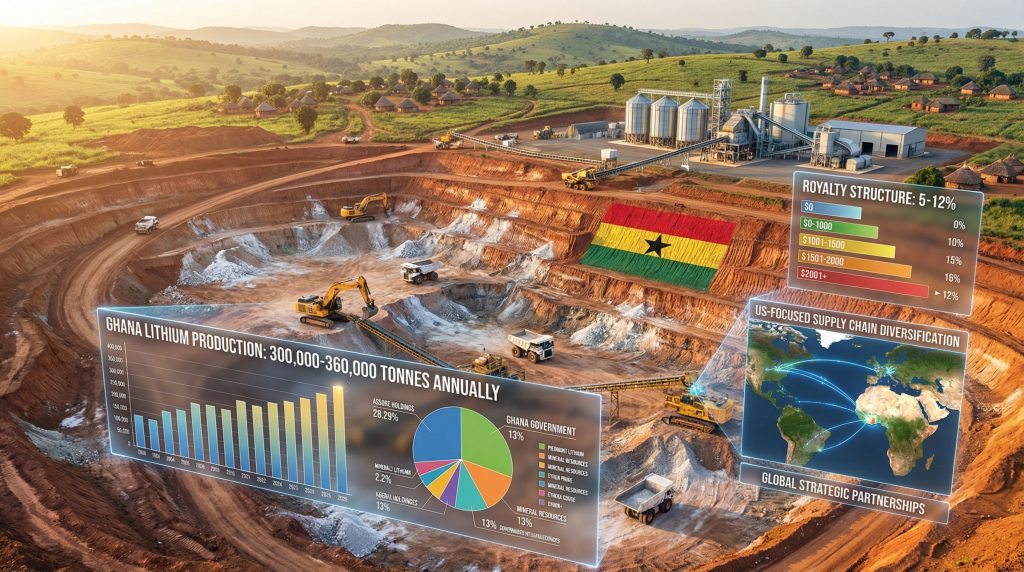
The lithium agreement introduces a different fiscal framework compared to traditional mining. Ghana secured a higher state participation and royalty structure than is typical in gold mining. The government holds a free carried interest of about 12–13% and benefits from royalties that can range from 5% to as high as 12% depending on global prices .
This sliding royalty system is critical. It allows Ghana to capture more value during periods of high lithium prices while maintaining investor viability during downturns. Unlike fixed royalty systems, this approach aligns government revenue with market conditions.
Exposure to Commodity Volatility
However, lithium introduces a new type of financial risk. Prices for lithium have been highly volatile, influenced by global electric vehicle demand, supply chain shifts, and technological changes. The renegotiation of the agreement itself was partly influenced by falling lithium prices at the time .
This volatility means that government revenue from lithium will not be stable. It will fluctuate significantly based on global market conditions, making fiscal planning more complex.
Broader Economic Impact
If managed effectively, lithium could diversify Ghana’s export base. Currently, Ghana relies heavily on gold, cocoa, and oil. Lithium introduces a fourth pillar, potentially reducing vulnerability to price shocks in any single commodity.
Investor Interest: Capital Flows and Market Confidence
Project Financing and Global Partnerships
The ratification of the lithium lease has unlocked the next phase of investor engagement. With regulatory approval secured, Atlantic Lithium can advance funding discussions and move toward a final investment decision .
This is a critical milestone. Investors typically wait for regulatory certainty before committing capital. The ratification effectively de-risks the project, making it more attractive to both equity and debt investors.

Market Reactions and Policy Sensitivity
At the same time, the lithium agreement has demonstrated how sensitive investor confidence is to policy changes. Earlier uncertainty and the withdrawal of the agreement contributed to a sharp decline in the company’s share price, highlighting the direct link between policy clarity and market valuation .
For Ghana, this creates a balancing act. The government must negotiate strong terms while maintaining predictability. Sudden policy shifts can undermine investor trust, even if they are intended to improve national benefits.
Positioning Ghana in the Global Lithium Market
The Ewoyaa project is expected to position Ghana as a significant player in the global lithium supply chain . While the country is not yet among the largest lithium producers, early entry into the market provides strategic advantages, particularly as demand continues to grow.
Government Policy Direction: From Extraction to Value Addition
Moving Beyond Raw Exports
A key objective of Ghana’s lithium strategy is to avoid the historical pattern of exporting raw materials with limited local value addition. Policymakers have emphasized the need for downstream processing, including potential lithium refining.
The agreement includes provisions requiring studies into the feasibility of local processing, signaling an intention to capture more value within the country .
Regulatory Innovation
The introduction of the Minerals and Mining (Royalty) Regulations, 2025, marks a shift toward more dynamic fiscal policies. By linking royalties to global prices, the government is adopting a more responsive approach to resource management .
This reflects a broader policy trend: moving from static agreements toward flexible frameworks that can adapt to changing market conditions.
Balancing National Interest and Investment
The government’s approach suggests an attempt to strike a middle ground. On one hand, higher royalties and increased state participation aim to maximize national benefit. On the other, the retention of investor-friendly terms ensures that projects remain financially viable.
This balance will determine whether Ghana can attract sustained investment in lithium and other transition minerals.
What the Lithium Deal Means for Ghana’s Economy
Economic Diversification
Lithium represents an opportunity to diversify Ghana’s economy beyond its traditional sectors. By entering the battery minerals market, Ghana aligns itself with long-term global trends rather than short-term commodity cycles.
This diversification reduces economic vulnerability and creates new revenue streams.

Industrial Development Potential
If local processing and value addition are successfully implemented, lithium could support industrial growth. This includes the development of processing plants, supporting industries, and specialized skills within the workforce.
Such developments would extend the economic impact beyond mining into manufacturing and technology.
Employment and Regional Development
The Ewoyaa project is expected to generate employment, particularly in the Central Region. While mining itself is not highly labor-intensive, the broader ecosystem—logistics, services, and infrastructure—can create additional economic activity.
Fiscal and Structural Risks
Despite its potential, lithium is not a guaranteed solution to Ghana’s economic challenges. Revenue volatility, governance issues, and global market dependence remain key risks. The success of the lithium strategy will depend on how effectively these risks are managed.
A Structural Turning Point
The ratification of Ghana’s lithium agreement marks more than the start of a new mining project. It represents a structural shift in how the country approaches natural resources. For the first time, Ghana is engaging directly with a mineral that sits at the center of the global energy transition.
Accra Street Journal observes that this transition introduces both opportunity and complexity. Lithium has the potential to reshape Ghana’s economic trajectory, but only if policy consistency, value addition, and long-term planning are maintained.
The real test will not be the signing of agreements, but how those agreements translate into sustained economic transformation.
FAQs
What is the Ewoyaa lithium project?
It is Ghana’s first major lithium mining project located in the Central Region, now approved for commercial development.
Why is lithium important to Ghana’s economy?
Lithium is used in batteries for electric vehicles and renewable energy, making it a high-demand mineral in the global energy transition.
How will Ghana earn from the lithium deal?
Through royalties, taxes, and a free carried interest in the mining company, with rates linked to global lithium prices.
What makes this deal different from gold mining agreements?
It includes higher state participation and a flexible royalty system tied to market prices.
Are there risks involved in lithium mining?
Yes, including price volatility, policy uncertainty, and environmental concerns.
Will Ghana process lithium locally?
There are plans and discussions around local processing, but implementation will depend on feasibility and investment.
How does the deal affect investors?
It provides regulatory clarity and investment opportunities but also highlights sensitivity to policy changes.
What does this mean for Ghana’s long-term economy?
It could diversify exports, support industrial growth, and position Ghana within the global energy transition supply chain.
Last Updated on April 29, 2026 by Samuel Kwame Boadu
Disclaimer: Some content on Accra Street Journal may be aggregated, summarized, or edited from third-party sources for informational purposes. Images and media are used under fair use or royalty-free licenses. Accra Street Journal is a subsidiary of SamBoad Publishing Hub under SamBoad Business Group Ltd, registered in Ghana since 2014.
For concerns or inquiries, please visit our Privacy Policy or Contact Page.

Samuel Kwame Boadu is a Ghanaian media entrepreneur and storyteller with a passion for amplifying urban voices and uncovering everyday truths. He is the Editor-in-Chief and Founder of Accra Street Journal, a dynamic digital platform dedicated to capturing the pulse of Ghana’s capital—its people, culture, challenges, business, sports and innovations.