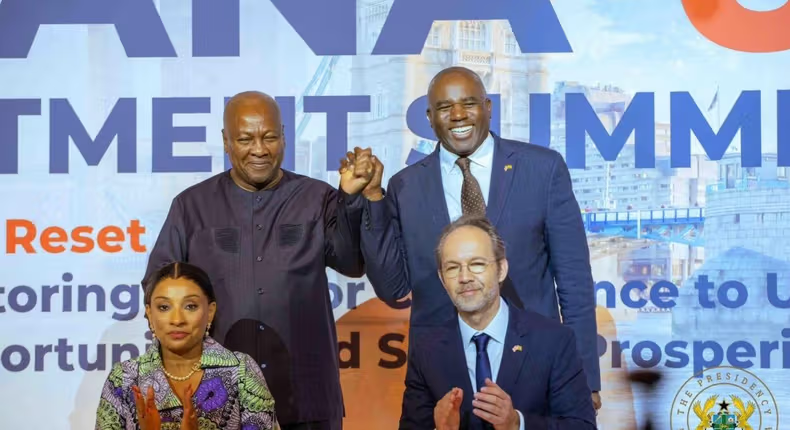
Ghana’s latest £215 million investment agreement with the United Kingdom is about far more than headline investment figures. The UK-Ghana Growth Partnership, signed in London during the Ghana-UK Investment Summit, brings together investments spanning maritime infrastructure, artificial intelligence, healthcare skills development and environmental restoration. At the centre of the deal is a strategic ambition that could reshape the country’s role in regional trade: turning the western port city of Takoradi into a major ship repair and maritime services hub for the Gulf of Guinea, one of Africa’s busiest shipping corridors.
The standout project is a £101 million floating dock and ship repair facility expected to become the Gulf of Guinea’s first commercial-scale dry-docking operation. Beyond maritime infrastructure, the package includes an £85 million reforestation fund and an additional £9 million commitment to forest restoration projects in the Oti Region, a £6 million partnership to support implementation of Ghana’s national Artificial Intelligence Strategy, and a £4 million programme focused on specialist clinical engineering training.

The investment comes as Ghana seeks new engines of growth following its recent economic crisis and debt restructuring programme, shifting focus from traditional commodity exports (gold, cocoa, oil) to logistics infrastructure, digital innovation, industrial services, and climate-related investment.
📢 GET A DETAILED ARTICLES + JOBS
Join ASJ's WhatsApp Channel and never miss a post or opportunity.

Key Developments: The Floating Dock, AI Strategy, Reforestation Fund, and Healthcare Training
The £101 million floating dock project in Takoradi is the centrepiece. The Gulf of Guinea handles a significant share of West Africa’s oil exports, container traffic, offshore energy activity, and commercial shipping. Yet vessels operating in the region often travel abroad for major maintenance and repair work, taking jobs, revenue, and industrial opportunities with them. The Takoradi Floating Dock Project could allow Ghana to retain more of that value chain while supporting offshore oil and gas operations, commercial shipping fleets, and maritime service providers across West Africa. The project is expected to create up to 430 direct jobs, with around 30% of positions reserved for women.
The reforestation component is substantial. The £85 million reforestation fund plus £9 million for the Oti Region totals £94 million—nearly half the entire package. These investments are expected to support job creation, land restoration, and climate resilience while helping Ghana tap into growing global demand for carbon and nature-based investment projects. The focus on the Oti Region, which has faced environmental degradation, signals a commitment to geographic diversification beyond the traditional economic centres of Accra and Kumasi.

The AI partnership is strategically significant. The £6 million programme will support implementation of Ghana’s national Artificial Intelligence Strategy and strengthen collaboration between Ghanaian and British universities in research, innovation, and digital skills development. AI is a priority for Ghana’s digital transformation agenda; the partnership provides technical assistance, training, and research collaboration. The amount is modest, but the strategic signal is important: Ghana wants to be a hub for digital innovation, not just a consumer of foreign technology.
The healthcare component addresses a specific, long-standing challenge. The £4 million programme focused on specialist clinical engineering training aims to improve the maintenance and management of critical medical equipment. Across many African countries, expensive medical equipment (MRI machines, ventilators, dialysis machines) falls into disrepair because local technicians lack the skills to maintain it. The programme will train biomedical engineers to keep equipment operational, extending its useful life and saving money.
The partnership’s structure is noteworthy. Rather than traditional development assistance (aid), the agreement is framed as a “growth partnership” focused on investment, skills, and infrastructure. The language reflects a shift in UK development policy toward economic cooperation rather than charitable transfers. The UK has been redefining its post-Brexit relationship with Africa; this partnership is a model.
Trade between Ghana and the United Kingdom has grown steadily, reaching roughly £1.6 billion. The new partnership suggests both countries are looking to deepen those commercial ties through targeted investments rather than traditional development assistance alone. The agreement aligns with Ghana’s strategy of diversifying its economy beyond gold, cocoa, and oil.
Analysis & Implications: The Maritime Hub Ambition, AI Readiness, and Climate Finance
The Takoradi floating dock is the most transformative project. Currently, vessels operating in West Africa travel to South Africa, Europe, or Asia for dry-docking (major repairs). The cost of travel, plus the lost time, is substantial. A dry-docking facility in Takoradi would reduce costs for regional shippers and attract vessels that would otherwise bypass West Africa. The project could position Ghana as a maritime hub, analogous to how Singapore became a hub in Southeast Asia.
The ship repair industry generates high-value jobs: welders, electricians, engineers, painters, and technicians. The 430 direct jobs projected (with 30% for women) is a start, but the indirect jobs (catering, transport, housing, retail) could be larger. The facility could also attract ship owners to base vessels in Ghana, increasing port revenues.
The AI strategy partnership is timely. Ghana launched its national AI strategy in 2025, focusing on agriculture, health, education, and public services. The UK partnership provides technical assistance, university collaboration, and skills training. The £6 million budget is small, but the value of the knowledge transfer may exceed the grant. Ghanaian universities will partner with UK institutions, creating research networks and student exchanges.
The reforestation fund taps into the growing market for carbon credits. Companies seeking to offset their emissions can buy credits from forest restoration projects. The Oti Region projects could generate verified carbon credits, attracting further investment. The £85 million fund is large enough to be impactful; the government must ensure that the projects are well-managed and that local communities benefit.
The healthcare training programme addresses a specific, chronic problem. Ghana imports millions of dollars of medical equipment; much of it ends up unused because of lack of maintenance skills. The training of biomedical engineers will improve equipment uptime, reduce the need for expensive service contracts, and save the health system money. The £4 million investment could pay for itself within a few years.

The Accra Street Journal notes that the partnership is a model for post-aid development cooperation. The UK is not simply giving money; it is investing in projects that have economic returns. Ghana is not simply receiving aid; it is building assets. The shift from aid to investment is a global trend; Ghana is positioning itself as a destination for such partnerships.
What This Means for Ghana’s Maritime Sector, Digital Economy, and Climate Strategy
For the maritime sector, the floating dock is a game-changer. Takoradi is already a major port for oil and gas exports; the dock would add ship repair to its portfolio. The facility could attract vessels from Nigeria, Côte d’Ivoire, Togo, and Benin, creating a regional hub. The government must ensure that the port infrastructure (berths, cranes, logistics) can support the increased activity.
For the digital economy, the AI partnership supports Ghana’s ambition to become a technology hub. Ghana has a young, English-speaking workforce, improving digital infrastructure, and a growing startup ecosystem. The partnership with UK universities could accelerate AI research and applications. The government should also attract private sector AI investment, not just public sector grants.
For the climate strategy, the reforestation fund aligns with Ghana’s commitments under the Paris Agreement. The country has pledged to reduce emissions and increase forest cover. The Oti Region projects will sequester carbon, protect watersheds, and provide livelihoods. The carbon credits generated could be sold on international markets, creating a revenue stream.
For healthcare, the biomedical engineering training will improve equipment maintenance, reducing the need for foreign technicians and costly service contracts. The programme should be expanded beyond the initial £4 million; the need is large. The government should also invest in local manufacturing of medical equipment, capturing more value.
For the UK, the partnership is a model for its post-Brexit Africa strategy. The UK is no longer bound by EU aid rules; it can design bespoke partnerships. Ghana is a natural partner: English-speaking, stable, and reform-oriented. The success of this partnership could lead to similar agreements with other African countries.
The Accra Street Journal’s assessment: the £215 million headline figure is less important than the strategic direction. Ghana is moving beyond aid dependency to investment-led growth. The maritime hub ambition, AI strategy, reforestation fund, and healthcare training are all aligned with that direction. The challenge is execution: delivering the floating dock on time and budget, managing the reforestation projects effectively, and scaling the AI and healthcare programmes. If successful, Ghana could become a model for middle-income African countries seeking to attract foreign investment for strategic assets.
Wider Context: Post-Aid Development Cooperation and Africa’s Infrastructure Gap
The shift from aid to investment is a global trend. Traditional donors (UK, US, Germany, Japan) are reducing direct budget support and instead using their development budgets to catalyse private investment. The UK’s CDC (now British International Investment) is a model; the Ghana partnership extends that approach to infrastructure and skills.
Africa’s infrastructure gap is estimated at $130 billion to $170 billion annually. Public finances cannot close the gap; private capital must be mobilised. Partnerships like the UK-Ghana Growth Partnership are one mechanism. The use of guarantees, blended finance, and technical assistance can make projects bankable.
The maritime sector is a priority because of its multiplier effects. Ports create jobs directly (cargo handling, ship repair, logistics) and indirectly (trade, manufacturing, services). Ghana’s location on the Gulf of Guinea—a major shipping route for oil, gas, and container traffic—gives it a competitive advantage. The Takoradi floating dock could be the anchor of a maritime industrial cluster.
The AI sector is a priority because of its transformative potential. AI can improve agricultural yields, health diagnostics, educational outcomes, and public service delivery. Ghana’s national AI strategy is a framework; the UK partnership provides expertise. The government must also invest in digital infrastructure (broadband, data centres) and skills (coding, data science).

The climate sector is a priority because of financing opportunities. Carbon credits are a growing market; Ghana can generate credits by protecting forests, restoring degraded land, and investing in renewable energy. The reforestation fund is a start; the government should also attract private investment in nature-based solutions.
The Accra Street Journal’s conclusion: the UK-Ghana Growth Partnership is a strategic investment in Ghana’s future. The £101 million floating dock, £94 million reforestation fund, £6 million AI partnership, and £4 million healthcare training are all aligned with Ghana’s development priorities. The challenge is execution. If the projects are delivered, Ghana will have taken a significant step toward becoming a maritime hub, a digital innovator, and a climate leader. If not, the partnership will be another well-intentioned but underperforming initiative. The government’s focus should now be on implementation.
Source: Accra Street Journal
Last Updated on June 4, 2026 by Samuel Kwame Boadu
Disclaimer: Some content on Accra Street Journal may be aggregated, summarized, or edited from third-party sources for informational purposes. Images and media are used under fair use or royalty-free licenses. Accra Street Journal is a subsidiary of SamBoad Publishing Hub under SamBoad Business Group Ltd, registered in Ghana since 2014.
For concerns or inquiries, please visit our Privacy Policy or Contact Page.

Samuel Kwame Boadu is a Ghanaian media entrepreneur and storyteller with a passion for amplifying urban voices and uncovering everyday truths. He is the Editor-in-Chief and Founder of Accra Street Journal, a dynamic digital platform dedicated to capturing the pulse of Ghana’s capital—its people, culture, challenges, business, sports and innovations.