








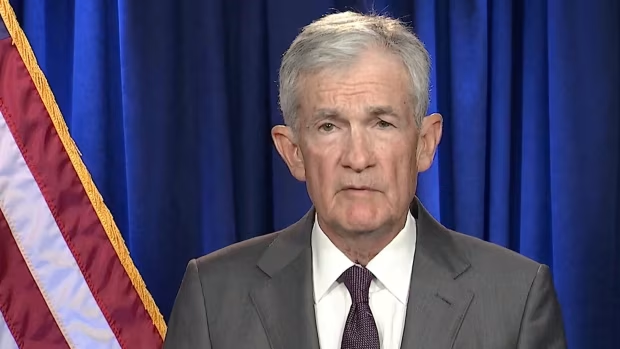

The criminal investigation opened against United States Federal Reserve Chair Jerome Powell has moved well beyond the boundaries of Washington politics. What began as a domestic controversy is now reverberating through global markets, forcing emerging economies such as Ghana to brace for potential spillovers into interest rates, currency stability, and investor confidence.

The US Justice Department has issued grand jury subpoenas to the Federal Reserve linked to Powell’s testimony before Congress on a multibillion-dollar renovation of the Fed’s headquarters. Powell has confirmed the probe publicly, framing it as an escalation of political pressure aimed at influencing monetary policy ahead of a US election year.
In a rare and pointed statement, Powell warned that the threat of criminal prosecution reflects “the consequence of the Federal Reserve setting rates based on our best assessment of what will serve the public, rather than following the preferences of the President.” The language was striking, underscoring growing concern that the independence of the world’s most influential central bank is being tested in real time.
📢 GET A DETAILED ARTICLES + JOBS
Join ASJ's WhatsApp Channel and never miss a post or opportunity.
Political reaction in Washington has only deepened uncertainty. President Donald Trump has denied any role in the investigation while renewing criticism of Powell’s interest-rate decisions. At the same time, Republican Senator Thom Tillis has warned that Congress could block future Federal Reserve nominations until lawmakers receive clearer answers. Such open political pressure on the institution that anchors global finance is highly unusual—and markets noticed immediately.
US stock futures slipped, the dollar softened, and gold prices edged higher as investors rotated toward safe-haven assets. These early reactions may appear modest, but for countries like Ghana, the real impact often emerges with a lag.
Ghana remains highly exposed to shifts in global financial sentiment. Even as domestic indicators have shown signs of improvement following fiscal adjustments and Bank of Ghana interventions, the economy is still navigating debt restructuring, inflation control, and fragile currency stability. History shows that when uncertainty rises in Washington, capital often retreats from frontier and emerging markets first.
In such episodes, foreign investors typically reprice risk, pulling funds toward US assets perceived as safer. The result is familiar: pressure on local currencies, higher yields on government bonds, and tighter financing conditions for businesses. As one currency trader at a leading Ghanaian bank put it privately, “If America sneezes, Africa catches a cold.”
Global analysts have also flagged the broader implications. Goldman Sachs chief economist Jan Hatzius has warned that even the perception of political interference at the Federal Reserve can weigh on investor confidence. Central bank independence, he noted, is as much about credibility as it is about policy outcomes. When that credibility is questioned, markets react defensively.
In Accra, economists are already reassessing assumptions for the first quarter. The cedi has enjoyed periods of relative calm, supported by improved reserves and tighter policy. Yet external shocks have repeatedly shown their ability to undo months of domestic discipline. Rising global risk aversion could quickly translate into renewed currency pressure and higher borrowing costs.
The Bank of Ghana has long stressed the importance of safeguarding its own independence. Governor Dr. Johnson Asiama has consistently argued that interest-rate decisions must remain data-driven and insulated from political cycles. While the central bank has not commented directly on the Powell investigation, its research has repeatedly highlighted how institutional credibility helps shield economies from external turbulence.
The timing is delicate. Ghana’s government has positioned 2026 as a launchpad for accelerating its 24-Hour Economy agenda, a strategy that depends heavily on stable financing conditions, predictable exchange rates, and sustained private investment. Any global volatility that lifts external debt servicing costs or weakens the cedi could complicate those ambitions.
Trade and investment analysts caution that uncertainty abroad often delays private sector decisions at home. Even when domestic fundamentals are improving, businesses tend to pause expansion plans when global signals turn negative—especially those linked to interest-rate expectations in the United States.
The legal process surrounding Powell may take months, and no charges have been filed. Yet the significance is already evident. The US Federal Reserve is not merely a national institution; it sets the tone for global money flows. When confidence in its independence is shaken, emerging markets feel the aftershocks.
For Ghana, the episode is a reminder of how interconnected—and vulnerable—modern financial systems remain. The trajectory of the cedi, investor appetite for local assets, and the pace of economic recovery may hinge as much on developments in Washington as on policy discipline at home. Until clarity returns, Ghana’s policymakers, businesses, and investors will be watching the Federal Reserve with heightened caution.
Source: Accra Street Journal
Last Updated on January 12, 2026 by Samuel Kwame Boadu
Disclaimer: Some content on Accra Street Journal may be aggregated, summarized, or edited from third-party sources for informational purposes. Images and media are used under fair use or royalty-free licenses. Accra Street Journal is a subsidiary of SamBoad Publishing Hub under SamBoad Business Group Ltd, registered in Ghana since 2014.
For concerns or inquiries, please visit our Privacy Policy or Contact Page.

Samuel Kwame Boadu is a Ghanaian media entrepreneur and storyteller with a passion for amplifying urban voices and uncovering everyday truths. He is the Editor-in-Chief and Founder of Accra Street Journal, a dynamic digital platform dedicated to capturing the pulse of Ghana’s capital—its people, culture, challenges, business, sports and innovations.