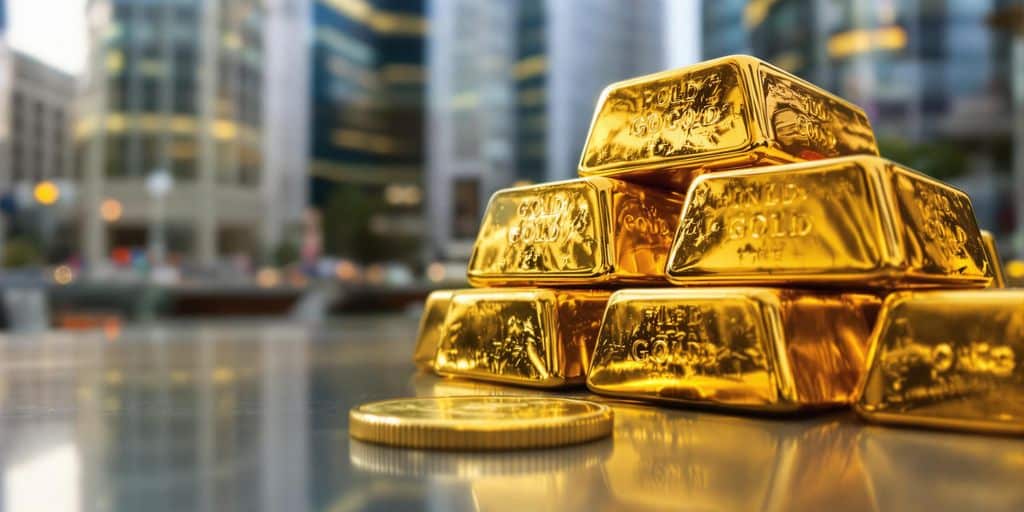
Gold’s surge to $4,635.98 per troy ounce on January 14, 2026, its highest level in seven months, reflects far more than a routine price movement. It signals a renewed shift in global investor psychology — one shaped by uncertainty, policy doubt, and geopolitical risk.
With a 1.08% daily gain, a 7.65% rise over the past month, and prices now more than 72% higher than a year ago, gold is once again asserting its traditional role as the world’s most trusted financial hedge.
This rally is not being driven by speculative momentum alone. It is anchored in deepening concerns about monetary policy direction, institutional credibility, and geopolitical stability.
📢 GET A DETAILED ARTICLES + JOBS
Join ASJ's WhatsApp Channel and never miss a post or opportunity.
📲 Join ASJ Channel Now
Monetary Policy Expectations Are Reshaping Market Behaviour
Rate-cut anticipation fuels demand
At the core of gold’s rise is the growing expectation that the U.S. Federal Reserve will begin cutting interest rates in 2026. December data pointing to moderating underlying inflation has strengthened the view that price pressures are easing after distortion from earlier temporary shutdown effects.
Futures markets now show investors divided between two or three rate cuts in 2026 — a far more aggressive outlook than the Fed’s own median projection of just one cut.
Why this matters for gold
Lower interest rates reduce the opportunity cost of holding non-yielding assets like gold. When returns on bonds and savings instruments weaken, gold becomes more attractive as a store of value — not for income, but for preservation.
Institutional Confidence and Political Risk
Concerns over Federal Reserve independence
Beyond rate expectations, market confidence has been shaken by renewed debate around the independence of the Federal Reserve. The criminal probe linked to Chair Jerome Powell’s testimony has introduced a political risk premium into financial markets.
For investors, institutional credibility matters. When central bank independence appears vulnerable, confidence in monetary stability weakens — and demand for hard assets rises.
Gold benefits directly from this trust deficit.
Geopolitics Re-enters the Equation
Iran and global risk perception
Geopolitical tension is once again amplifying market anxiety. Investors are closely monitoring signals of potential U.S. involvement in Iran following repeated warnings of possible military action.
Even without immediate conflict, the risk of escalation alone is enough to strengthen safe-haven demand. Markets tend to price in uncertainty early, rather than wait for disruption to materialise.
Gold thrives in this environment — not because crisis is guaranteed, but because stability is no longer assumed.
A Broader Shift in Investor Strategy
From growth to protection
What makes this rally structurally significant is its context. Gold is rising not in isolation, but alongside a broader shift in investor priorities:
-
From growth assets to protective assets
-
From yield-seeking to risk-hedging
-
From optimism to resilience
This reflects a market environment where uncertainty has become permanent rather than temporary.
What This Means for Global Markets in 2026
Volatility, not clarity
Gold’s performance is not simply about inflation, interest rates, or geopolitics — it is about confidence. Confidence in institutions. Confidence in policy. Confidence in global stability.
As long as uncertainty persists across these pillars, gold is likely to remain structurally supported.
Rather than a speculative spike, this rally represents a re-pricing of risk.
Final Reflection
Gold’s surge to a seven-month high is not a short-term anomaly — it is a signal. A signal that markets are preparing for a world where policy predictability, institutional trust, and geopolitical stability can no longer be taken for granted.
In 2026, gold is no longer just a hedge against inflation.
It is a hedge against uncertainty itself.