







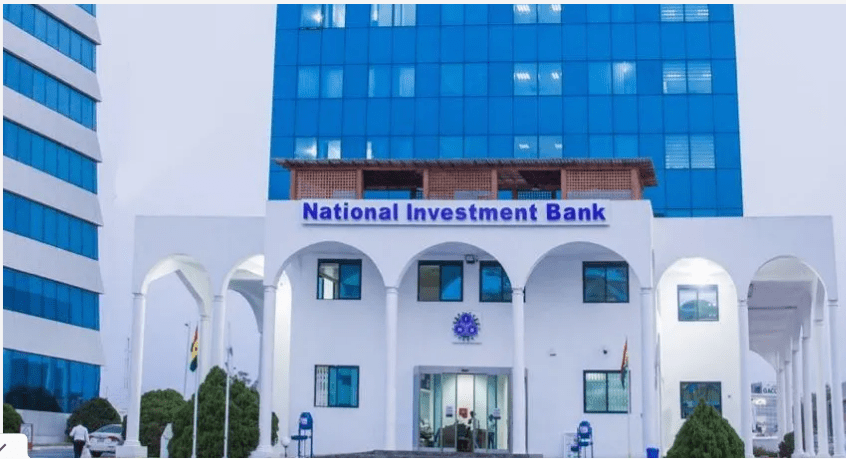

Once technically insolvent with a negative capital adequacy ratio of 53%, Ghana’s oldest development finance institution executed the most dramatic financial turnaround in recent memory. This is the inside story of the NIB revival, the leadership duo behind it, and whether the bank can sustain its new trajectory.

Executive Introduction
In the history of Ghanaian banking, there are turnarounds, and then there is the resurrection of the National Investment Bank (NIB) PLC. The distinction is not semantic; it is substantive. A turnaround improves an institution. An intervention—as witnessed at NIB between 2024 and 2025—rescues it, redefines it, and repositions it from a national liability into a national asset.
For years, NIB was synonymous with fragility. Established by an Act of Parliament in 1963 (Act 212) as the country’s premier development finance institution, its mandate was to catalyse industrialisation: financing manufacturing, construction, mining, and energy. Yet, by mid-2024, the bank was a clinical case of institutional collapse. It had not published audited financial statements in over a decade. Its Capital Adequacy Ratio (CAR)—the measure of a bank’s ability to absorb losses—had plunged to -53.13%, far below the Bank of Ghana’s regulatory floor of 13%. Independent audits flagged solvency risks severe enough that the central bank warned of potential liquidation.
📢 GET A DETAILED ARTICLES + JOBS
Join ASJ's WhatsApp Channel and never miss a post or opportunity.
Fast forward to the 2025 audited results. The numbers defy conventional business logic. From a loss position, NIB recorded a Profit After Tax of GH¢343.9 million. The Capital Adequacy Ratio swung to a robust 54.5%—one of the highest in the industry. Customer deposits surged past GH¢10 billion, and the bank finally published its first audited accounts in over a decade.
For corporate Ghana, investors, and policymakers, NIB represents a high-stakes case study in state-led rescue versus private sector discipline. It poses a critical question: Can a state-owned development bank, revived with government bonds and political will, genuinely compete with private commercial giants like Ecobank or Stanbic, or is this a temporary sugar rush before the next structural relapse?
This ASJ profile dissects the “Three-Pillar” revival strategy engineered by Managing Director Dr. Doliwura Zakaria, the injection of GH¢3.4 billion in paid-up capital, the lingering risks of legacy debt, and the bank’s ambitious plan to eventually list on the Ghana Stock Exchange.
Company Overview
Historical Foundation: The Industrial Dream
NIB was established in 1963 as a vehicle for Ghana’s post-independence industrialisation drive. Unlike commercial banks focused on trade finance or retail deposits, NIB’s mandate was development finance: providing medium to long-term capital for factories, infrastructure, and heavy industries. For decades, it played a foundational role in sectors like construction, mining, and energy.
However, this development mandate came with structural vulnerabilities. Development finance requires long-term patient capital, yet NIB often funded itself with short-term deposits—a classic duration mismatch. When economic conditions tightened, non-performing loans accumulated, and by the 2010s, the bank was in a state of quiet decay.
The Collapse Pre-2024
By mid-2024, the situation was publicly acknowledged to be dire. Key metrics included:
-
Capital Adequacy Ratio (CAR): -53.13% (deeply insolvent)
-
Audit Status: No published audited accounts for over a decade
-
Liquidity: Reliant on short-term support from the Bank of Ghana
-
Public Perception: Widely viewed as a “zombie bank”
Notably, NIB was not part of the dramatic financial sector cleanup between 2017 and 2019 that saw nine banks collapse. It survived that purge largely due to its state-owned status and political connections. However, the International Monetary Fund (IMF) eventually forced the issue, making the resolution of NIB a prior action for the approval of Ghana’s $3 billion loan programme.
Ownership Structure: The State’s Heavy Hand
NIB is wholly owned by the Government of Ghana, distinguishing it from partially state-owned entities like GCB Bank (publicly traded) or ADB (mixed ownership). The major shareholders are effectively the Ministry of Finance and the Bank of Ghana, with oversight from the State Interests and Governance Authority (SIGA).
This ownership structure is a double-edged sword. It allowed the government to orchestrate a massive GH¢3.4 billion recapitalisation that no private investor would have touched. However, it also exposes the bank to political interference, procurement delays, and governance risks typical of state-owned enterprises.
Leadership: The Doliwura-Zakaria Effect
The revival of NIB is widely attributed to the synergistic leadership of Dr. Doliwura Zakaria (Managing Director) and Thomas Hughes Amissah (Deputy Managing Director).
-
Dr. Doliwura Awushi Zakaria: Appointed in 2024, Dr. Zakaria brought over two decades of experience in governance, public financial management, and revenue mobilisation. He is also a traditional leader and a chartered accountant. His primary role was the “external architect”: securing political buy-in, negotiating the recapitalisation package with the IMF and Ministry of Finance, and resetting stakeholder confidence. His efforts earned him the CEO of the Year in Finance and Transformational Leadership CEO awards at the Ghana CEOs Awards in 2025.
-
Thomas Hughes Amissah (Deputy MD): As the “internal engineer,” Mr. Amissah focused on operational prudence. He overhauled the bank’s risk management frameworks, strengthened internal audit functions, and ensured that the injected capital was deployed strategically rather than consumed by legacy liabilities.
-
Board of Directors: In July 2025, Finance Minister Dr. Cassiel Ato Forson inaugurated a new nine-member board chaired by Frank Adu Jnr. , the former CEO of CalBank. The board includes professionals like Dr. Othniel Ekow Kwainoe, Ebenezer Kwaku Addo, and Dr. Mercy Naa Aku Ofei-Koranteng.
Business Model: The Development Bank Pivot
NIB operates a development and commercial banking hybrid. Unlike pure commercial banks (e.g., Stanbic) that prioritise short-term profit, or pure merchant banks (e.g., UMB) focused on wholesale trade, NIB is mandated to finance the “real sector”—manufacturing, infrastructure, energy, and mining.
The Three-Pillar Strategy
According to the 2025 audited reports and analysis by the Africa Research and Consulting Centre, the revival rested on three strategic pillars:
1. The Financial Rescue (Recapitalisation)
-
Action: Secured a government-backed package: GH¢450 million in cash, GH¢1.5 billion in bonds, and the transfer of GH¢500 million worth of government shares in Nestlé Ghana Limited.
-
Result: Total paid-up capital reached GH¢3.4 billion; CAR surged to 54.5%.
2. Operational Prudence & Cultural Transformation
-
Action: Aggressive investment in staff (salary adjustments exceeding 140% cumulatively), promotions for over 500 stagnant staff, and certification programmes for leadership.
-
Result: Cost-to-income ratio dropped to about 64% (down from over 100% in 2024); Operating Income surged 134% to GH¢885.5 million.
3. Strategic Growth & Transparency
-
Action: Publication of financial statements (first in a decade); launch of a new mobile banking application; removal of legacy audit qualifications.
-
Result: Total assets grew to GH¢12.23 billion; Deposits hit GH¢10.19 billion.
How They Make Money: The 2025 Financials
NIB’s 2025 audited financials reveal a bank that has fundamentally restructured its income statement.
| Metric | 2024 | 2025 | Change |
|---|---|---|---|
| Profit After Tax | GH¢2.8 million | GH¢343.9 million | +12,280% |
| Operating Income | GH¢378.4 million | GH¢885.5 million | +134% |
| Net Interest Income | ~GH¢200 million | GH¢633.1 million | Tripled |
| Total Assets | GH¢5.84 billion | GH¢12.23 billion | +109% |
| Customer Deposits | GH¢6.4 billion | GH¢10.19 billion | +59% |
| Equity Position | Negative GH¢850.6 million | Positive GH¢1.55 billion | Reversed |
| Capital Adequacy Ratio (CAR) | Negative (-53.13%) | 54.5% | Reversed to surplus |
Analysis of Turnaround Drivers:
-
Net Interest Income Tripled: This suggests the bank has successfully restructured its loan portfolio and reduced non-performing loans, allowing interest payments to flow again.
-
Operating Expenses Controlled: While expenses rose, revenue growth far outpaced costs. The bank cut inefficiencies by approximately 25% while simultaneously raising staff salaries—a difficult balance achieved through digital automation.
-
Off-Balance Sheet Strength: The independent auditor issued an unmodified opinion (clean audit) for the 2025 statements, a sharp departure from the disclaimers of previous years.
Market Position and Competition
Industry Standing: From “Life Support” to Lead
Before 2025, NIB was absent from any “Top Bank” lists. As of the 2026 financial year, it has re-entered the conversation. Its 54.5% CAR is one of the highest in Ghana, far exceeding the 13% regulatory minimum and even surpassing the capitalisation of private sector giants like Ecobank and Stanbic.
However, in terms of total assets (GH¢12.23 billion), NIB sits in the upper mid-tier—comparable to CalBank or OmniBSIC, but still significantly smaller than GCB Bank (GH¢60 billion) or Ecobank.
Competitive Landscape: David vs. Goliath
NIB is attempting to carve a niche between the State-Owned Enterprises (SOEs) and the Private Multinationals.
| Competitor | Where NIB Wins | Where NIB Loses |
|---|---|---|
| GCB Bank | Long-term development loans (10+ years) | Retail network (183 branches vs. NIB’s smaller footprint) |
| Ecobank | Government-backed project guarantees | Cross-border trade finance & Forex liquidity |
| Stanbic | Financing local manufacturing (cheaper cost of funding via govt bonds) | Investment banking & M&A advisory |
| CBG/ADB | “Cleaner” balance sheet post-recapitalisation | Historical brand trust in agriculture/consumer banking |
Unique Value Proposition
NIB’s greatest weapon is its cost of funding. Because the government injected GH¢1.5 billion in bonds and GH¢450 million in cash, NIB has a massive, low-cost capital base. This allows it to offer longer tenors and potentially lower interest rates on industrial loans than commercial banks racing to meet short-term deposit costs.
Digital Strategy and Innovation
For a bank that was technically insolvent just 18 months ago, NIB has moved aggressively on the technology front, even if it lags behind nimble fintechs.
The New Mobile App
In 2025, NIB unveiled its new mobile banking application, signalling a move to retain younger depositors and corporate clients who demand seamless digital experiences. The focus has been on speed, security, and basic transactional functionality, though detailed feature sets are still evolving.
First Audited Statements (The Tech Infrastructure)
Perhaps the most significant “digital” achievement was the ability to produce audited accounts. This required untangling legacy IT systems inherited from years of neglect, reconciling ledgers, and closing books—an operational IT feat that is often underappreciated.
Transparency as Strategy
NIB’s Head of Marketing and Corporate Communications, Marian Toure, explicitly framed the publication of financial results as “a declaration of readiness”. This transparency is a radical departure from the bank’s past, positioning it as a trustworthy counterparty for international development finance partners.
Challenges and Risks
The “Phoenix” narrative is compelling, but the risks remain substantial. NIB is flying high, but the winds of Ghanaian banking can change rapidly.
1. The Government Dependency Risk
NIB is currently reliant on the state. GH¢1.5 billion of its capital is tied up in bonds issued by the very government that owns it. If Ghana faces another debt restructuring or fiscal crisis, NIB’s balance sheet is directly exposed to sovereign risk. It is, in essence, a mirror of the state’s health.
2. Persistent Weaknesses
Despite the turnaround, the Institute for Fiscal Studies (IFS) raised concerns about the fiscal transparency of the recapitalisation. The IFS noted that while the government disclosed GH¢450 million in cash injection, it omitted GH¢1.95 billion in bonds and shares, effectively understating the true cost to the taxpayer. This reliance on “off-book” transfers creates a murky accounting standard.
3. Non-Performing Loans (The Hidden Iceberg)
While the CAR is fixed, the bank has not fully detailed the reduction of its legacy NPL portfolio in all sources. The dramatic rise in net interest income suggests recoveries, but development banks globally struggle with political lending (loans forced by government directives that later default). NIB may still hold “zombie” loans to defunct state enterprises that are not market-viable.
4. Governance Reforms (Talk vs. Walk)
The Finance Minister has promised a plan to “prevent insider dominance” and “enhance board independence”. However, for a wholly state-owned bank, true independence is difficult to achieve. The political pressure to lend to politically exposed persons (PEPs) or failing SOEs remains a real risk.
Economic and Industry Impact
Preserving National Assets
The most immediate impact was the preservation of GH¢6.4 billion in depositor funds and the saving of over 900 direct jobs. In a country still recovering from the banking sector collapse of 2017-2019, a liquidation of NIB would have shattered confidence in indigenous banks.
Industrial Financing “Crowding In”
NIB’s core mandate is manufacturing. With a healthy balance sheet, it can now offer the long-term loans necessary for factories to retool and expand. This directly supports the government’s 24-hour economy and import substitution agenda.
Capital Markets Development
The government has explicitly stated that part of the restructuring plan includes eventually listing NIB on the Ghana Stock Exchange. If successful, this would be a massive liquidity event for the GSE, providing a new blue-chip stock for pension funds and retail investors.
Future Outlook: The 2026-2027 Strategy
As of May 2026, NIB is in the “show me” phase. The immediate survival is secure, but the bank must now prove it can generate profit without constant life support.
The Bull Case (Optimistic)
-
Commercial Discipline: Management continues to resist political lending pressures. The 54.5% CAR allows NIB to aggressively pursue profitable commercial projects without taking excessive risk.
-
GSE Listing: An IPO within the next 3-5 years forces transparency and efficiency. It would also allow the government to recoup some of the GH¢3.4 billion investment.
-
Mergers & Acquisitions: There is market speculation about the consolidation of state-owned banks (NIB, ADB, CBG) into a single development behemoth. If NIB is the survivor, its scale could triple overnight.
The Bear Case (Pessimistic)
-
Relapse into Distress: If the governance reforms fail and the board is stacked with political loyalists rather than professionals, the capital buffer will be eroded by bad loans within two years.
-
Macroeconomic Shock: A return to high inflation or a new debt restructuring would render the GH¢1.5 billion in bonds on NIB’s books virtually worthless.
-
Competition: Privately owned banks (Fidelity, CalBank) are moving up-market into manufacturing finance, armed with better technology and faster service.
The Verdict
The National Investment Bank PLC is the most compelling “comeback” story in Ghanaian banking in 2026, but it is not a “growth stock” in the traditional sense. It is a recovery special situation.
The leadership has done the Herculean work of cleaning a stable that was dirty for over a decade. The capital is there, the morale is high, and the audits are clean. However, NIB remains a creature of the state. For corporate clients, it offers a safe haven for deposits and a potential source of cheap long-term capital for manufacturers. For investors, the true test will be whether the government keeps its promise to list the bank—and whether retail investors trust the state enough to buy its shares.
FAQ SECTION
1. What is the National Investment Bank (NIB) PLC?
NIB is a state-owned development and commercial bank established in 1963 (Act 212). Its primary mandate is to provide medium to long-term financing for Ghana’s industrial, manufacturing, mining, construction, and energy sectors. It operates as a universal bank but retains a focus on developmental projects.
2. Was NIB Bank in danger of collapsing?
Yes. By mid-2024, NIB was technically insolvent. Its Capital Adequacy Ratio (CAR) was negative 53.13%, violating Bank of Ghana rules. It was reliant on central bank liquidity support, and there were discussions about potentially winding it down under the IMF programme.
3. How did the government save NIB?
The government executed a three-pronged rescue package in 2025: a cash injection of GH¢450 million, the issuance of marketable bonds worth GH¢1.5 billion to the bank, and the transfer of GH¢500 million worth of government shares in Nestlé Ghana Limited to NIB, bringing total paid-up capital to GH¢3.4 billion.
4. Who is the CEO of NIB?
The Managing Director is Dr. Doliwura Zakaria (also referred to as Doli-Wura Dr Zakaria Awushi Abdul-Malik Seidu). He was awarded CEO of the Year in Finance and Transformational Leadership CEO at the Ghana CEOs Awards in 2025.
5. Is NIB profitable now?
Yes, dramatically so. According to the 2025 audited financial statements, NIB recorded a Profit After Tax of GH¢343.9 million, a massive leap from GH¢2.8 million in 2024. This represents a growth of over 12,000%.
6. What is NIB’s current Capital Adequacy Ratio?
As of December 2025, NIB’s CAR was 54.5% , up from negative 53.13% in 2024. This is one of the highest CARs in the Ghanaian banking industry, providing a massive buffer against potential losses.
7. Does NIB have a mobile banking app?
Yes. As part of its 2025 transformation, NIB launched a new mobile banking application and initiated a major technology upgrade to enhance speed, security, and digital capability for retail and corporate customers.
8. Is the government planning to sell NIB?
Not immediately. The government has stated that the restructuring plan includes eventual listing on the Ghana Stock Exchange (GSE). However, the bank remains wholly state-owned currently, with a new board installed in July 2025 to professionalise operations.
9. How many branches does NIB have?
While specific branch numbers vary, NIB operates a national network across Ghana. The bank has recently focused on “strategic branch positioning” as part of its operational efficiency drive, serving industrial hubs and regional capitals.
10. Who audits NIB?
The 2025 financial statements were audited by an independent audit firm (reporting entity not named in sourced briefs). Crucially, the bank received an unmodified (clean) audit opinion, marking the first time in over a decade that the bank has had such a clean bill of health.
11. What is the “Three-Pillar” strategy that saved NIB?
The strategy, engineered by MD Doliwura Zakaria and DMD Thomas Hughes Amissah, consisted of:
-
Pillar 1 (Financial Rescue): Securing the GH¢3.4bn recapitalisation.
-
Pillar 2 (Operational Prudence): Cutting costs by 25% while raising staff salaries to boost morale.
-
Pillar 3 (Strategic Growth): Publishing financials and upgrading technology.
12. Is NIB a commercial bank or a development bank?
It is a hybrid. NIB operates under a universal banking license (commercial), allowing it to take deposits from the public. However, its core mandate remains that of a Development Finance Institution (DFI) , meaning it prioritises lending to industry and manufacturing over consumer goods.
QUICK FACTS BOX
| Item | Details |
|---|---|
| Founded | 1963 (Act 212 of Parliament) |
| Headquarters | Accra, Ghana (Main branch near Ministries area) |
| Industry | Banking / Development Finance |
| Services | Corporate Banking, Manufacturing Finance, Infrastructure Loans, Mining & Energy Finance, Treasury |
| Ownership | 100% Government of Ghana (State-Owned Enterprise) |
| CEO (MD) | Dr. Doliwura Awushi Zakaria |
| Deputy MD | Thomas Hughes Amissah |
| Board Chairman | Frank Adu Jnr. (former CalBank CEO) |
| Market Position | Upper mid-tier; Specialised Industrial Bank |
| Total Assets (2025) | GH¢12.23 billion |
| Customer Deposits (2025) | GH¢10.19 billion |
| Profit After Tax (2025) | GH¢343.9 million |
| Capital Adequacy Ratio | 54.5% (one of the highest in Ghana) |
| Equity Position (2025) | GH¢1.55 billion (positive, reversed from negative) |
| Depositors Saved | GH¢6.4 billion |
| Employees Saved | 900+ direct jobs |
| Key Innovation | First audited accounts in a decade; New Mobile App (2025) |
| Future Plan | Listing on Ghana Stock Exchange (GSE) |
| Regulator | Bank of Ghana |
| Website | nib-ghana.com |
Source: Accra Street Journal
Last Updated on May 3, 2026 by Samuel Kwame Boadu
Disclaimer: Some content on Accra Street Journal may be aggregated, summarized, or edited from third-party sources for informational purposes. Images and media are used under fair use or royalty-free licenses. Accra Street Journal is a subsidiary of SamBoad Publishing Hub under SamBoad Business Group Ltd, registered in Ghana since 2014.
For concerns or inquiries, please visit our Privacy Policy or Contact Page.

Samuel Kwame Boadu is a Ghanaian media entrepreneur and storyteller with a passion for amplifying urban voices and uncovering everyday truths. He is the Editor-in-Chief and Founder of Accra Street Journal, a dynamic digital platform dedicated to capturing the pulse of Ghana’s capital—its people, culture, challenges, business, sports and innovations.