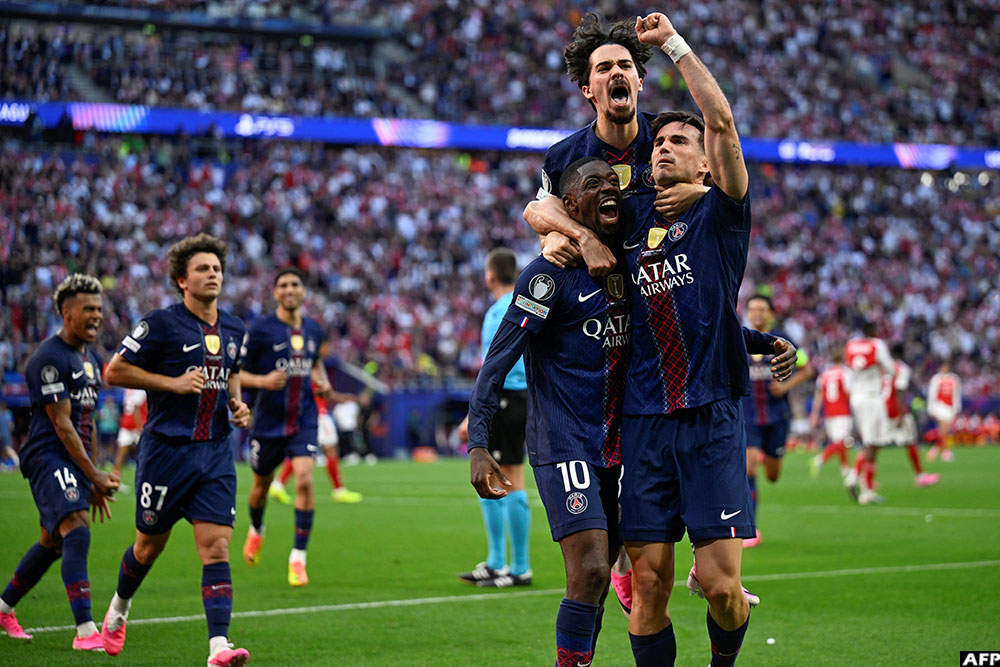
Paris Saint-Germain defeated Arsenal 4–3 on penalties to win the UEFA Champions League title after the match ended 1–1 through extra time at the Puskás Aréna in Budapest. Kai Havertz handed Mikel Arteta‘s newly crowned Premier League champions an early lead in the 6th minute, but Ousmane Dembélé leveled from the penalty spot in the 64th minute after Cristhian Mosquera fouled Khvicha Kvaratskhelia.
Both defenses stood tall despite mounting fatigue, pushing the final into a shootout where PSG converted four of their five spot-kicks while Arsenal saw Eberechi Eze and Gabriel Magalhães miss. With the victory, Luis Enrique‘s PSG side secured back-to-back European titles, while Arsenal’s historic wait for their first Champions League trophy continues.

Vitinha was officially named the PlayStation Player of the Match by the UEFA Technical Observer Group after a historic, tempo-controlling display in midfield, completing 141 passes—tying the record for the most passes in a Champions League final, matching Barcelona icon Xavi’s 2011 performance against Manchester United. PSG statistically dominated possession (78% to 22%) and total shots (8 to 3), reflecting Luis Enrique’s possession-heavy structure against Arteta’s defensive block.
📢 GET A DETAILED ARTICLES + JOBS
Join ASJ's WhatsApp Channel and never miss a post or opportunity.

Key Developments: Early Arsenal Lead, Dembélé’s Penalty, and the Shootout Collapse
The final began with a shock. Arsenal, playing their first Champions League final since 2006, took the lead in the 6th minute through Kai Havertz. The German forward, who has reinvented himself as a crucial big-game player for Arteta, capitalized on a defensive lapse to hand Arsenal an early advantage. For the next hour, Arsenal defended resolutely, absorbing PSG pressure and threatening on the counter.
PSG’s equalizer came from the penalty spot. Cristhian Mosquera’s foul on Kvaratskhelia was indisputable, and Dembélé—who has emerged as a reliable penalty taker for PSG—stepped up to convert. The goal shifted momentum decisively toward the French champions, who dominated possession and territory for the remainder of regulation and extra time.

Extra time saw both teams prioritize defensive stability. Arteta made a double switch before the extra period, introducing Martín Zubimendi for Myles Lewis-Skelly to anchor a midfield that was losing physical duels, and Eberechi Eze for Havertz to offer counter-attacking progression. However, sacrificing Havertz stripped Arsenal of their primary aerial target and physical outlet, forcing the team to defend even deeper. With Bukayo Saka and Leandro Trossard already substituted, Arsenal morphed into a low-block 4–5–1, leaving striker Viktor Gyökeres entirely isolated.
The penalty shootout was decided by fine margins. Gonçalo Ramos and Viktor Gyökeres converted in Round 1. Désiré Doué scored for PSG; Eberechi Eze missed for Arsenal. Nuno Mendes’s penalty was saved, but Declan Rice scored for Arsenal to keep them level. Achraf Hakimi and Gabriel Martinelli converted in Round 4. Lucas Beraldo scored for PSG, and Gabriel Magalhães missed the decisive fifth penalty. Arteta’s decision to withdraw calm, experienced players like Ødegaard and Havertz during regular time meant that newer, fatigue-worn players were tasked with the shootout. The gamble backfired.
The all-time head-to-head UEFA record is now perfectly balanced. This final marked the 8th competitive European meeting between the two clubs. PSG has two wins (both in the 2024/25 Champions League semifinals). Arsenal has two wins (1993/94 Cup Winners‘ Cup and 2024/25 league phase). Four matches have ended in draws, including this 1–1 final deadlock before penalties.
Analysis & Implications: Vitinha’s Record-Breaking Control, Arteta’s Reactive Gamble, and Tactical Contrast
Vitinha’s performance will be studied for years. The Portuguese midfielder served as PSG’s primary engine over his 105 minutes on the pitch, completing 141 passes—tying Xavi’s 2011 final record. He also marked his ninth tournament game with over 100 completed passes, matching another single-edition record held by Xavi. His tactical assignments proved decisive: when Achraf Hakimi advanced high up the right wing, PSG shifted into a back three, leaving Vitinha to act as the single anchor in possession. He consistently dropped deep to draw out Arsenal’s markers, creating vertical passing lanes for Dembélé to drop in as a false nine. Alongside João Neves, he successfully absorbed Arsenal’s central transitions, forcing Arteta’s side to attack through less dangerous wide crosses.
The statistical disparity reflects the tactical contrast. PSG had 78% possession, 8 total shots (3 on target), 5 corner kicks, and 0 goalkeeper saves. Arsenal had 22% possession, 3 total shots (1 on target), 1 corner kick, and 2 goalkeeper saves. Arsenal’s defensive block was effective at limiting clear chances, but they created virtually nothing offensively after Havertz’s early goal. Gyökeres, who replaced Martin Ødegaard in the 65th minute, was left entirely isolated, resulting in an extra-time caution for frustration.
Arteta’s substitutions were reactive rather than proactive. Zubimendi stabilized possession but operated purely in a low block; Eze offered progression but lacked Havertz’s physical presence. The decision to withdraw Saka and Trossard in the 83rd minute for Noni Madueke and Gabriel Martinelli further reduced Arsenal’s attacking threat. The fresh wingers were tasked almost entirely with tracking back to stop overlapping runs from Hakimi and Nuno Mendes. While the changes successfully preserved defensive stability, they introduced fatal volatility for the penalty shootout.
The contrast between the two managers’ approaches was stark. Luis Enrique trusted his possession structure and his players’ composure. Arteta prioritized defensive resilience but sacrificed the attacking outlets and experienced penalty takers that might have won the shootout. The result extends Arsenal’s wait for their first Champions League trophy—a drought that now stretches over three decades since their last European final appearance in 2006.
The individual tournament statistics highlight the attacking talent on display. Kvaratskhelia finished the campaign with 15 appearances, 10 goals, and 6 assists. Hakimi recorded 12 appearances and 6 assists. Martinelli contributed 13 appearances, 6 goals, and 1 assist. David Raya played every minute of Arsenal’s campaign, with 13 appearances and 1,170 minutes.
What This Means for PSG, Arsenal, and European Football’s Financial Landscape
For PSG, back-to-back Champions League titles cement Luis Enrique’s legacy and validate the club’s long-term project. After years of high-profile exits despite massive investment, PSG has now established itself as Europe’s dominant force. The retention of key players like Vitinha, Kvaratskhelia, and Hakimi will be easier with the prestige of consecutive titles. The club also secures the €25 million prize for winning the final, on top of accumulated performance bonuses.

For Arsenal, the defeat is devastating. The club has not won the Champions League since its inception in its current format; its only European Cup came in the pre-Champions League era. Arteta has built a competitive team that won the Premier League, but the inability to close out the final will raise questions about squad depth, tactical flexibility, and mental resilience. The €18.5 million runner-up prize is cold comfort.
The financial breakdown under the revamped 36-team single league phase format is substantial. The base participation fee is €18.62 million guaranteed for every team that qualifies. Match victories earn €2.1 million; draws earn €700,000. League placement bonuses start at €275,000 for the lowest-ranked club, scaling up to €9.9 million for the top-seeded finisher. Knockout progression adds: play-offs €1 million, Round of 16 €11 million, quarter-finals €12.5 million, semi-finals €15 million. Cumulative revenues easily exceed €100 million for champions, including TV market pools and value-pillar shares.
The broadcast and commercial implications are significant. The final drew a global audience estimated at over 500 million viewers. The Puskás Aréna in Budapest hosted a dramatic, memorable final that will be replayed for years. The tournament’s new format, which replaced the traditional group stage with a single league phase, was considered a success, with competitive matches throughout and no dead rubbers.
The Accra Street Journal notes that while European football dominates global attention, the financial flows from the Champions League—broadcasting rights, sponsorships, prize money—ultimately benefit clubs that then invest in players, some of whom come from Africa. PSG’s squad includes African stars like Achraf Hakimi (Morocco); Arsenal’s includes Thomas Partey (Ghana). The success of European clubs indirectly supports African football through transfer fees, player development, and exposure.
Wider Context: Champions League Evolution and the State of European Football
The 2025/26 Champions League was the second season under the new format: 36 teams in a single league phase, each playing eight matches (four home, four away). The top eight qualify directly for the Round of 16; places 9 to 24 enter a knockout play-off round. The format was designed to increase competitive matches and reduce dead rubbers. Early reviews are positive, though the expanded schedule adds to player fatigue.
The financial distribution remains heavily skewed toward established clubs. PSG and Arsenal, as members of Europe’s elite, earned far more from the tournament than smaller clubs that qualified. The gap between the rich and the rest continues to widen, raising questions about competitive balance. UEFA’s Financial Sustainability Regulations (FSR) have replaced Financial Fair Play (FFP), but enforcement remains uneven.
The final’s location—Budapest’s Puskás Aréna—is part of UEFA’s strategy to host major finals in emerging European markets. Hungary has invested heavily in football infrastructure, and the stadium provided a fitting stage for a dramatic final. Future finals are scheduled for other non-traditional hosts, reflecting UEFA’s desire to expand the game’s geographic footprint.
The performance of English clubs in the Champions League remains strong. Arsenal reached the final; Manchester City, Liverpool, and Chelsea also progressed to the knockout stages. However, the dominance of English clubs has been challenged by Spanish (Real Madrid, Barcelona), German (Bayern Munich), and French (PSG) sides. The competition remains unpredictable.
The record-breaking performance of Vitinha—matching Xavi’s 141 passes in a final—places him in elite company. Xavi’s 2011 performance is considered one of the greatest midfield displays in Champions League history. Vitinha’s achievement, in a final where PSG had 78% possession, is statistically impressive, though the opposition (Arsenal’s defensive block) was different from Manchester United’s 2011 side. Nonetheless, Vitinha has established himself as one of Europe’s premier midfielders.
The Accra Street Journal’s conclusion: the 2025/26 Champions League final was a tactical chess match won by composure. PSG’s 78% possession and Vitinha’s record-breaking passing display reflected Luis Enrique’s philosophy. Arsenal’s defensive block worked for 120 minutes but cracked in the shootout. Arteta’s substitutions, while preserving defensive stability, introduced volatility that cost his team.
For PSG, back-to-back titles mark a dynasty. For Arsenal, the wait continues. The financial rewards—over €100 million for the champions—will fuel further investment, widening the gap between Europe’s elite and the rest. The tournament remains the pinnacle of club football, but its economic structure favors the already wealthy.
Source: Accra Street Journal
Last Updated on May 30, 2026 by Samuel Kwame Boadu
🏟️ Discover More Sports Stories
Looking for more in-depth sports news, interviews, and features? Visit Accra Sports News — your go-to for exclusive sports content in Ghana and beyond.
Disclaimer: Some content on Accra Street Journal may be aggregated, summarized, or edited from third-party sources for informational purposes. Images and media are used under fair use or royalty-free licenses. Accra Street Journal is a subsidiary of SamBoad Publishing Hub under SamBoad Business Group Ltd, registered in Ghana since 2014.
For concerns or inquiries, please visit our Privacy Policy or Contact Page.

Samuel Kwame Boadu is a Ghanaian media entrepreneur and storyteller with a passion for amplifying urban voices and uncovering everyday truths. He is the Editor-in-Chief and Founder of Accra Street Journal, a dynamic digital platform dedicated to capturing the pulse of Ghana’s capital—its people, culture, challenges, business, sports and innovations.