
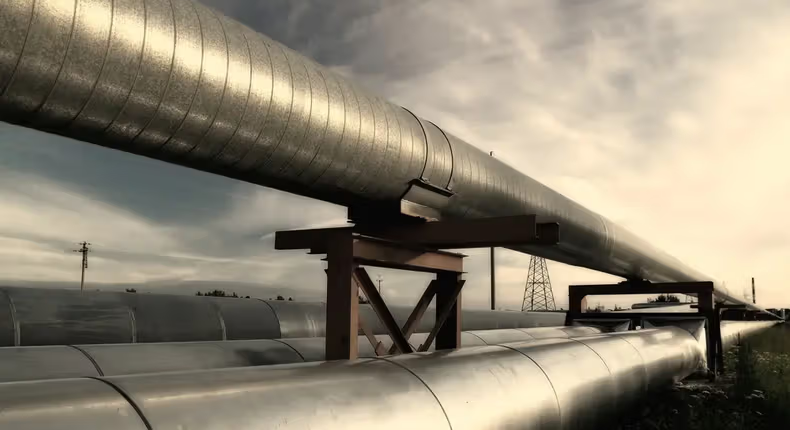
Nigeria, Niger and Algeria are advancing a 4,128-kilometre gas pipeline that could supply Europe with up to 30 billion cubic metres of natural gas annually as it seeks alternatives to Russian energy. Construction has begun on the Algerian section of the Trans-Saharan Gas Pipeline, advancing a decades-old plan to carry Nigerian gas through Niger to European markets. The start of work marks a major step for one of Africa’s largest planned energy infrastructure projects, which will cross Nigeria and Niger before linking with Algeria’s extensive pipeline and export network.
The pipeline is designed to stretch from Warri in southern Nigeria to Algeria’s Hassi R’Mel gas hub, passing through Niger. From Hassi R’Mel, the gas can be moved through Algeria’s existing network to Mediterranean export terminals and pipelines serving European markets. Project documents indicate that the new Algerian section will run about 1,210 kilometres from the border with Niger to Aoulef in southern Algeria, connecting with existing infrastructure to Hassi R’Mel. Niger is expected to begin work on its 720-kilometre section in early 2027.

Algerian Energy and Mines Minister Mohamed Arkab described the pipeline as a “driver of economic and social development, a source of wealth and employment, and a tool for strengthening African energy integration.
📢 GET A DETAILED ARTICLES + JOBS
Join ASJ's WhatsApp Channel and never miss a post or opportunity.

Key Developments: Algerian Construction Start, Niger’s 2027 Target, and European Demand
The start of construction on the Algerian section is a significant milestone. The project has been discussed for decades but has faced delays due to financing, security, and geopolitical challenges. The actual commencement of work on the ground signals that the project is moving from concept to reality. The Algerian section is the most straightforward because much of Algeria’s pipeline infrastructure is already in place; the new section will connect to existing networks.
Niger’s commitment to begin work on its 720-kilometre section in early 2027 is equally important. Niger is the transit country; without its cooperation, the pipeline cannot function. The timeline suggests that the project could be completed by the early 2030s, assuming no major delays. Niger’s Petroleum Minister Hamadou Tini described the pipeline as a “historic undertaking that would have a significant economic and social impact on communities along the pipeline route.”

The European demand driver is powerful. The European Union plans to end its reliance on Russian gas by late 2027, with LNG imports due to stop by December 31, 2026, and pipeline-gas imports by September 30, 2027. This creates a urgent need for alternative supplies. The Trans-Saharan pipeline, if completed, could provide up to 30 billion cubic metres annually—approximately 10% to 15% of Europe’s current gas imports from Russia.
Algeria already supplies about 12% of the EU’s gas imports, giving it the infrastructure to move Nigerian gas into the market. The pipeline would complement Algeria’s existing exports, not replace them. For Nigeria, the pipeline provides an additional route to European markets, complementing the LNG cargoes it already exports by sea (from Bonny Island and other terminals). For Niger, the pipeline provides transit fees, which could be a significant source of revenue.
The project faces financing challenges. The estimated cost of the pipeline is in the billions of dollars. The African Development Bank, European financial institutions, and private investors may provide funding. Security concerns are also significant: the pipeline will pass through the Sahel region, which has experienced instability and insurgency. The governments must ensure the pipeline’s security.
The competition with the proposed Nigeria-Morocco Gas Pipeline is noteworthy. The Nigeria-Morocco route would follow the Atlantic coast, connecting several West African countries before reaching Morocco and potentially Europe. The Trans-Saharan route is shorter and may be cheaper. The Nigeria-Morocco route has broader regional integration benefits. Both projects cannot be built; the market will decide which is viable.
Analysis & Implications: European Gas Diversification, African Energy Integration, and Project Economics
The European Union’s decision to end Russian gas imports is a geopolitical earthquake. Russia supplied approximately 40% of the EU’s gas before the 2022 invasion of Ukraine; that share has fallen, but alternatives are needed. The Trans-Saharan pipeline could provide a significant volume, but it will take years to build. In the short term, Europe will rely on LNG imports (from the US, Qatar, Australia) and pipeline gas from Norway, Azerbaijan, and Algeria.
African energy integration is a long-standing aspiration. The Trans-Saharan pipeline would connect West Africa (Nigeria) to North Africa (Algeria) and then to Europe. It would also enable gas trade among African countries: Nigeria could supply gas to Niger and perhaps other countries along the route. The African Union’s Agenda 2063 includes energy integration as a priority.
The project economics depend on gas prices. At current prices (European hub prices of $10 to $15 per million British thermal units), the pipeline would be profitable. If prices fall due to a global gas glut or a rapid energy transition, the project may become uneconomic. The long-term outlook for gas is uncertain; the International Energy Agency projects that gas demand may peak by 2030 and then decline. Investors must weigh that risk.
The security challenge is substantial. The Sahel region has experienced coups, insurgencies, and banditry. The pipeline will be a target for attacks. The governments must deploy security forces to protect the infrastructure. International partners may provide security assistance.
The financing model is not yet clear. The pipeline could be financed through a public-private partnership, with the three governments providing guarantees and private investors providing capital. The African Development Bank, the European Investment Bank, and other DFIs may provide concessional loans. The involvement of Chinese companies (which have built pipelines in Africa) is possible.

The Accra Street Journal notes that Ghana is not directly involved in the Trans-Saharan pipeline but is connected to the West African Gas Pipeline (WAGP), which supplies Nigerian gas to Ghana, Togo, and Benin. The WAGP has operated intermittently due to gas supply and payment issues. The Trans-Saharan pipeline does not compete with the WAGP; they serve different markets.
What This Means for Nigeria, Niger, Algeria, and European Energy Security
For Nigeria, the pipeline provides a new export route. The country has vast gas reserves (over 200 trillion cubic feet) but has struggled to monetise them due to lack of infrastructure. The pipeline could generate billions in export revenue. It would also reduce flaring (burning of gas) and associated environmental damage.
For Niger, the pipeline provides transit fees and associated development. The country is one of the poorest in the world; the pipeline could be transformative. However, the pipeline also passes through unstable regions; the government must ensure that local communities benefit, not just the central government.
For Algeria, the pipeline reinforces its position as a major gas supplier to Europe. The country already has the infrastructure; the pipeline will increase utilisation. Algeria also gains politically, as Europe becomes more dependent on its gas.
For European energy security, the pipeline provides diversification. Europe is reducing dependence on Russia; new sources are needed. The Trans-Saharan pipeline, together with LNG from the US, Qatar, and other suppliers, can replace Russian gas. However, the pipeline will not be completed by the 2027 deadline; Europe will need interim solutions.
For the global gas market, the pipeline adds supply. If completed, it could put downward pressure on prices, benefiting consumers. However, the timeline is uncertain; the impact will be felt in the 2030s, not immediately.
The Accra Street Journal’s assessment: the Trans-Saharan pipeline is a positive development for African energy integration and European energy security. The start of construction on the Algerian section is a milestone. However, significant challenges remain: financing, security, and the completion of Niger’s section. The project is not yet a certainty. The governments and their partners must sustain momentum.
Wider Context: African Gas Pipelines and European Energy Transition
African gas pipelines are not new. The West African Gas Pipeline (WAGP) was completed in 2010. The East African Crude Oil Pipeline (EACOP) is under construction. The Nigeria-Morocco pipeline has been studied. The Trans-Saharan pipeline is the most ambitious in terms of length and capacity.
The European energy transition complicates the outlook. The EU is committed to net-zero emissions by 2050. Natural gas is a fossil fuel; its long-term role is limited. The EU classifies gas as a “transition fuel” but requires compliance with methane emissions standards. The pipeline’s gas must be responsibly sourced.
The competition with LNG is fierce. LNG can be shipped from anywhere; pipeline gas is fixed to a specific route. Europe is building LNG import terminals (in Germany, the Netherlands, Poland). The Trans-Saharan pipeline must compete with LNG on price and reliability.
The comparison with the Nigeria-Morocco pipeline is instructive. The Nigeria-Morocco route is longer and more expensive but would connect several West African countries, promoting regional integration. The Trans-Saharan route is shorter and cheaper but passes through the unstable Sahel. The two projects are competing for the same gas and the same European market.

The Accra Street Journal’s conclusion: the Trans-Saharan pipeline is a bold project. The start of construction on the Algerian section is a significant step. The project could supply Europe with 30 billion cubic metres of gas annually, replacing a portion of Russian imports. It could also promote African energy integration and generate revenue for Nigeria, Niger, and Algeria. But the challenges are substantial: financing, security, and the completion of Niger’s section. The project is not yet a done deal. The governments must demonstrate sustained commitment.
Source: Accra Street Journal
Last Updated on June 7, 2026 by Samuel Kwame Boadu
Disclaimer: Some content on Accra Street Journal may be aggregated, summarized, or edited from third-party sources for informational purposes. Images and media are used under fair use or royalty-free licenses. Accra Street Journal is a subsidiary of SamBoad Publishing Hub under SamBoad Business Group Ltd, registered in Ghana since 2014.
For concerns or inquiries, please visit our Privacy Policy or Contact Page.

Samuel Kwame Boadu is a Ghanaian media entrepreneur and storyteller with a passion for amplifying urban voices and uncovering everyday truths. He is the Editor-in-Chief and Founder of Accra Street Journal, a dynamic digital platform dedicated to capturing the pulse of Ghana’s capital—its people, culture, challenges, business, sports and innovations.