








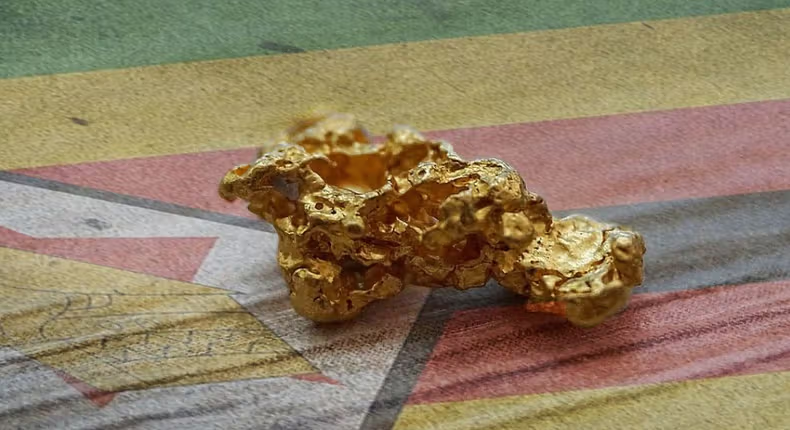

The new facility is expected to be commissioned next year as the state-owned Fidelity Gold Refinery struggles to keep pace with production projected to reach 50 tonnes in 2026.

Zimbabwe has licensed a second gold refinery as it moves to expand its processing capacity amid rising output of the precious metal and growing pressure on its existing infrastructure.
The new refinery, which will be located in Bulawayo, the country’s second-largest city, is expected to be commissioned next year, according to government officials who spoke to Bloomberg. Currently, all gold produced in Zimbabwe is processed through the state-owned Fidelity Gold Refinery. However, officials say the facility may soon be unable to handle the country’s increasing production volumes, particularly as output is projected to reach 50 tonnes in 2026, up from a record 46.7 tonnes last year.
📢 GET A DETAILED ARTICLES + JOBS
Join ASJ's WhatsApp Channel and never miss a post or opportunity.
The investors behind the Bulawayo refinery have not been disclosed. Authorities said their identities would only be made public once the facility is formally commissioned.
Gold continues to play a central role in Zimbabwe’s external earnings. In the first quarter of 2026 alone, gold exports brought in $1.19 billion, more than double the $579 million recorded in the same period the previous year. In 2025, the sector generated $4.61 billion, accounting for roughly 47.5 percent of the country’s total export revenue of $9.7 billion.
The government is also pushing to scale up production further. Mutapa Gold Resources, the state-owned mining entity, has set a target of doubling output by 2029. Meanwhile, the Mutapa Investment Fund, Zimbabwe’s sovereign wealth vehicle, is seeking $250 million to expand mining operations and strengthen output.
The funding drive comes as Zimbabwe intensifies its push for resource-driven industrialisation, including a new policy that prohibits foreign individuals and firms from participating in small-scale gold mining, part of a broader strategy to boost local ownership and develop the domestic mineral industry.
According to a report by Accra Street Journal, the new refinery marks another step in Zimbabwe’s broader strategy to deepen its dependence on gold as a stabilising force for its foreign exchange earnings. The expansion highlights the country’s growing reliance on the precious metal as a critical source of foreign currency amid ongoing economic pressures.
Source: Accra Street Journal
Last Updated on June 19, 2026 by Samuel Kwame Boadu
Disclaimer: Some content on Accra Street Journal may be aggregated, summarized, or edited from third-party sources for informational purposes. Images and media are used under fair use or royalty-free licenses. Accra Street Journal is a subsidiary of SamBoad Publishing Hub under SamBoad Business Group Ltd, registered in Ghana since 2014.
For concerns or inquiries, please visit our Privacy Policy or Contact Page.

Samuel Kwame Boadu is a Ghanaian media entrepreneur and storyteller with a passion for amplifying urban voices and uncovering everyday truths. He is the Editor-in-Chief and Founder of Accra Street Journal, a dynamic digital platform dedicated to capturing the pulse of Ghana’s capital—its people, culture, challenges, business, sports and innovations.