







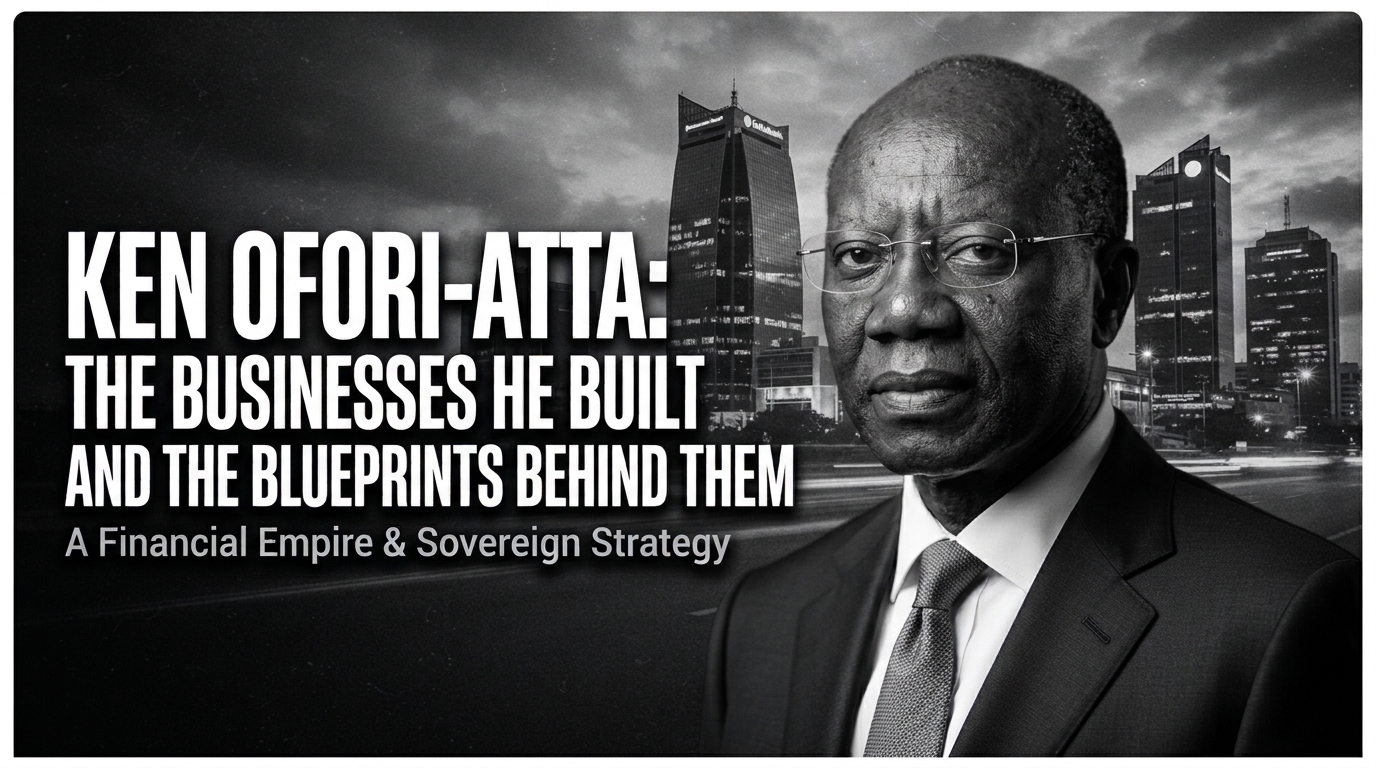
Before he became Ghana’s Finance Minister, Ken Ofori-Atta was an investment banker who built an empire on a simple but powerful idea: ordinary Ghanaians could be a source of capital. He did not build factories or trade goods. He built pipelines that collected small, fragmented savings and converted them into institutional money that could buy banks, fund infrastructure, and restructure debt.
Here is how he did it, and what those businesses look like today.

The Key Businesses
The Databank Group
Ofori-Atta co-founded Databank in 1990 with Keli Gadzekpo, James Akpo, and Togbe Afede XIV. It started as a three-person equity research shop and grew into Ghana’s premier investment bank, dominating brokerage, asset management, and corporate finance advisory.
📢 GET A DETAILED ARTICLES + JOBS
Join ASJ's WhatsApp Channel and never miss a post or opportunity.

Databank’s breakthrough was Epack, Ghana’s first and largest mutual fund. Launched in October 1996, Epack allowed everyday citizens to pool their small savings into the stock market. Before Epack, investing was seen as a luxury for institutions or the very wealthy. Databank changed that.
Epack grew from a pilot with 28 investors and GH¢2,500 in seed capital to a fund serving over 100,000 shareholders with an asset base worth hundreds of millions of cedis.

Enterprise Group Limited (GSE: EGL)
Ofori-Atta has historically held significant equity and executive board positions within Enterprise Group, a financial services giant listed on the Ghana Stock Exchange. The group spans Enterprise Insurance (general insurance), Enterprise Life, Enterprise Trustees (pensions), and real estate.
The strategic value of Enterprise Group was not just its size. It was the synergy with Databank. Insurance companies and pension trustees collect premiums upfront and pay claims later. This leaves them holding large cash reserves—the “float.” In Ofori-Atta’s model, that float was efficiently funnelled into Databank’s investment vehicles, capturing fees at every stage of the financial lifecycle.
Pan-African Banking Partnerships
Ofori-Atta extended his financial footprint beyond Ghana. He acquired equity and chairmanship seats in several regional banks across West and East Africa, including Trust Bank Limited (The Gambia), International Bank of Liberia, and Bank of Kigali (Rwanda).
The logic was regulatory arbitrage and currency diversification. In the late 1990s and 2000s, banking regulations and interest rate spreads varied wildly across Africa. When Ghana’s economy faced inflation spikes or currency crunches, his operations in Rwanda or The Gambia acted as a financial buffer. By spreading his network across multiple currencies—the Gambian Dalasi, Rwandan Franc, Liberian Dollar, and Ghanaian Cedi—his holding companies enjoyed an organic hedge against localized depreciation.
Family Ventures and Offices Limited
A private West African investment platform he founded to oversee family acquisitions, real estate holdings, and private equity placements. This was the holding structure that consolidated his family’s wealth.
How He Made Them: The Strategies
1. Wall Street Training and the Homecoming
Ofori-Atta studied economics at Columbia University and earned an MBA from Yale School of Management. He then worked on Wall Street as an investment banker for Morgan Stanley and Salomon Brothers, handling debt and equity management in New York for four years.
When he returned to Ghana in 1990, he possessed highly specialized financial engineering knowledge that was virtually non-existent in the local market at the time. That knowledge was his first competitive advantage.
2. Capitalizing on the Genesis of the Ghana Stock Exchange
When Databank opened in 1990, the Ghana Stock Exchange was just starting up. Ofori-Atta and his co-founders realized that foreign and local investors had no data to work with.
They created value by compiling raw data on Ghanaian businesses, designing the first local stock market index, and interpreting trading results for the public. This foundational analytical work built immediate institutional credibility. Databank was not just a broker. It was the source of market intelligence.

3. Securing Seed Capital and Leveraging Personal Assets
To scale from pure research to full financial execution, Databank secured a vital $25,000 seed loan from CAL Merchant Bank. This leverage allowed them to expand into corporate advisory and brokerage.
Later, during tight macroeconomic cycles, the partners aggressively leveraged their personal assets. During a severe liquidity crunch, Ofori-Atta famously put up his shares in Enterprise Insurance as collateral to secure an emergency private bridge loan to keep his foundational enterprises liquid. The willingness to put his own wealth on the line was a defining feature of his risk profile.
4. The Retail Mobilization Strategy
Before Databank, investing was an exclusive club. Ofori-Atta disrupted it by launching retail mutual funds like Epack.
The Epack model was built on three pillars:
Pan-African Diversification. Epack was designed as an aggressive growth fund. From inception, Databank secured regulatory leeway to invest across multiple African exchanges, buying equities on the Nigerian Stock Exchange, the Nairobi Securities Exchange in Kenya, and the BRVM in Ivory Coast. When the Ghanaian cedi faced pressure, Epack’s offshore, dollar- and CFA-denominated equity returns provided an organic hedge that boosted its Net Asset Value.
Mass Mobilization. Databank lowered the barrier to entry to zero, allowing retail clients to start investing with very small amounts. They marketed the concepts of dollar-cost averaging and compound interest to the Ghanaian middle class, pitching the fund to student groups, teachers’ unions, church congregations, and micro-entrepreneurs. This steady stream of small, recurring deposits provided reliable liquidity, allowing the fund manager to aggressively buy undervalued stocks during market downturns when larger institutional investors were forced to freeze capital.
Strategic Concentration in Blue Chips. Epack became an anchor institutional investor in major local success stories, notably accumulating massive early blocks of MTN Ghana, GCB Bank, and Fan Milk. Capturing the rapid expansion of these corporations allowed Epack to regularly outperform bank fixed deposits and treasury bills.
5. The Fee-Yield Shield
The beauty of the mutual fund model lies in its fee structure. Mutual funds charge an asset management fee—typically 1.5% to 2.5% of total Assets Under Management annually—regardless of whether the market goes up or down.
As Epack’s volume grew into hundreds of millions of cedis, it generated massive, predictable, recurring cash flow for Databank. This insulated the firm from economic downturns. The fee stream was the foundation of Databank’s stability.
From Databank to the Ministry of Finance
Ofori-Atta’s 26-year tenure building Databank heavily influenced the financial mechanisms he deployed as Finance Minister from January 2017.
The Investment Banker’s Approach to Sovereign Debt
At Databank, his primary skill was leveraging capital and structuring corporate bonds. As Finance Minister, he applied the same investment banking approach to sovereign debt. He aggressively shifted Ghana’s debt profile from expensive, short-term domestic loans to long-term international Eurobonds, capitalizing on global liquidity.

The ESLA Model: Asset Securitization
When he took over the Ministry, he inherited a mountain of legacy energy sector debts owed by state-owned enterprises like the Volta River Authority and the Ghana National Petroleum Corporation to local banks and bulk oil distributors. These non-performing loans were choking the banking sector.
His solution was a classic investment banking strategy: asset securitization through a Special Purpose Vehicle.
The government incorporated an off-balance sheet public limited liability company called E.S.L.A. PLC. The state legally assigned cash flows from the Energy Sector Levies—charged on every litre of fuel purchased nationwide—directly to this SPV. E.S.L.A. PLC then issued long-term, cedi-denominated corporate bonds to institutional investors, backed entirely by those continuous fuel levies.
The cash raised from the bond auctions was immediately used to pay off the commercial banks, wiping out bad debts and injecting liquidity back into the financial sector. Because the debt belonged to the SPV and was serviced by a specific consumer levy, it insulated the national budget from immediate default risk.
The Agyapa Royalties Model
This was a direct translation of an investment banking asset-bundling play. The strategy sought to take Ghana’s steady, long-term gold mineral royalties, bundle them into a secure offshore SPV called Agyapa, and list it on the London Stock Exchange to raise immediate, front-ended cash. It was the exact financial blueprint of a mutual fund, applied to national mineral wealth. The proposal was controversial and was eventually withdrawn, but the structural logic reflected his private-sector training.
The Financial Sector Clean-Up (2017–2019)
Between 2017 and 2019, the Bank of Ghana and the Securities and Exchange Commission revoked the licences of 9 commercial banks, 347 microfinance companies, and 53 asset management firms due to severe capital insolvency.
The clean-up triggered a massive “flight to quality.” Retail and corporate investors pulled capital out of tier-3 firms and flooded tier-1 institutions with liquidity. Because Databank possessed a 25-year unblemished track record and robust fund structures like Epack, it became a primary beneficiary. Its Assets Under Management expanded significantly as it absorbed displaced market share.
The DDEP Collision
The intersection of his private and public paths culminated in the Domestic Debt Exchange Programme in 2023. To prevent a sovereign default, the Finance Ministry restructured domestic bonds. This directly impacted the liquidity and NAV valuations of retail mutual funds across Ghana—including the very asset management industry Ofori-Atta had spent his early career establishing.
The Ofori-Atta Business Blueprint: A Summary
| Business Component | Private Sector Execution (Databank/Enterprise) | Sovereign Sector Translation (Finance Ministry) |
|---|---|---|
| Capital Sourcing | Pooling small retail deposits from everyday citizens | Mobilizing international Eurobonds and structured local bonds |
| Revenue Generation | Charging recurring management fees on continuous capital pools | Levying targeted sector taxes (E-Levy, Energy Levies) to back loans |
| Risk Management | Diversifying equity investments across multiple African exchanges | Restructuring debt instruments via the DDEP |
| Structural Alignment | Interlocking insurance floats directly into asset management desks | Creating state SPVs (Agyapa, ESLA) to monetize public revenue streams |
ASJ Takeaway
Ken Ofori-Atta built his wealth by understanding a simple truth: capital is not just money. It is a pipeline. If you can build the pipeline that collects fragmented savings and converts them into institutional investment, you capture fees at every stage.
He built that pipeline in the private sector through Databank and Epack. He translated it into public policy through ESLA and the DDEP. And in doing so, he demonstrated both the power and the risk of financial engineering—the ability to create liquidity where none existed, and the systemic exposure that comes when that liquidity is concentrated in a few institutions.
Frequently Asked Questions
1. What businesses does Ken Ofori-Atta own?
He co-founded Databank Group, holds significant equity in Enterprise Group (Enterprise Insurance, Enterprise Life, Enterprise Trustees), and has banking interests in Trust Bank (The Gambia), International Bank of Liberia, and Bank of Kigali (Rwanda).
2. What is Epack?
Epack is Ghana’s first and largest mutual fund, launched by Databank in October 1996. It started with 28 investors and GH¢2,500, and grew to serve over 100,000 shareholders.
3. How did Ofori-Atta build Databank?
He leveraged his Wall Street training at Morgan Stanley and Salomon Brothers, compiled the first local stock market data, secured a $25,000 seed loan from CAL Merchant Bank, and pioneered retail mutual funds that mobilized small savings from ordinary Ghanaians.
4. How did Epack grow so large?
Through pan-African diversification, mass mobilization of retail investors, strategic concentration in high-yield blue chips like MTN Ghana, GCB Bank, and Fan Milk, and recurring asset management fees.
5. What was Ofori-Atta’s role at Enterprise Group?
He held significant equity and executive board positions. The strategic value was the synergy with Databank—insurance floats were funnelled into Databank’s investment vehicles.
6. What is the ESLA model?
The Energy Sector Levy Act model was an asset securitization strategy. The government created an SPV (E.S.L.A. PLC) that issued bonds backed by fuel levies to pay off legacy energy sector debts.
7. What was Agyapa Royalties?
A proposed offshore SPV that would bundle Ghana’s gold mineral royalties and list them on the London Stock Exchange to raise front-ended cash. It was controversial and was eventually withdrawn.
8. How did the Financial Sector Clean-Up affect Databank?
The clean-up triggered a “flight to quality.” Databank, with its long track record, absorbed displaced market share as smaller asset management firms collapsed.
9. What was the DDEP’s impact on Ofori-Atta’s industry?
The Domestic Debt Exchange Programme restructured domestic bonds, directly impacting the liquidity and NAV valuations of retail mutual funds—including the asset management industry he had built.
10. What is Ofori-Atta’s business blueprint?
Capturing fragmented retail cash, consolidating it into institutional capital, charging recurring management fees, and diversifying across African markets to hedge currency risk.
Last Updated on October 29, 2026 by Samuel Kwame Boadu
Disclaimer: Some content on Accra Street Journal may be aggregated, summarized, or edited from third-party sources for informational purposes. Images and media are used under fair use or royalty-free licenses. Accra Street Journal is a subsidiary of SamBoad Publishing Hub under SamBoad Business Group Ltd, registered in Ghana since 2014.
For concerns or inquiries, please visit our Privacy Policy or Contact Page.

Samuel Kwame Boadu is a Ghanaian media entrepreneur and storyteller with a passion for amplifying urban voices and uncovering everyday truths. He is the Editor-in-Chief and Founder of Accra Street Journal, a dynamic digital platform dedicated to capturing the pulse of Ghana’s capital—its people, culture, challenges, business, sports and innovations.