







The electronics market in Ghana is a two-tier system. On one side sit the official retail listings—Jumia, authorised dealers, brand stores—where prices are published, warranties are offered, and the device is what it claims to be. On the other side sits the vast informal market of used imports, “UK used” phones, and clones dressed up as new. The price difference between the two can be tempting. The risk difference can be costly. Here is what the numbers actually show.
iPhone Prices: The Retail Listings
The retail prices for iPhones on Jumia Ghana vary widely by model, storage, and seller. These are advertised prices, often discounted from a higher “was” price.

| Model | Listed Price (GH₵) | Source |
|---|---|---|
| iPhone X (64GB) | 1,999 | Jumia listing |
| iPhone 11 (128GB) | 4,717 | Jumia listing |
| iPhone 13 (128GB) | 4,380 | Jumia listing |
| iPhone 13 Pro (128GB) | 7,400 | Jumia listing |
| iPhone 13 Pro Max (128GB) | 11,913 | Jumia listing |
| iPhone 13 Pro Max (256GB) | 9,900 | Jumia listing |
| iPhone 16 (128GB) | 13,370 | Jumia listing |
| iPhone 17 Pro Max (512GB) | 38,000 | Jumia listing |
A political claim to note: In September 2026, an NDC communications team member claimed the iPhone 13 Pro Max now sells for GH₵4,000–6,000, down from nearly GH₵12,000 under the previous administration . The Jumia listings show the 128GB model at GH₵11,913, which is closer to the higher figure. The claim may refer to used or specific market conditions. Treat it as a political statement, not a price guide.
📢 GET A DETAILED ARTICLES + JOBS
Join ASJ's WhatsApp Channel and never miss a post or opportunity.

Samsung Phone Prices: From Budget to Flagship
Samsung’s range is broader than Apple’s, and the price spread reflects that.
Budget and Mid-Range (Galaxy A Series)
| Model | Listed Price (GH₵) | Source |
|---|---|---|
| Galaxy A07 (128GB) | 2,118 | Jumia listing |
| Galaxy A27 (128GB) | 3,445 | Jumia listing |
| Galaxy A27 (256GB) | 4,298 | Jumia listing |
| Galaxy A37 5G | 4,799 | Jumia listing |
| Galaxy A57 5G (256GB) | 5,906 | Jumia listing |
Flagship (Galaxy S Series)
| Model | Listed Price (GH₵) | Source |
|---|---|---|
| Galaxy S24 (128GB) | 6,999 | Jumia listing |
| Galaxy S24 Ultra (256GB) | 10,700 | Jumia listing |
| Galaxy S25 (128GB) | 9,500 | Jumia listing |
| Galaxy S25 Ultra (256GB) | 16,500 | Jumia listing |
| Galaxy S26 (128GB) | 14,999 | Jumia listing |
| Galaxy S26 Ultra (256GB) | 14,308–19,999 | Jumia listings |
Foldables
The Galaxy Z Flip 5 (256GB) is listed at GH₵10,869 . The Galaxy Z Fold 5 (256GB) sits at GH₵11,848 .

Laptop Prices: Refurbished vs New
The laptop market in Ghana is dominated by refurbished business machines—HP EliteBook, Dell Latitude, Lenovo ThinkPad—alongside new consumer models.
Refurbished Business Laptops
| Model | Listed Price (GH₵) | Source |
|---|---|---|
| HP EliteBook 830 G8 (i5, 8GB, 256GB) | 4,753 | Jumia listing |
| HP EliteBook 840 G8 (i5, 8GB, 256GB) | 4,850 | Jumia listing |
| Dell Latitude 5420 (i5, 8GB, 256GB) | 4,750 | Jumia listing |
| Lenovo ThinkPad T14s G2 (i5, 8GB, 256GB) | 4,830 | Jumia listing |
| Dell Latitude 7420 (i7, 16GB, 512GB) | 6,950 | Jumia listing |
New Consumer Laptops
| Model | Listed Price (GH₵) | Source |
|---|---|---|
| Dell 14 D14260 (Core Ultra 7, 16GB, 512GB) | 10,799 | Jumia listing |
| Dell XPS 13 | 13,000 | Jumia listing |
| Dell XPS 14 (Core Ultra 7, 16GB, 1TB) | 14,500 | Jumia listing |
| Apple MacBook Air 13″ (M5, 16GB, 512GB) | 16,999 | Jumia listing |
| Dell Precision 7680 Workstation | 23,500 | Jumia listing |
The pattern is clear: a refurbished business laptop with an 11th-gen Intel processor costs GH₵4,700–4,900. A new consumer laptop with a current processor costs GH₵10,000–17,000. The refurbished market is where most Ghanaian buyers operate.
Where to Buy Electronics in Ghana
Jumia Ghana is the largest online marketplace, with both official brand stores and third-party sellers. The listings above are drawn from Jumia. The risk is that third-party sellers may not be authorised, so check the seller’s rating and whether the item carries a warranty .
Franko Trading Enterprise is a major physical and online retailer based in Kumasi, with delivery across Ghana. It positions itself as selling “100% genuine devices” from Samsung, Apple, Infinix, Tecno, HP, and Dell. Contact: +233 24 083 8628 .
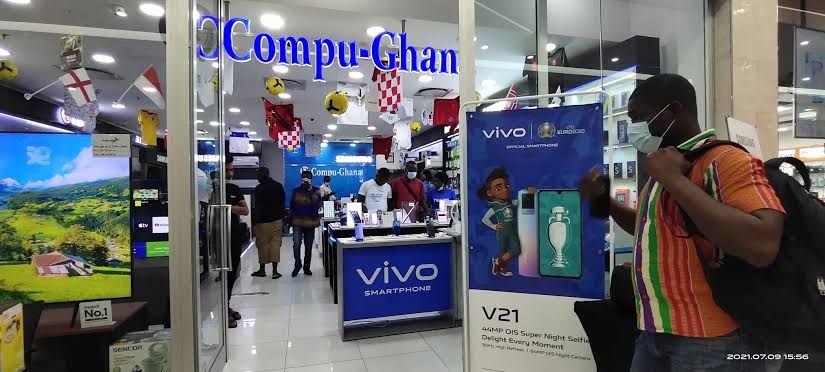
CompuGhana is a long-established IT retail outlet, with an app for browsing and shopping .
The Ultra Centre (for DVLA services, not electronics) is not relevant here.
The informal market—Circle, Tip Toe Lane, and various phone shops—offers lower prices but higher risk. This is where clones and “refurbished as new” devices circulate.
How to Identify Genuine Devices
For iPhones
Check the IMEI on Apple’s coverage page. Go to checkcoverage.apple.com, enter the serial number from Settings > General > About. If Apple recognises the device and shows warranty or purchase information, it is genuine. If the serial number is invalid or unrecognised, it is a clone .
Check Activation Lock. Ask the seller to sign out of their Apple ID in front of you. Then erase the phone and set it up with your own account. If it asks for someone else’s Apple ID or shows “iPhone Locked to Owner,” walk away .

Test the App Store. A clone runs Android dressed up to look like iOS. It cannot open the real App Store, iCloud, or FaceTime. If you can sign into the App Store and download an app, it is a real iPhone .
Check the box and serial number. The serial number on the box must match the serial number in Settings > General > About .
For Samsung Phones
Check the model number. Go to Settings > About phone. A real Samsung shows a model number starting with SM- (e.g., SM-S9xx for Galaxy S, SM-A for Galaxy A). Search that exact model number on samsung.com and compare the specs .
Check the IMEI. Dial *#06# and match the IMEI with Settings > About phone and with the box. The IMEI should identify the same model .
Run Samsung Members diagnostics. Open the Samsung Members app, go to Support > View tests > Test all. It checks the screen, touch, sensors, speakers, microphone, cameras, buttons, and charging. A Samsung account is needed, but it takes about ten minutes and is the best way to find a fault before you pay .
Check for “refurbished sold as new.” A truly new phone starts setup from the welcome screen. If it boots straight to a home screen full of apps, it has been used. Check the charging port and SIM tray for scratches .
Remove the accounts. Ask the seller to remove their Google and Samsung accounts in front of you before you pay. Android phones have Factory Reset Protection. If the last owner did not remove their account, the phone will ask for their login when you set it up .
Factors Affecting Electronics Prices
Exchange rate. Electronics are imported. The cedi’s value against the dollar directly affects shelf prices. A weaker cedi raises the cost of every imported device.
Import duties and VAT. Phones and laptops attract import duty, VAT, NHIL, and GETFund levies. These are baked into the retail price.
Model age and generation. Older models depreciate. The iPhone X at GH₵1,999 and the iPhone 17 Pro Max at GH₵38,000 illustrate the spread.
New vs used vs refurbished. A refurbished HP EliteBook at GH₵4,753 is a fraction of a new Dell XPS at GH₵14,500. The trade-off is warranty and battery health.

Seller type. Official brand stores and authorised retailers charge more but offer genuine products and warranties. Informal sellers charge less but carry the risk of clones, iCloud locks, and stolen devices.
Storage and RAM. The same model with more storage costs more. The Galaxy A27 128GB at GH₵3,445 versus the 256GB at GH₵4,298 is a clear example .
ASJ Bottom Line
The retail prices on Jumia give you a benchmark. A mid-range Samsung Galaxy A-series phone sits in the GH₵2,000–6,000 range. A flagship S-series phone sits in the GH₵7,000–20,000 range. An iPhone 13 sits around GH₵4,400–8,000 depending on condition and storage. A refurbished business laptop sits around GH₵4,700–7,000. A new consumer laptop sits above GH₵10,000.
The informal market can beat these prices. But the checks are not optional. For an iPhone, check the IMEI on Apple’s site and confirm Activation Lock is cleared. For a Samsung, check the model number, run the Samsung Members diagnostics, and confirm the accounts are removed. For a laptop, check the battery health and confirm it is not “refurbished as new” when you paid for new.
The cheapest device is not always the best value. A phone that is locked to someone else’s iCloud, or a laptop with a dying battery, costs more in the end than the few hundred cedis you saved at the point of sale.
Quick Facts
| Category | Price Range (GH₵) |
|---|---|
| Budget Samsung (A07, A27) | 2,118 – 4,298 |
| Mid-Range Samsung (A37, A57) | 4,799 – 5,906 |
| Flagship Samsung (S24–S26) | 6,999 – 19,999 |
| iPhone 11–13 | 4,380 – 11,913 |
| iPhone 16 | 13,370 |
| Refurbished Business Laptop | 4,750 – 6,950 |
| New Consumer Laptop | 10,799 – 24,999 |
| MacBook Air (M5) | 16,999 |
Frequently Asked Questions
1. How much is an iPhone in Ghana in 2026?
Retail listings show the iPhone X at GH₵1,999, the iPhone 11 at GH₵4,717, the iPhone 13 at GH₵4,380, the iPhone 13 Pro Max at GH₵9,900–11,913, and the iPhone 16 at GH₵13,370 . Used and informal prices can be lower.
2. How much is a Samsung Galaxy phone in Ghana?
Budget models like the Galaxy A07 start at GH₵2,118. Mid-range models like the A37 and A57 sit at GH₵4,799–5,906. Flagships like the S24 and S25 range from GH₵6,999 to GH₵16,500. The S26 Ultra is listed between GH₵14,308 and GH₵19,999 .
3. How much is a laptop in Ghana?
Refurbished business laptops (HP EliteBook, Dell Latitude, Lenovo ThinkPad) cost GH₵4,750–6,950. New consumer laptops cost GH₵10,799–24,999. The MacBook Air (M5) is listed at GH₵16,999 .
4. How do I check if an iPhone is genuine in Ghana?
Go to checkcoverage.apple.com and enter the serial number from Settings > General > About. If Apple recognises the device, it is genuine. Also confirm the seller has signed out of their Apple ID and erased the phone so Activation Lock is cleared .
5. How do I check if a Samsung phone is original?
Go to Settings > About phone and check the model number starts with SM-. Search that model on samsung.com. Dial *#06# and match the IMEI with the box. Run the Samsung Members diagnostics app to test the hardware .
6. What is “UK used” in Ghana?
It means a phone that was owned abroad and imported for resale. It is not a certified grade. Some are clean; some have been repaired with cheap parts or are locked to a foreign network or iCloud account .
7. Where can I buy genuine electronics in Ghana?
Jumia Ghana has official brand stores, but check the seller. Franko Trading Enterprise positions itself as selling genuine devices from Samsung, Apple, Infinix, Tecno, HP, and Dell. CompuGhana is a long-established IT retailer .
8. What factors affect electronics prices in Ghana?
The exchange rate, import duties and VAT, model age, storage capacity, and whether the device is new, used, or refurbished all affect the final price.
9. Is it safe to buy a used iPhone in Ghana?
It can be, but you must check the IMEI on Apple’s site, confirm Activation Lock is cleared, check battery health, and test all functions before paying. If the seller refuses to let you check, walk away .
10. Why are refurbished laptops cheaper in Ghana?
They are ex-corporate machines imported in bulk, often several generations old. They offer good value for basic tasks but may have worn batteries and no manufacturer warranty. Check the battery health and seller’s return policy before buying.
Source: Accra Street Journal
Last Updated on November 1, 2026 by Samuel Kwame Boadu
Disclaimer: Some content on Accra Street Journal may be aggregated, summarized, or edited from third-party sources for informational purposes. Images and media are used under fair use or royalty-free licenses. Accra Street Journal is a subsidiary of SamBoad Publishing Hub under SamBoad Business Group Ltd, registered in Ghana since 2014.
For concerns or inquiries, please visit our Privacy Policy or Contact Page.

Samuel Kwame Boadu is a Ghanaian media entrepreneur and storyteller with a passion for amplifying urban voices and uncovering everyday truths. He is the Editor-in-Chief and Founder of Accra Street Journal, a dynamic digital platform dedicated to capturing the pulse of Ghana’s capital—its people, culture, challenges, business, sports and innovations.