









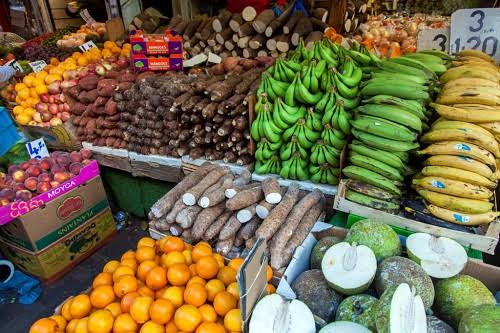
The cost of feeding a household in Ghana is not a single number. It is a combination of imported staples whose prices move with the cedi, fresh produce that swings with the seasons, and a retail markup that varies from market to market. In 2026, the data shows a mixed picture: some imported goods have climbed sharply, while food inflation has eased from its peak. Here is what the numbers actually show.
Rice: The Premium Staple That Breaks Budgets
Rice is the single most important imported staple in Ghana, and its price reflects that dependency.

A 50kg bag of premium imported rice costs between GH¢1,445 and GH¢1,511 at wholesale, according to a January 2026 price list for Lele rice . That means a single bag of premium rice can consume more than GH¢1,000 of a household’s budget—a benchmark that illustrates how far the cedi has stretched .
📢 GET A DETAILED ARTICLES + JOBS
Join ASJ's WhatsApp Channel and never miss a post or opportunity.

The price reflects Ghana’s reliance on imports. The main suppliers are Vietnam, China, Thailand, India, and Pakistan . Rice imports attract a 20% import duty plus VAT, NHIL, GETFund, and other levies, all of which are baked into the shelf price .
For households buying smaller quantities, the per-kilogram cost of premium rice works out to roughly GH¢29–30, which is consistent with the broader cost-of-living data for Ghana .

Cooking Oil: The Price Depends on How You Buy It
Cooking oil prices vary dramatically by package size and type.
Per litre: Global product price data placed Ghana’s cooking oil at $5.17 per litre in January 2026 . At prevailing exchange rates, that is roughly GH¢60–65 per litre for imported brands.
Bulk purchasing: For institutions and large households, a public procurement award in Tamale in March 2026 showed 25-litre gallons of vegetable cooking oil awarded at GH¢89,600 for a bulk supply contract. That works out to a significantly lower per-litre cost than retail, reflecting the wholesale discount .
For ordinary retail buyers, the practical range is wide: small bottles for daily cooking, larger jugs for families, and bulk gallons for caterers and traders.
Sugar: The Retail Listing and the Import Reality
Sugar prices are less consistently reported, but the available data points to a clear range.
Retail listing: On Jiji Ghana, organic brown sugar was listed at GH¢85 for 2kg, GH¢69 for 1kg, and GH¢50 for 500g . That works out to roughly GH¢42.50 per kilogramme for the 2kg pack.
Import transaction: A sample import record for raw cane sugar into Ghana showed a unit price of $1.07 per kilogramme in mid-2026 . At current exchange rates, that is roughly GH¢12–13 per kilogramme at the port, before duties, distribution, and retail markup.
The gap between the import price and the retail shelf price reflects the full cost chain: shipping, port charges, import duty, local distribution, packaging, and retailer margin.
Milk: Evaporated and Condensed
Milk in Ghana is overwhelmingly imported, and retail prices are anchored to import costs.

Evaporated milk (160g tin): Typically retails in the GH¢8–15 band .
Condensed milk (397g tin): Typically sells between GH¢18 and GH¢30 .
Bulk purchase: A Jiji listing for Peak Green Evaporated Milk (390g) offered a box of 24 tins for GH¢590, which works out to roughly GH¢24.60 per tin for the larger 390g size .
Fresh milk: Cost-of-living data for Accra placed whole fat milk at approximately GH¢30 per litre as of September 2026 .
The price of milk is directly tied to the cedi’s movement against the euro and US dollar, because 80–90% of supply is imported . A weaker cedi translates quickly into higher shelf prices.
Chicken: Frozen, Imported, and Volatile
Chicken prices are driven by global markets and import costs.
World market price: The World Bank Pink Sheet recorded chicken at $1.81 per kilogramme in September 2026, up 7.1% from August and 4.0% year-on-year .
Import transaction: A sample import record for frozen whole chicken into Ghana showed a unit price of $1.30 per kilogramme in February 2026 .
Retail: Cost-of-living data for Accra put boneless chicken breast at approximately GH¢49.65 per kilogramme . A separate estimate placed 500g of boneless chicken breast at GH¢59, which works out to GH¢118 per kilogramme—a reminder that retail cuts and locations vary widely .
For households buying whole frozen chicken, the price will sit between the import cost and the premium cut retail price, depending on the brand and the market.
Tomatoes and Onions: The Fresh Produce Pressure Points
Fresh produce is where prices fluctuate most dramatically.

Tomatoes: The Channel One TV Market Price Barometer for April 2026 recorded tomatoes averaging GH¢122.25 per mini paint container . By August 2026, a separate market report noted that tomato prices had fallen to GH¢193 per 4.5-litre bucket—a 30.8% decline . This volatility is characteristic of fresh produce, which swings with harvest seasons and supply disruptions.
Onions: The same April 2026 barometer recorded onions at GH¢61.25 per mini paint container . By August, onions had risen to GH¢82 per bucket, up 10.8% .
Retail per kilogramme: Cost-of-living data for Ghana placed tomatoes at approximately GH¢30.47 per kilogramme and onions at GH¢24.11 per kilogramme .
The lesson is that fresh produce prices cannot be captured in a single figure. They move week to week, and the same item can cost twice as much in one market as another.
The Broader Food Inflation Picture
Food inflation eased to 2.2% in April 2026, down from 2.3% in March . That is a significant improvement from the double-digit food inflation of previous years, but it does not mean food is cheap. It means prices are rising more slowly.
The top items driving overall inflation in April 2026 included cooked rice (5.7%) , alongside charcoal, rent, river fish, smoked herrings, and school fees . The presence of cooked rice in the top ten is a reminder that rice—the staple grain—remains a significant cost pressure for households.
Wholesale vs Retail: The Price Gap
The difference between wholesale and retail prices is substantial, and it matters for anyone buying in bulk.
Rice: Wholesale 50kg bags of Lele rice were listed at GH¢1,445.40, while the retail price was GH¢1,511.10—a gap of about GH¢65 per bag .
Cooking oil: Institutional procurement of 25-litre gallons achieved per-litre costs far below retail pricing, because the buyer purchased in bulk directly from suppliers .
Milk: A box of 24 tins at GH¢590 works out to GH¢24.60 per tin, compared to the GH¢8–15 retail range for smaller 160g tins. The larger size and bulk purchase change the economics.
For households that can afford to buy in bulk and store safely, the savings are real. For those buying daily or weekly in small quantities, the retail markup is unavoidable.
What Drives Food Prices in Ghana
Exchange rate. Rice, cooking oil, milk, and chicken are all imported or have significant imported content. The cedi’s value against the dollar and euro directly affects their shelf prices .
Import duties and levies. Rice imports attract a 20% duty plus VAT, NHIL, GETFund, and other charges . These are passed through to consumers.
Global commodity prices. Chicken prices on the world market rose 7.1% in September 2026 alone . Skimmed milk powder and palm oil prices affect milk and cooking oil costs.
Seasonality and supply disruptions. Tomato and onion prices swing with harvests and border flows. A supply disruption from Burkina Faso in early 2026 pushed tomato prices up sharply before they fell later in the year.
Port and logistics costs. Congestion at Tema Port affects the cost of clearing imported goods, as seen in the cement surcharge earlier in 2026. Food importers face the same pressures.
ASJ Bottom Line
Feeding a household in Ghana in 2026 means navigating a two-speed market. Imported staples—rice, milk, chicken, cooking oil—are tied to the cedi and global prices, and they remain expensive. Fresh produce is volatile but can be cheap when supply is good.
The single most useful habit is to buy staples in bulk where storage allows, and to buy fresh produce in season and from markets rather than supermarkets. The price difference between a 50kg bag of rice bought wholesale and the same rice bought in small retail quantities is not trivial—it is the difference between a budget that works and one that does not.
Quick Facts
| Item | Indicative Price |
|---|---|
| Premium rice (50kg bag, wholesale) | GH¢1,445 – GH¢1,511 |
| Cooking oil (per litre) | ~GH¢60–65 (imported retail) |
| Sugar (2kg, retail) | GH¢85 |
| Evaporated milk (160g tin) | GH¢8 – GH¢15 |
| Condensed milk (397g tin) | GH¢18 – GH¢30 |
| Chicken breast (per kg, retail) | ~GH¢50–118 (cut and location vary) |
| Tomatoes (per kg) | ~GH¢30 |
| Onions (per kg) | ~GH¢24 |
| Food inflation (April 2026) | 2.2% |
Last Updated on November 1, 2026 by Samuel Kwame Boadu
Disclaimer: Some content on Accra Street Journal may be aggregated, summarized, or edited from third-party sources for informational purposes. Images and media are used under fair use or royalty-free licenses. Accra Street Journal is a subsidiary of SamBoad Publishing Hub under SamBoad Business Group Ltd, registered in Ghana since 2014.
For concerns or inquiries, please visit our Privacy Policy or Contact Page.

Samuel Kwame Boadu is a Ghanaian media entrepreneur and storyteller with a passion for amplifying urban voices and uncovering everyday truths. He is the Editor-in-Chief and Founder of Accra Street Journal, a dynamic digital platform dedicated to capturing the pulse of Ghana’s capital—its people, culture, challenges, business, sports and innovations.