


15 min read
Introduction
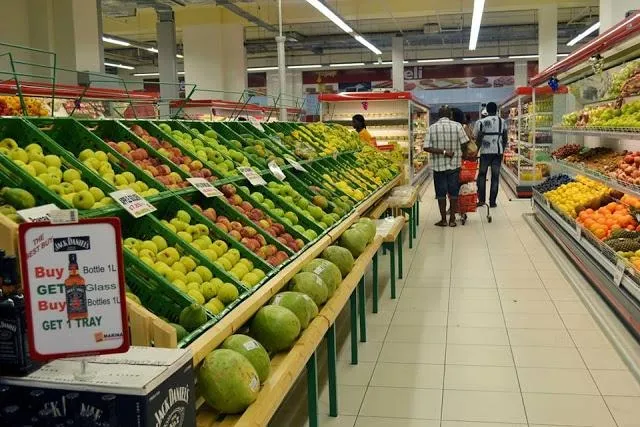
Walk through the bustling stalls of Makola Market or the sprawling shops of Abossey Okai and you will see a familiar pattern. Rice from Thailand. Poultry from Brazil. Sanitary pads from China. Even the simple toothpick often comes from abroad. Ghana makes things, yes. But the country still buys far more from the world than it sells to it.
That is the puzzle at the heart of Ghana’s manufacturing story. The government says it wants to change this. In November 2026, Finance Minister Cassiel Ato Forson announced a $10 billion “New Economy” programme running from 2027 to 2030, with manufacturing as a core pillar . The Trade Minister, Elizabeth Ofosu-Adjare, has been touring investors, outlining opportunities in garments, pharmaceuticals, auto components, sugar, and oil palm . New factories are opening. Old ones are being revived.
Key Takeaways
- In November 2026, Finance Minister Cassiel Ato Forson announced a $10 billion "New Economy" programme running from 2027 to 2030, with manufacturing as a core pillar .
- A $10 billion government plan running from 2027 to 2030, aimed at transforming Ghana into a manufacturing-backed economy through investments in agriculture, minerals value addition, textiles, pharmaceuticals, and technology.
- Nadkansco cashew processing in Techiman, Nordiq Hygiene Care in Tema (sanitary pads), and several garment factories are examples of local manufacturing that is creating jobs and adding value .
But the road is not smooth. Some flagship projects have failed. A cassava starch factory in Assin South, built with millions from the African Development Bank and the government, now sits abandoned, overtaken by weeds . The One District One Factory (1D1F) programme, once the centrepiece of industrial policy, has been effectively scrapped by the current government, replaced by a new approach .
This article explains where Ghana’s manufacturing sector stands today, what is working, what is failing, and what it will take for “Made in Ghana” to become more than a slogan.
Background: The Promise and the Problem
Ghana’s manufacturing ambitions are not new. Since independence, successive governments have talked about industrialisation. Kwame Nkrumah built factories. The structural adjustment programmes of the 1980s and 1990s dismantled many of them. The 2000s brought a commodities boom that made it easy to import rather than produce.
The result is a manufacturing sector that contributes relatively little to GDP and employment compared to its potential. Ghana exports cocoa beans but imports chocolate. It exports gold but imports jewellery. It exports raw cashew but imports processed nuts. The value is added elsewhere, and the jobs go with it.
The 1D1F programme, launched in 2017 under the New Patriotic Party government, was meant to change this by supporting at least one factory in every district. By 2026, according to government figures, 321 factories had been started, with 170 operational, directly employing about 24,621 people . But critics point to abandoned projects, poor planning, and political interference. The current government has moved away from 1D1F, integrating some projects into new programmes and cancelling others .
Now the focus has shifted. The New Economy programme, announced in the 2027 budget, is the new framework. It targets eight pillars, including commercial agriculture, textiles and garments, pharmaceuticals, critical minerals value addition, and technology . The question is whether this new approach will succeed where previous ones fell short.
What Is Working: Success Stories
Despite the challenges, there are real manufacturing success stories in Ghana. They offer lessons in what works.
Nadkansco Cashew Processing. In November 2026, President Mahama commissioned a GH¢148.4 million cashew processing factory in Techiman, financed by GEXIM . The factory can process 100 metric tonnes of raw cashew nuts per day. It is expected to create 1,500 direct jobs and generate about $40 million in annual foreign exchange earnings. The company has already trained over 1,200 farmers and has an outgrower network of 6,000 . This is value addition in action: instead of exporting raw cashew and importing processed nuts, Ghana is doing the processing at home.

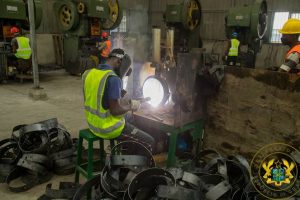
Nordiq Hygiene Care. Based in Tema Free Zones, Nordiq manufactures affordable sanitary pads for the Ghanaian market and for export to Togo, Mali, Burkina Faso, and Côte d’Ivoire . It employs over 300 people, with women making up about 75 percent of the workforce. The company deliberately uses some manual processes alongside automation to maximise employment. It supplies the government’s Free Sanitary Pads Initiative, helping keep girls in school . This is a model of local manufacturing that combines profit with social impact.
Garments and Textiles. The government has identified garments as a quick-win sector because workers do not need lengthy training. Four garment factories are projected to create approximately 36,000 direct jobs at full capacity . The government has extended zero-rated VAT on textiles and garments until December 2028 to reduce production costs . The “Dress Ghana and Build Ghana” campaign is pushing for public institutions to buy locally made uniforms .

Zonda Tec and Auto Assembly. Zonda Tec Ghana assembles vehicles in the country. At the commissioning of its Phase Three plant, President Mahama called for the next stage: local production of batteries, tyres, glass, wiring harnesses, and plastic parts . The vision is an integrated automotive industry where Ghanaian SMEs supply components to assemblers. A draft Automotive Component Manufacturing Development Policy is being reviewed .
What Is Not Working: The Failures
The failures are just as instructive as the successes. They show where the manufacturing push goes wrong.
The Assin South Starch Factory. This is the cautionary tale. The One District One Factory cassava starch processing facility at Kyekyewere was meant to process cassava into starch, flour, gari, and ethanol. It was financed by the African Development Bank, IFAD, and the government. Construction began around 2019. By 2026, the site was overgrown with weeds, equipment rusted, concrete cracked . Young people who had trained in agriculture and processing were left jobless. Farmers who expanded their cassava farms expecting a steady buyer lost money. Our dreams of getting jobs at the factory are rotting like the facility,” one young woman told the Ghana News Agency .
The problem was not the idea. Cassava processing is a sensible use of Ghana’s agricultural resources. The problem was execution: funding shortfalls, procurement delays, and a lack of accountability. Local officials claimed they did not even know about a project sitting in their own district .
The broader 1D1F problem. The Assin South factory is not an isolated case. The 1D1F programme was politically driven, with projects sometimes sited based on political considerations rather than commercial viability. Some factories were built without secure raw material supply or guaranteed markets. The current government’s decision to scrap the programme has left some existing operators in limbo, with the Minority Leader calling for a transitional policy to protect businesses already enrolled .
The structural challenges. Beyond individual project failures, manufacturing in Ghana faces deep structural problems. The Trade Minister herself acknowledged them: “Ghana has never lacked products worth making. What we have lacked is the skill and the standards, market access that skill depends on” . In plain terms: Ghana can make things, but it struggles to make them well enough and cheaply enough to compete.
Energy costs are high. Access to affordable finance is limited. Infrastructure, from roads to electricity, is unreliable in many areas. And the small size of many Ghanaian firms makes it hard for them to achieve economies of scale.
How Manufacturing Works in Ghana
To understand the sector’s potential and its limits, it helps to see how the business actually operates.
The value chain. Manufacturing starts with raw materials. For agro-processing, that means crops from farmers. For garments, it means fabric, thread, and accessories. For pharmaceuticals, it means active ingredients. Ghana often imports these inputs, which exposes manufacturers to exchange rate movements. When the cedi weakens, imported inputs become more expensive, squeezing margins.
The market. Manufacturers sell to three main markets: domestic consumers, institutional buyers (government, schools, hospitals, security services), and export markets. The domestic market is large but price-sensitive. Institutional procurement, if directed toward local producers, can provide the stable demand that factories need to plan and invest . Export markets offer growth but require meeting international standards and competing with established suppliers.

The money. Manufacturing is capital-intensive. Building a factory, buying machinery, and training workers require significant upfront investment. GEXIM and other state institutions provide some financing, but access to affordable credit remains a major constraint. The New Economy programme aims to address this through its focus on “macroeconomic stability and affordable finance” as one of its pillars .
The jobs. Manufacturing jobs are often better paid and more stable than informal work. A factory worker in Tema or Techiman earns a regular wage, receives training, and has opportunities for advancement. The multiplier effects are significant: each factory job supports jobs in transport, packaging, catering, and services.
The New Economy Programme: What It Means
The $10 billion New Economy programme is the government’s big bet on manufacturing. Announced in November 2026, it will run from 2027 to 2030. The pillars most relevant to manufacturing are commercial agriculture, critical minerals value addition, textiles and garments, pharmaceuticals and biomanufacturing, and the technology economy .
Some specific targets stand out. At least 70 percent of artisanal and small-scale gold will be refined locally by December 2027, and 100 percent by December 2028. At least 50 percent of manganese and bauxite will be processed locally by the end of 2028, with full local processing targeted by 2030 . A 24-hour minerals processing enclave is planned for the Western Region.
For agro-processing, the focus is on strengthening links between farmers and factories. The Feed the Industry programme, mentioned by the Trade Minister at the Nadkansco commissioning, is meant to ensure that processors have reliable access to raw materials . The sugar industry is being restructured around a hub-and-spoke model, with central processing facilities supplied by 30,000 to 40,000 smallholder households .
The financing is complex. The programme will be partly funded by reducing the primary surplus target by one percentage point of GDP, along with tax reforms expected to generate revenue equivalent to 0.5 percent of GDP . Whether this is enough, and whether the political will exists to see it through, is uncertain.
Challenges
The obstacles to Ghana’s manufacturing ambitions are real and stubborn.
Competitiveness. Ghanaian manufacturers struggle to compete with imports from China, India, and elsewhere. Production costs are higher. Energy is expensive. Bureaucracy is burdensome. Without protection or support, many local producers cannot survive.
Infrastructure. Roads, electricity, water, and ports are all essential for manufacturing. When power is unreliable, factories must run generators, which is costly. When roads are bad, transporting goods is expensive and slow.
Skills. The Trade Minister has acknowledged gaps in skills development . Manufacturers need technicians, engineers, quality control experts, and managers. Ghana’s education system does not always produce enough of these workers.
Access to finance. Banks see manufacturing as risky. Interest rates, while falling, are still high. Small manufacturers struggle to get the loans they need to expand.
Political instability in policy. The 1D1F experience shows the danger of policies tied to specific administrations. When governments change, programmes are scrapped or redesigned. Manufacturers need predictability. Without it, they cannot plan long-term investments.
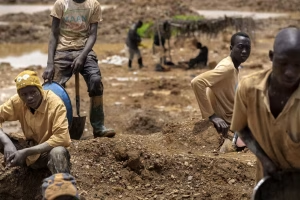
The small-scale mining problem. Galamsey (illegal mining) diverts labour and capital away from manufacturing and destroys land and water resources. It also competes for the same young workers that factories need.
Why It Matters to Ordinary Ghanaians
Manufacturing matters because it affects daily life in ways that are easy to see and feel.
Prices. When Ghana imports less and produces more locally, prices are less vulnerable to exchange rate swings. Locally made goods can be cheaper than imports, especially when transport costs and import duties are factored in. But this only works if local producers are efficient.
Jobs. Manufacturing jobs are a path out of poverty for young people who cannot find work in the informal sector. A factory job in Techiman or Tema provides a regular income, skills, and dignity. The thousands of jobs promised by new factories matter to real families.
The future of young people. Ghana’s population is young. Every year, hundreds of thousands of young people enter the job market. Agriculture and informal trade cannot absorb them all. Manufacturing and agribusiness offer the best hope for large-scale job creation.
Self-reliance. A country that cannot feed itself or make basic goods is vulnerable. The COVID-19 pandemic showed how global supply chains can break down. Local manufacturing reduces that vulnerability.
National pride. “Made in Ghana” is not just an economic slogan. It is about building a country that can stand on its own feet, that values its own products, and that gives its people the opportunity to create and build.
Future Outlook
The future of Ghanaian manufacturing will be shaped by whether the New Economy programme delivers, and whether the private sector responds.
If things go well, the cashew processing model could be replicated across other crops. Garment factories could absorb thousands of workers. Local content policies in mining and oil could create demand for Ghanaian-made inputs. The 24-hour economy, if it works, could increase utilisation of factory capacity. The Tema Integrated Industrial Park, supported by four sector policies approved by Cabinet, could become a hub for export-oriented manufacturing .
The risks are equally clear. If the New Economy programme is poorly implemented, it will become another abandoned promise. If electricity remains unreliable and expensive, factories will not be competitive. If access to finance stays constrained, small manufacturers will not grow. And if political instability continues to disrupt policy, investors will stay away.
The most likely scenario is uneven progress. Some sectors will succeed: cashew processing, garments, and perhaps auto components, where there is clear government focus and private sector interest. Others will struggle. The jobs will come, but not at the scale needed to transform the labour market. Manufacturing’s share of GDP will grow slowly, if at all.
The wild card is the global trading environment. If the African Continental Free Trade Area (AfCFTA) works as intended, Ghanaian manufacturers could access a much larger market. That would change the calculus significantly. But AfCFTA is still being implemented, and the benefits are not yet guaranteed.
ASJ Conclusion
Ghana has been talking about manufacturing for decades. The factories have been built, abandoned, revived, and built again. The promises have been made, broken, and made again. What is different now is not the rhetoric. It is the urgency.
The young people entering the job market every year need work. The food import bill is too high. The dependence on raw commodity exports is too risky. Ghana must make things, not just grow them and dig them up.
The successes are real. Cashew processing in Techiman. Sanitary pads in Tema. Garments in factories that are slowly coming online. These show that it can be done. But the failures are also real. The weeds at Assin South are a warning.
The future of Made in Ghana depends on whether the country can learn from its failures and build on its successes. It depends on whether government creates a stable environment for investment, rather than chasing headlines with new programmes. It depends on whether the private sector has the confidence to invest, and the skills to compete. And it depends on whether Ghanaians themselves choose to buy what their country makes.
That is not just an economic question. It is a question of national will.
Quick Facts
Topic: Local Manufacturing in Ghana
Manufacturing Growth (August 2026): Main driver of industrial sector growth of 4.5%
New Economy Programme: $10 billion, 2027-2030
**Key Sectors:** Agro-processing, garments, pharmaceuticals, auto components, minerals value addition
**Garment Jobs Target:** 36,000 direct jobs from four factories at full capacity
**Recent Success:** Nadkansco cashew factory, Techiman: 1,500 jobs, $40m annual forex
Recent Failure: Assin South cassava starch factory, abandoned
Key Policy Shift: 1D1F effectively scrapped, replaced by New Economy approach
Main Challenge: Competitiveness, infrastructure, access to finance, policy instability
Key Opportunity: AfCFTA, local content policies, institutional procurement
FAQ Section
1. What is the state of manufacturing in Ghana?
The sector is growing, driven by agro-processing, garments, and some auto assembly. But it remains a relatively small part of the economy and faces major challenges in competitiveness, infrastructure, and access to finance.
2. What is the New Economy Programme?
A $10 billion government plan running from 2027 to 2030, aimed at transforming Ghana into a manufacturing-backed economy through investments in agriculture, minerals value addition, textiles, pharmaceuticals, and technology.
3. What happened to the One District One Factory programme?
The current government has effectively scrapped it, arguing it was politically driven and poorly executed. Some 1D1F projects have been integrated into new programmes, while others have been abandoned .
4. Are there successful manufacturing companies in Ghana?
Yes. Nadkansco cashew processing in Techiman, Nordiq Hygiene Care in Tema (sanitary pads), and several garment factories are examples of local manufacturing that is creating jobs and adding value .
5. Why is manufacturing important for Ghana?
It creates jobs, reduces dependence on imports, adds value to local raw materials, stabilises the currency by reducing import demand, and builds a more resilient economy.
6. What are the biggest challenges facing manufacturers?
High energy costs, unreliable infrastructure, limited access to affordable finance, skills gaps, and policy instability. Competition from cheap imports is also a major problem.
7. What is the government doing to support local manufacturing?
Providing financing through GEXIM, extending VAT exemptions on textiles, pushing institutional procurement of local goods, and developing sector policies for garments, pharmaceuticals, auto components, and agribusiness .
8. How many jobs can manufacturing create?
The garment sector alone could create 36,000 direct jobs from four factories at full capacity . The Nadkansco cashew factory is expected to create 1,500 direct jobs .
9. What is the “Dress Ghana and Build Ghana” campaign?
An advocacy campaign launched in 2026 to push for public institutions to buy locally made uniforms and garments, supporting local manufacturers and creating jobs .
10. Can Ghana compete with Chinese manufacturers?
Not on price for all goods. But for products where Ghana has raw material advantages (cashew, cocoa, shea), proximity to West African markets, or where government procurement can provide stable demand, local manufacturing can be competitive.
11. What is the Tema Integrated Industrial Park?
A planned industrial park in Tema developed through a public-private partnership, expected to create over 4,000 direct jobs. Cabinet has approved four sector policies to support its development .
12. What can ordinary Ghanaians do to support local manufacturing?
Buy Ghanaian products where possible. Support local brands. Demand quality from local producers. And hold government accountable for delivering on its industrial promises.
Source: Accra Street Journal
Last Updated on November 20, 2026 by Samuel Kwame Boadu
Disclaimer: Some content on Accra Street Journal may be aggregated, summarized, or edited from third-party sources for informational purposes. Images and media are used under fair use or royalty-free licenses. Accra Street Journal is a subsidiary of SamBoad Publishing Hub under SamBoad Business Group Ltd, registered in Ghana since 2014.
For concerns or inquiries, please visit our Privacy Policy or Contact Page.

Samuel Kwame Boadu is a Ghanaian media entrepreneur and storyteller with a passion for amplifying urban voices and uncovering everyday truths. He is the Editor-in-Chief and Founder of Accra Street Journal, a dynamic digital platform dedicated to capturing the pulse of Ghana’s capital—its people, culture, challenges, business, sports and innovations.
Use the following reference when citing or referencing this article.
Your feedback helps us improve our journalism.
Report an Error
Help us maintain accuracy. Let our editorial team know if you spot an issue in this article.
Report a problem with this article