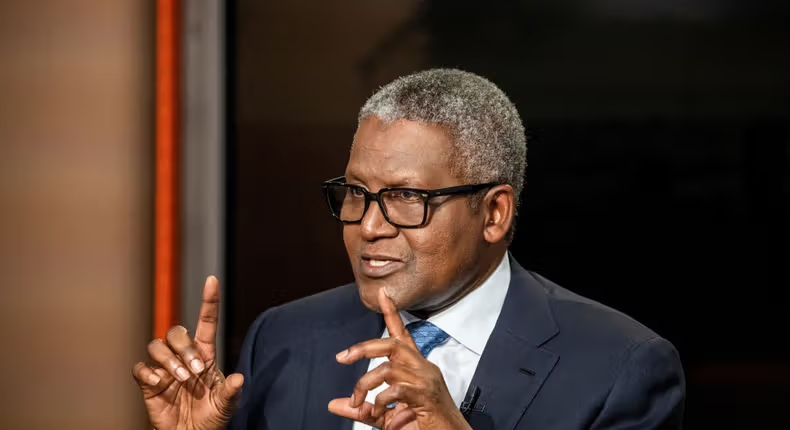
Africa’s richest man, Aliko Dangote, is charting a new course for his sprawling conglomerate, unveiling plans to expand into steel production, electricity generation and port development as part of a broader industrialisation drive across the continent.
The president of Dangote Group said oil refining represents only one pillar of a far more ambitious blueprint aimed at transforming Africa from a raw-material exporter into a manufacturing powerhouse.

“We have to industrialise Africa,” Dangote said in a recent interview, describing steel, power and logistics infrastructure as critical next steps in strengthening the continent’s productive base.
📢 GET A DETAILED ARTICLES + JOBS
Join ASJ's WhatsApp Channel and never miss a post or opportunity.

Beyond Refining: A Bigger Industrial Vision
Dangote’s flagship refinery project in Lagos has dominated headlines over the past two years, but the billionaire has signaled that it is merely the opening act.
The Dangote Petroleum Refinery—the largest single-train facility of its kind globally—is currently producing approximately 650,000 barrels of refined products per day. A $12 billion expansion plan is underway to lift capacity to 1.4 million barrels per day, alongside the scaling up of petrochemical production.

Dangote has also disclosed plans to list the refinery on the Nigerian Exchange, a move designed to broaden domestic investor participation and deepen Nigeria’s capital markets.
Yet refining, in Dangote’s view, is just one segment of an integrated industrial ecosystem.
Steel manufacturing is emerging as the next frontier. By developing a large-scale steel operation, Dangote aims to reduce Africa’s heavy reliance on imported industrial materials—an enduring structural weakness that inflates costs for infrastructure and construction projects across the continent.
Power and Ports as Industrial Enablers
Electricity generation and port infrastructure form the other pillars of the expansion strategy.
Unreliable power supply has long constrained manufacturing growth in many African economies. Dangote’s entry into electricity generation would not only support his own industrial assets but could also strengthen grid stability in host countries.
Port development, meanwhile, addresses a critical logistics bottleneck. Efficient maritime infrastructure is essential for scaling exports, reducing turnaround times and lowering freight costs. By investing in port capacity, Dangote is effectively targeting the arteries of trade that underpin large-scale industrialisation.
Together, steel, power and ports represent a vertically integrated strategy—one that mirrors the industrial models seen in emerging Asian economies decades earlier.
Cement, Fertiliser and a Continental Footprint
The Dangote Group already operates in 17 African countries across sectors including cement, sugar, salt, fertiliser and petrochemicals. Its cement subsidiary, Dangote Cement Plc, recently signed a $1 billion agreement with Sinoma International Engineering to construct new plants and expand existing facilities in seven African markets.
The move reinforces Dangote’s long-standing bet on infrastructure-led growth. Cement demand is closely tied to housing, roads and commercial construction—sectors that would also benefit from a domestic steel supply chain.

By aligning cement expansion with prospective steel manufacturing, Dangote appears to be knitting together complementary industrial segments under a single strategic umbrella.
Governance and Succession
As the conglomerate expands into more capital-intensive sectors, governance structures are also evolving. Dangote recently appointed his daughters to senior leadership positions within the group, a move widely interpreted as part of long-term succession planning.
The appointments come at a time when the group’s asset base and geographic reach are expanding rapidly. Strengthening corporate governance and leadership continuity may prove critical as the business transitions into its next growth phase.
Industrialisation as Economic Strategy
Dangote’s expansion plans land at a moment when many African economies are seeking to shift from commodity dependence toward value-added manufacturing.
Steel production, in particular, remains a strategic gap. Africa imports significant volumes of finished and semi-finished steel products, despite abundant iron ore reserves in several countries. Local production capacity could lower import bills, support construction sectors and stimulate downstream industries.
Electricity and ports, meanwhile, are foundational enablers. Without stable power and efficient logistics, manufacturing ambitions often falter. By targeting these structural constraints, Dangote’s blueprint reflects an understanding that industrialisation requires ecosystem-wide investment.
A High-Stakes Bet
The scale of capital required for steel plants, power stations and port terminals is immense. Execution risks—from regulatory approvals to financing and operational management—are significant.
Yet Dangote has demonstrated an appetite for transformative projects. The refinery itself, once viewed as overly ambitious, has begun reshaping Nigeria’s fuel import dynamics.
Whether the new push achieves similar impact will depend on macroeconomic stability, policy alignment and regional cooperation. Still, the message is clear: Dangote intends to move beyond refining into the deeper architecture of industrial development.
For Africa’s richest man, the next chapter is not simply about expanding a conglomerate. It is about testing whether private capital can accelerate the continent’s long-debated industrial transformation.
Source: Accra Street Journal

Last Updated on April 26, 2026 by Samuel Kwame Boadu
Disclaimer: Some content on Accra Street Journal may be aggregated, summarized, or edited from third-party sources for informational purposes. Images and media are used under fair use or royalty-free licenses. Accra Street Journal is a subsidiary of SamBoad Publishing Hub under SamBoad Business Group Ltd, registered in Ghana since 2014.
For concerns or inquiries, please visit our Privacy Policy or Contact Page.

Samuel Kwame Boadu is a Ghanaian media entrepreneur and storyteller with a passion for amplifying urban voices and uncovering everyday truths. He is the Editor-in-Chief and Founder of Accra Street Journal, a dynamic digital platform dedicated to capturing the pulse of Ghana’s capital—its people, culture, challenges, business, sports and innovations.