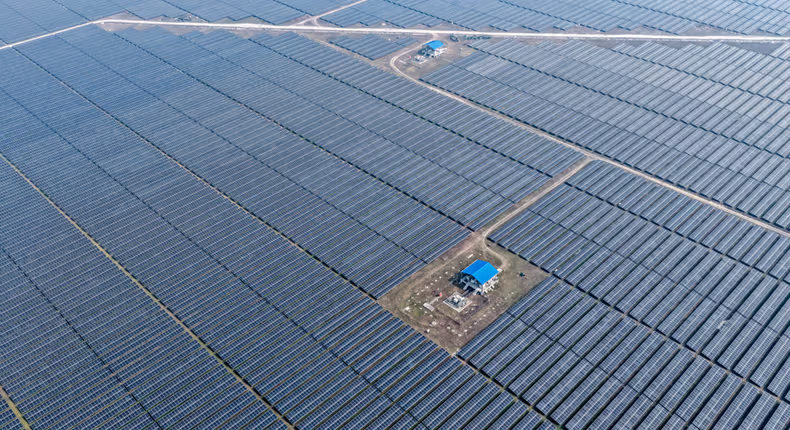
The government of Nigeria has unveiled a $750 million renewable electrification programme aimed at dramatically expanding electricity access across the country through solar mini-grids and off-grid energy systems.
Officials say the initiative could mobilise more than $1.1 billion in private sector investment, positioning it as one of the largest publicly funded renewable electricity programmes in the world.
The project will be implemented by the Rural Electrification Agency (REA), which plans to deploy 1,350 solar mini-grids nationwide, including 250 interconnected systems that will supply electricity directly into the national power grid.
📢 GET A DETAILED ARTICLES + JOBS
Join ASJ's WhatsApp Channel and never miss a post or opportunity.
📲 Join ASJ Channel Now
Solar Power to Bridge Nigeria’s Electricity Gap
Nigeria, Africa’s most populous country, has long struggled with unreliable electricity supply. Millions of households and businesses rely heavily on diesel and petrol generators due to frequent power outages and limited grid coverage.
According to REA Managing Director Abba Aliyu, the solar mini-grid initiative represents a major step toward solving these long-standing challenges.
“For the first time, we are witnessing the implementation of the biggest publicly funded renewable electricity project in the entire world,” Aliyu said during a briefing in Abuja. “It is a $750 million project that will catalyse $1.1 billion in private sector funding to deploy 1,350 mini-grids across the country.”
The programme will focus heavily on rural and underserved communities where extending the national grid is often expensive and slow.
Universities and Hospitals Already Benefiting
Beyond rural electrification, Nigeria is also expanding renewable power for higher education and healthcare facilities under the Energising Education Programme.
So far, 15 large solar projects have been completed under the initiative, providing electricity to universities and teaching hospitals across the country.
In one case, Aliyu said, a 12-megawatt solar installation was deployed at a single university campus, supplying electricity to the university, its teaching hospital, and a water treatment plant through a newly built distribution network.
Institutions already benefiting from the programme include:
Additional solar installations are planned for major institutions such as:
Officials say the programme is helping reduce energy costs while ensuring reliable power for critical academic and medical facilities.
Solar Power for Government Institutions
The federal government is also expanding renewable power deployment through the National Public Sector Solarisation Initiative, which has received about ₦100 billion (roughly $74 million) in funding.
The programme is designed to supply solar electricity to public institutions that face high energy costs or unreliable grid power.
Solar systems have already been installed at several government agencies, including:
-
Department of State Services
-
Economic and Financial Crimes Commission
-
Independent Corrupt Practices and Other Related Offences Commission
-
National Hospital Abuja
Officials say the initiative will significantly reduce government spending on diesel generators while improving electricity reliability in critical public facilities.
Growing Investment Opportunities in Renewable Energy
Energy analysts say the scale of Nigeria’s solar expansion could create major investment opportunities in Africa’s largest economy.
By combining public funding with incentives for private developers, the programme is expected to attract global investors interested in renewable infrastructure across emerging markets.
With governments across Africa accelerating the shift toward decentralised and clean energy systems, Nigeria’s latest solar rollout could become one of the most closely watched renewable energy programmes on the continent.
If successfully implemented, the initiative could help transform electricity access for millions of Nigerians while reducing the country’s dependence on fossil-fuel generators and strengthening its long-term energy security.