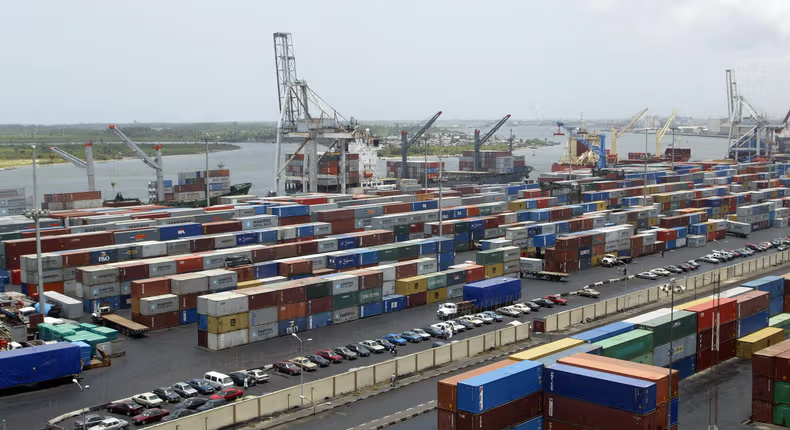
Imagine a container ship leaving the port of Jebel Ali in Dubai, bound for Lagos. On board are industrial machinery for a factory in Ogun State, medical supplies for a hospital in Abuja, and electronics for a trader in Onitsha market. The journey should take three to four weeks. But in today’s world of global supply chain disruptions—port congestion, geopolitical tensions, customs delays, fluctuating shipping rates—that same journey can take twice as long, cost three times as much, and leave businesses scrambling for alternatives.
Now imagine a different scenario. The same container ship leaves Jebel Ali, but this time, customs procedures have been streamlined. There is a “green corridor” that fast-tracks certain shipments. An Advance Cargo Information system has pre-processed the paperwork before the ship even arrives. And if the main route is blocked, there is an alternative corridor already mapped out.

That second scenario is what the United Arab Emirates is working to make real—not just for itself, but for its trading partners, and particularly for Nigeria, one of Africa’s largest economies and a key maritime hub in West Africa.
📢 GET A DETAILED ARTICLES + JOBS
Join ASJ's WhatsApp Channel and never miss a post or opportunity.

As global supply chains face ongoing disruptions, the UAE is intensifying logistics coordination to secure trade flows with Nigeria. Officials have outlined new customs frameworks, alternative corridors, and shipping initiatives designed to improve efficiency and resilience. For Nigeria, which recorded a trade surplus of approximately $70 billion in 2025, the stakes are high. Efficient trade corridors are not a luxury—they are a necessity.
In this Accra Street Journal editorial, we break down what the UAE is doing, why Nigeria matters to the Gulf nation’s logistics strategy, and what this means for trade resilience in West Africa and beyond.

The UAE’s Logistics Push: What Is Happening?
The initiative was outlined by Thani bin Ahmed Al Zeyoudi, the UAE’s minister of foreign trade, during a high-level meeting in Dubai convened by the Ports, Customs and Free Zone Corporation (PCFC) . The gathering brought together shipping executives, maritime stakeholders, and government officials to address bottlenecks affecting regional cargo flows and to identify practical solutions to maintain trade continuity.
Al Zeyoudi said the UAE was prioritising “continuity of trade flows” through closer coordination with industry players and the deployment of more adaptive logistics policies. The strategy includes three main components.
1. Developing Alternative Trade Corridors
The UAE is investing in mapping and developing alternative trade routes that can be activated when primary corridors are disrupted. This is a classic resilience strategy: do not rely on a single path. If the Red Sea route becomes too dangerous (as it did during recent Houthi attacks on shipping), have a land-bridge option through Saudi Arabia. If the Strait of Hormuz is congested, have an alternative port arrangement.
For Nigeria-bound cargo, alternative corridors could include routing through other Gulf ports, using land-based transport across the Arabian Peninsula, or leveraging the UAE’s extensive network of free zones to reroute shipments.
2. Enhancing Customs Frameworks
Customs delays are one of the biggest sources of friction in international trade. The UAE is working to reduce this friction through:
-
Streamlined transit procedures along a “green corridor” with Oman, allowing faster movement of pre-approved shipments
-
Acceptance of alternative guarantees for shipments, reducing the need for cash deposits or complex bond arrangements
-
Expanded engagement with traders to identify and resolve bottlenecks before they become crises
3. Piloting Advance Cargo Information Systems
One of the most significant innovations is the pilot Advance Cargo Information (ACI) system for pre-arrival processing. Under this system, shippers submit cargo data before the vessel departs. Customs authorities review the information, identify high-risk shipments, and clear low-risk ones before the ship even arrives. The result: cargo moves off the dock and onto trucks within hours instead of days.
The ACI system is not new in global trade—similar systems operate in the United States, the European Union, and China. But its expansion to UAE-Nigeria trade corridors could significantly reduce delays at both ends of the journey.
4. Launching a New Maritime Feeder Service
The UAE is also launching a new maritime feeder service linking the region with India. Feeder services are smaller vessels that collect cargo from major hub ports and distribute it to smaller, regional ports. This service will improve connectivity between the Gulf, India, and East Africa, with potential extensions to West African ports including Lagos.
For Nigeria, better connectivity to Indian markets is particularly valuable. India is a major trading partner, and more efficient shipping links could reduce costs and transit times for Nigerian importers and exporters.

Why Nigeria? The $70 Billion Trade Surplus
The UAE’s intensified focus on logistics coordination with Nigeria is not accidental. Nigeria matters to the Gulf nation’s trade strategy for several compelling reasons.
Nigeria’s Export Strength
According to Jumoke Oduwole, Nigeria’s minister for trade and investment, the country recorded a trade surplus of ₦113 trillion in 2025 , equivalent to roughly $70 billion at current exchange rates. This is a staggering figure. A trade surplus means Nigeria exports more than it imports—a position of strength in global trade negotiations.
Nigeria’s export capacity is driven largely by hydrocarbons. The country is Africa’s largest oil producer and a major supplier of crude oil to global markets, including the UAE’s trading partners. But non-oil exports are also growing, including agricultural products, processed foods, and manufactured goods.
Nigeria’s Import Reliance
While Nigeria exports heavily, it also relies on efficient import channels for industrial and consumer goods. The country imports machinery, chemicals, vehicles, electronics, pharmaceuticals, and food products—many of which transit through Gulf hubs like Jebel Ali.
For the UAE, Nigeria is both a source of export revenue (selling goods to Nigerian importers) and a logistics partner (moving Nigerian exports to global markets). The bilateral trade relationship is substantial, and disruptions hurt both sides.
Nigeria as a West African Hub
Nigeria is not just a large economy—it is a gateway. Lagos is one of West Africa’s busiest ports, handling cargo destined not only for Nigeria but for landlocked neighbours like Niger, Chad, and Burkina Faso. If Lagos faces supply chain disruptions, the effects ripple across the subregion.
By strengthening logistics coordination with Nigeria, the UAE is also strengthening its access to the broader West African market. This is a strategic play, not just a bilateral one.
The Global Context: Why Supply Chain Resilience Matters Now
The UAE’s push for logistics coordination with Nigeria is happening against a backdrop of persistent global supply chain disruptions. Several factors are driving the urgency.
Geopolitical Tensions
The Red Sea crisis of 2023–2024, during which Houthi attacks forced shipping to reroute around the Cape of Good Hope, added thousands of miles and millions of dollars to shipping routes between Asia and Europe. While the situation has calmed, the vulnerability of key chokepoints—the Suez Canal, the Strait of Hormuz, the Bab el-Mandeb—has become starkly apparent.
Port Congestion
Post-pandemic port congestion has not fully resolved. Major hubs like Rotterdam, Los Angeles, and Shanghai still experience periodic backups. For developing economies like Nigeria, port congestion is even more acute, with infrastructure constraints exacerbating delays.
Shipping Rate Volatility
During the peak of the supply chain crisis, shipping rates increased by over 500% on some routes. For Nigerian importers, who often operate on thin margins, such volatility can be devastating. More resilient trade corridors can help stabilise rates by providing alternatives when primary routes become expensive.
Climate Risks
Climate change is introducing new supply chain risks. Droughts affect river transport (like the Rhine in Europe). Floods close ports and damage infrastructure. Heatwaves affect cargo handling. The UAE’s investment in alternative corridors is, in part, a hedge against climate-related disruptions.
What the UAE Is Doing: A Deeper Look at the Measures
Let us examine the specific measures announced at the Dubai meeting in more detail.
The Green Corridor with Oman
The “green corridor” with Oman is a bilateral arrangement that allows pre-approved, low-risk shipments to move quickly between the two countries. The corridor reduces inspection times, simplifies documentation, and prioritises certain categories of cargo.
For Nigeria-bound shipments, the green corridor matters because Oman is a key transshipment point. Cargo arriving at Omani ports can be fast-tracked to UAE ports, reducing overall transit time.
Alternative Guarantees
Traditional customs arrangements often require importers to post bonds or cash deposits to cover potential duties. These guarantees tie up working capital. The UAE’s acceptance of alternative guarantees—such as bank guarantees, insurance policies, or corporate commitments—frees up capital for businesses, making trade more affordable.
Advance Cargo Information (ACI) System
The ACI system is the most technologically significant measure. Under the system:
-
Shippers submit cargo data electronically before the vessel departs
-
Customs authorities analyse the data using risk-assessment algorithms
-
Low-risk shipments receive “green light” clearance pre-arrival
-
High-risk shipments are flagged for inspection upon arrival
The result is that most cargo can be cleared within hours of docking, rather than days or weeks. For perishable goods, time-sensitive industrial inputs, and high-value consumer products, the difference is enormous.
Maritime Feeder Service to India
The new maritime feeder service linking the region with India is designed to improve connectivity between secondary ports. Feeder vessels are smaller than the massive container ships that ply main routes, allowing them to access ports that cannot accommodate deep-draft vessels.
For Nigeria, improved feeder connectivity to India means:
-
More frequent sailings
-
Lower costs for smaller shipments
-
Access to Indian ports that are not served by mainline carriers
-
Reduced reliance on transshipment through overburdened hubs
The Nigeria-UAE Comprehensive Economic Partnership Agreement (CEPA)
The logistics coordination push is not happening in isolation. In 2025, Nigeria and the UAE signed a Comprehensive Economic Partnership Agreement (CEPA) , unlocking duty-free trade and new investment flows between the two countries .
The CEPA is a broad agreement that covers:
-
Tariff reductions on thousands of products traded between the two countries
-
Investment protections for businesses operating in each other’s markets
-
Services trade liberalisation in sectors like logistics, finance, and professional services
-
Customs cooperation to streamline border procedures
The logistics measures announced in Dubai are the operational arm of the CEPA. The agreement sets the strategic direction; the customs frameworks, green corridors, and ACI systems are the mechanisms that make it work.
For Nigerian businesses, the combination of CEPA and enhanced logistics coordination means lower costs, faster transit times, and more predictable supply chains. For the UAE, it means deeper integration with one of Africa’s largest and fastest-growing economies.
Implications for West African Trade
While the UAE-Nigeria logistics push is bilateral, its effects will be felt across West Africa.
Improved Access for Landlocked Countries
Nigeria’s ports serve as the primary maritime gateway for landlocked Niger, Chad, and Burkina Faso. If logistics coordination with the UAE reduces congestion and delays at Nigerian ports, those benefits will flow inland. Faster clearance at Lagos means faster delivery to Niamey or N’Djamena.
Competition for Other Gulf Hubs
The UAE is not the only Gulf state investing in African logistics. Qatar, Saudi Arabia, and Oman are also expanding their trade ties with the continent. The UAE’s aggressive push with Nigeria may spur competition, leading to better terms for African traders across the board.
A Model for Other African Countries
If the UAE-Nigeria logistics framework proves successful, it could serve as a model for similar arrangements with other African countries. Ghana, Côte d’Ivoire, Senegal, and Kenya are all potential partners for enhanced logistics coordination with Gulf states.
Reduced Reliance on European Hubs
Currently, much of West Africa’s trade with Asia and the Gulf transits through European hubs like Rotterdam or Antwerp. Direct shipping links between Gulf ports and West African ports, supported by streamlined customs and alternative corridors, could reduce this reliance, lowering costs and transit times.
Challenges and Risks
The UAE-Nigeria logistics push is promising, but it is not without challenges.
Infrastructure Constraints in Nigeria
While the UAE can streamline its side of the equation, Nigeria’s ports face significant infrastructure challenges. Congestion at Apapa and Tin Can Island ports in Lagos is legendary. Road access to the ports is poor. Rail connectivity is limited. The UAE’s efficiency gains will be partially offset if Nigerian ports cannot handle increased throughput.
Regulatory Coordination
The ACI system and green corridor arrangements require close coordination between UAE and Nigerian customs authorities. Differences in data standards, legal frameworks, and enforcement priorities could create friction.
Political Stability
Nigeria’s political environment is complex. Changes in government or policy priorities could affect the implementation of the CEPA and associated logistics measures. Long-term trade resilience requires long-term political commitment.
Competition for Resources
The UAE is pursuing logistics coordination with multiple African countries simultaneously. Nigeria is a priority, but it is not the only one. The UAE’s attention and resources are finite, and other African countries may compete for the same benefits.
Conclusion: A Strategic Pivot for Trade Resilience
The UAE’s intensified logistics coordination with Nigeria represents a strategic pivot toward trade resilience. In a world of persistent supply chain disruptions—geopolitical, climatic, economic—relying on a single route, a single port, or a single customs procedure is no longer viable.
The UAE is building redundancy into its trade architecture: alternative corridors, green lanes, pre-arrival clearance, and feeder services that can adapt to changing conditions. Nigeria, as one of Africa’s largest economies and a key maritime hub, is a central partner in this effort.
For Nigerian businesses, the benefits are tangible. Lower costs. Faster transit times. More predictable supply chains. For the UAE, the benefits are equally clear: deeper economic ties with a major African economy and a strategic foothold in West Africa.
The $70 billion trade surplus that Nigeria recorded in 2025 is both a testament to its export strength and a reminder of its reliance on stable import channels. The UAE’s logistics push is designed to protect both sides of that equation.
As global trade patterns continue to evolve, the UAE-Nigeria partnership offers a model for how countries can work together to build resilience into their supply chains. It is not a silver bullet—infrastructure constraints and regulatory hurdles remain—but it is a significant step in the right direction. For businesses on both sides of the Gulf of Guinea, that is good news.
Frequently Asked Questions (FAQs)
1. What is the UAE doing to improve logistics coordination with Nigeria?
The UAE is implementing several measures: developing alternative trade corridors that can be activated when primary routes are disrupted; enhancing customs frameworks including streamlined transit procedures along a “green corridor” with Oman; piloting an Advance Cargo Information (ACI) system for pre-arrival cargo processing; and launching a new maritime feeder service linking the region with India to improve connectivity.
2. Why is Nigeria important to the UAE’s trade strategy?
Nigeria is important for three main reasons. First, Nigeria recorded a trade surplus of approximately $70 billion in 2025, highlighting its export strength, particularly in hydrocarbons. Second, Nigeria relies on efficient import channels for industrial and consumer goods, making it a major market for UAE exports. Third, Nigeria serves as a maritime gateway to landlocked West African countries like Niger, Chad, and Burkina Faso, amplifying its regional importance.
3. What is the Advance Cargo Information (ACI) system?
The ACI system allows shippers to submit cargo data electronically before the vessel departs. Customs authorities analyse the data using risk-assessment algorithms. Low-risk shipments receive clearance pre-arrival, while high-risk shipments are flagged for inspection upon arrival. The result is that most cargo can be cleared within hours of docking instead of days or weeks, significantly reducing delays.
4. What is the Nigeria-UAE Comprehensive Economic Partnership Agreement (CEPA)?
The CEPA is a bilateral trade agreement signed in 2025 that unlocks duty-free trade and new investment flows between Nigeria and the UAE. It covers tariff reductions on thousands of products, investment protections, services trade liberalisation, and customs cooperation. The logistics measures announced in Dubai are the operational implementation of the CEPA’s strategic framework.
5. How does this logistics push benefit West African countries beyond Nigeria?
Improved logistics coordination at Nigerian ports benefits landlocked countries like Niger, Chad, and Burkina Faso, which rely on Nigerian ports as their primary maritime gateway. Faster clearance at Lagos means faster delivery to inland destinations. Additionally, the UAE’s push may spur competition among Gulf states, potentially leading to better trade terms for African countries across the continent.
6. What are the main challenges to implementing these logistics measures?
The main challenges include infrastructure constraints at Nigerian ports (congestion, poor road access, limited rail connectivity); regulatory coordination between UAE and Nigerian customs authorities (differences in data standards and legal frameworks); political stability in Nigeria; and competition for the UAE’s attention and resources from other African countries.
Last Updated on April 26, 2026 by Samuel Kwame Boadu
Disclaimer: Some content on Accra Street Journal may be aggregated, summarized, or edited from third-party sources for informational purposes. Images and media are used under fair use or royalty-free licenses. Accra Street Journal is a subsidiary of SamBoad Publishing Hub under SamBoad Business Group Ltd, registered in Ghana since 2014.
For concerns or inquiries, please visit our Privacy Policy or Contact Page.

Samuel Kwame Boadu is a Ghanaian media entrepreneur and storyteller with a passion for amplifying urban voices and uncovering everyday truths. He is the Editor-in-Chief and Founder of Accra Street Journal, a dynamic digital platform dedicated to capturing the pulse of Ghana’s capital—its people, culture, challenges, business, sports and innovations.