The global race for critical minerals is intensifying, and the Democratic Republic of Congo—already the world’s dominant producer of cobalt and a major copper supplier—is positioning itself at the centre of the action.
In a significant development, DRC’s state mining company Gécamines has dramatically expanded its copper export commitment to the United States, pledging 500,000 tonnes for sale through its Swiss trading partner Mercuria. The revised volume is approximately five times higher than previously disclosed, underscoring the rapid scale-up of a vehicle central to Washington’s broader critical minerals strategy in Central Africa.

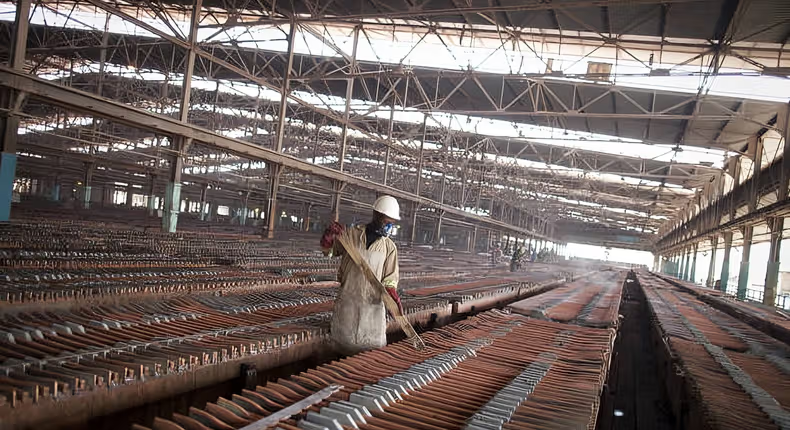
The pledge was revealed in a sovereign debt prospectus filed in London, providing rare public insight into the scale of Gécamines’ ambitions. The arrangement allows production linked to Gécamines’ minority stakes in some of the DRC’s largest mining assets—including Glencore’s Kamoto Copper Company and the Chinese-operated Tenke Fungurume mine—to be aggregated and sold through Mercuria. In effect, Gécamines is converting its equity positions into physical copper flows bound for the United States.
📢 GET A DETAILED ARTICLES + JOBS
Join ASJ's WhatsApp Channel and never miss a post or opportunity.

This deal is not happening in isolation. It is part of a wider shift across Africa’s Copperbelt towards state-backed commodity trading models, as governments attempt to exert greater influence over how their mineral resources are marketed and sold. Zambia has already launched a similar Mercuria-supported structure through its Industrial Development Corporation, placing the two neighbouring countries at the forefront of an experimental model in mining trade.
In this Accra Street Journal editorial, we break down what Gécamines is doing, why it matters for the US critical minerals strategy, how the state-backed trading model works, and what it means for the future of Africa’s Copperbelt.

The Big Picture: Who Is Gécamines and Why Does This Matter?
Gécamines (La Générale des Carrières et des Mines) is the DRC’s state-owned mining company. Founded in 1906 during the colonial era, it was once a giant of African mining, but decades of mismanagement, war, and underinvestment left it a shadow of its former self.
In recent years, however, Gécamines has been attempting a comeback. The company holds minority stakes in some of the world’s richest copper and cobalt deposits, including:
-
Kamoto Copper Company (KCC): A massive copper-cobalt operation in which Glencore is the majority owner. KCC is one of the world’s largest cobalt producers.
-
Tenke Fungurume: One of the world’s richest copper and cobalt deposits, now operated by Chinese mining giant CMOC.
-
Other joint ventures with international mining companies operating in the DRC’s Katanga province.
Historically, Gécamines received dividends and royalties from these operations but had limited control over how the metals were marketed and sold. The new arrangement with Mercuria changes that. By aggregating production linked to its stakes and selling through a single trading partner, Gécamines gains visibility, control, and a direct channel to end markets—including the United States.
The Numbers: 500,000 Tonnes of Copper
The expanded commitment of 500,000 tonnes of copper is substantial. To put it in perspective:
-
Global copper production in 2025 was approximately 22 million tonnes
-
The DRC produced approximately 2.5 million tonnes of copper in 2025, making it Africa’s largest copper producer and the world’s third-largest after Chile and Peru
-
500,000 tonnes represents roughly 20% of the DRC’s annual copper production
This is not a small pilot programme. It is a major supply commitment that could meaningfully impact global copper markets, particularly as the United States seeks to secure critical mineral supply chains for the energy transition.
The pledge is routed through Mercuria, one of the world’s largest commodity trading houses. Based in Geneva, Switzerland, Mercuria trades oil, gas, power, metals, and agricultural products globally. The company has deep experience in African markets and has been expanding its presence in the critical minerals space.
Under the arrangement, Mercuria acts as the seller of record, handling logistics, financing, and customer relationships. Gécamines, meanwhile, receives the proceeds and builds capacity for a future in-house trading arm. It is a hybrid model: state ownership of the resource, private sector execution of the trade.
Why the United States?
The expanded copper commitment to the United States is not accidental. It reflects several converging factors.
The US Critical Minerals Strategy
The United States has identified critical minerals—including copper, cobalt, lithium, and rare earth elements—as essential to national security and economic competitiveness. These minerals are needed for electric vehicle batteries, defence systems, renewable energy infrastructure, and advanced manufacturing.

The Biden administration (and now the Trump administration, depending on the timing) has prioritised diversifying critical mineral supply chains away from China, which currently dominates processing of many key minerals. The DRC, as the world’s largest cobalt producer and a major copper producer, is a natural partner.
The Energy Transition
Copper is essential to the energy transition. Electric vehicles contain twice as much copper as internal combustion engine vehicles. Wind turbines, solar panels, and grid infrastructure all require significant amounts of copper. As the world decarbonises, copper demand is projected to grow substantially.
The International Energy Forum has noted that “the energy transition is a copper-intensive process.” Securing reliable supplies of copper is therefore a strategic imperative for Western economies.
Reducing Reliance on China
China currently dominates the processing of Congolese copper and cobalt. Chinese companies, including CMOC, operate many of the DRC’s largest mines. Chinese trading houses purchase a significant portion of the DRC’s mineral output.
By routing 500,000 tonnes of copper through Mercuria to the United States, Gécamines is diversifying its customer base and reducing its reliance on Chinese buyers. This aligns with both US strategic interests and Gécamines’ own desire to maximise value from its assets.
How the State-Backed Trading Model Works
The Gécamines-Mercuria arrangement is part of a broader trend across Africa’s Copperbelt: state-backed commodity trading vehicles.
The Basic Structure
Under the model, a state-owned mining company (like Gécamines) partners with an international commodity trading house (like Mercuria). The trading house provides:
-
Financing: Commodity trading requires significant working capital. The trading house advances funds to the state miner or to the operating mines.
-
Logistics: Moving copper from mines in the DRC’s interior to ports in South Africa, Tanzania, or Mozambique requires complex logistics—trucks, trains, warehousing, shipping. The trading house manages this.
-
Market access: The trading house has relationships with end customers (smelters, manufacturers, traders) around the world. It knows who is buying, at what price, and on what terms.
-
Risk management: Commodity prices are volatile. The trading house hedges price risk using futures, options, and other financial instruments.
In return, the trading house earns fees, commissions, or a share of the trading profits.
The Hybrid Nature
The model is hybrid because the state retains ownership of the resource and ultimate control over sales strategy, but execution is outsourced to the private trading house. This allows the state miner to benefit from private sector expertise and capital without having to build its own trading operation from scratch.
The Zambian Parallel
Zambia’s Industrial Development Corporation (IDC) has launched a similar Mercuria-supported structure. Zambia is the DRC’s southern neighbour and Africa’s second-largest copper producer. The two countries’ Copperbelt regions are geologically continuous, and they face similar challenges: mines are operated by international companies, and much of the output is sold to Chinese buyers.
By launching its own state-backed trading vehicle, Zambia aims to capture more value from its copper resources and diversify its customer base. The Mercuria partnership is central to that strategy.

The Long-Term Goal: Building an In-House Trading Arm
The Gécamines-Mercuria arrangement is not intended to be permanent. Gécamines has previously stated that the partnership would improve visibility over its portfolio and strengthen control over how its resources are marketed. The ultimate goal is to build an independent, in-house trading arm that can market Gécamines’ copper and cobalt directly to end customers.
This ambition faces significant challenges.
The Experience Gap
Global metals trading is a specialised, high-stakes business. It requires expertise in:
-
Financing: Trading houses maintain billions of dollars in credit lines. They manage counterparty risk, currency exposure, and payment terms.
-
Logistics: Moving physical metal across continents requires relationships with shippers, port operators, warehousing companies, and customs authorities.
-
Market intelligence: Knowing who is buying, at what price, and on what terms requires a global network of traders, analysts, and brokers.
-
Risk management: Hedging price risk using futures, options, and swaps requires sophisticated financial modelling and execution capabilities.
Gécamines does not currently have this expertise. Building it will take years and significant investment.
The Infrastructure Gap
The DRC’s mining industry is plagued by infrastructure challenges. Roads are poor. Rail links are limited. Ports are congested. The country is landlocked, meaning all exports must transit through neighbouring countries—Angola, Zambia, Tanzania, or South Africa.
An in-house trading arm would need to manage these logistics, negotiating with multiple governments, port authorities, and transport providers. This is not impossible, but it is difficult, especially for a state-owned company with a history of operational challenges.
Analyst Caution
Industry analysts remain cautious about how quickly Gécamines could transition to full independence.
Piotr Kulas, lead copper supply analyst at Benchmark Mineral Intelligence, said he “wouldn’t bet his money on it” happening soon, noting that global metals trading depends heavily on established networks and infrastructure.
Albert Mackenzie, also at Benchmark, added that developing a full trading operation would require significant investment in financing, insurance, and risk management capabilities, as well as physical market access.
Ekpen Omonbude, senior policy adviser at the International Institute for Sustainable Development, described the state-backed trading model as “rare for mining,” underscoring how unusual the Gécamines-Mercuria arrangement is in global context.
Implications for the DRC and the Copperbelt
The expanded copper commitment has significant implications for the DRC, for Africa’s Copperbelt, and for global critical mineral supply chains.
For the DRC
The deal represents a step toward greater state control over the DRC’s mineral resources. For decades, Gécamines was a passive recipient of dividends and royalties, with little influence over how its copper and cobalt were marketed. The Mercuria partnership changes that.
If successful, the model could increase government revenue from mining, improve transparency, and reduce the DRC’s reliance on Chinese buyers. It could also serve as a template for other state-owned mining companies across Africa.
For the Copperbelt
The DRC and Zambia are the two pillars of Africa’s Copperbelt. If both countries successfully implement state-backed trading models—DRC through Gécamines-Mercuria and Zambia through IDC-Mercuria—it could shift the balance of power in global copper markets.
Instead of individual mines selling output to a handful of international traders, state-owned entities could aggregate production and negotiate from a position of strength. This could lead to better terms for African producers and greater stability in global copper supply.
For Global Critical Mineral Supply Chains
The United States is actively seeking to diversify its critical mineral supply chains away from China. The DRC, as the world’s largest cobalt producer and a major copper producer, is an obvious partner.
The 500,000-tonne copper pledge is a tangible commitment that could help secure US supply chains for the energy transition. It also signals that the DRC is open to doing business with Western economies, not just China.
However, the deal also highlights the challenges of building alternative supply chains. Even with a committed trading partner like Mercuria, moving 500,000 tonnes of copper from the DRC to the United States requires significant logistics, financing, and coordination. The infrastructure gap remains a major constraint.
Challenges and Risks
The Gécamines-Mercuria arrangement is ambitious, but it is not without risks.
Execution Risk
The deal involves aggregating production from multiple mines operated by different international companies (Glencore, CMOC, others). Coordinating these different operations, ensuring consistent quality and volume, and managing the logistics of moving the copper to port is complex. Any breakdown in coordination could disrupt supply.
Price Risk
Copper prices are volatile. The 500,000-tonne commitment is a volume commitment, not a fixed-price contract. If copper prices fall sharply, the value of the pledge would decline. Gécamines and Mercuria will need to manage this risk through hedging and other financial instruments.
Political Risk
The DRC has a history of political instability. Changes in government, regulatory frameworks, or mining policies could affect the deal. The United States’ own political environment could also shift, affecting demand for Congolese copper.
Capacity Constraints
The DRC’s mining industry is already operating at or near capacity in some areas. Scaling up production to meet the 500,000-tonne commitment may require additional investment in mining, processing, and logistics infrastructure.
Competition from Other Buyers
Chinese trading houses and smelters have long-standing relationships with Congolese mines. They may not cede market share quietly. There could be competition for available copper, driving up prices and making it more expensive for Gécamines to fulfil its US commitment.
Conclusion: A Bold Experiment in State-Backed Trading
The DRC’s Gécamines has embarked on a bold experiment. By expanding its copper commitment to the United States to 500,000 tonnes and partnering with Swiss trader Mercuria, the state miner is attempting to transform itself from a passive royalty collector into an active player in global commodity markets.
The model is hybrid: state ownership of the resource, private sector execution of the trade. It allows Gécamines to benefit from Mercuria’s financing, logistics, market access, and risk management expertise without having to build its own trading operation from scratch.
The long-term goal, however, is independence. Gécamines eventually wants to market its own copper and cobalt directly to end customers. Analysts are sceptical about how quickly that transition can happen. Global metals trading depends heavily on established networks and infrastructure, and building those capabilities takes years.
For the United States, the deal is a win. It secures a significant volume of copper from a strategic partner, helping to diversify critical mineral supply chains away from China. For the DRC, it is an opportunity to capture more value from its mineral resources and reduce reliance on Chinese buyers. For Africa’s Copperbelt, it could be a model for how state-owned mining companies can play a more active role in global markets.
The experiment is just beginning. Whether it succeeds will depend on execution, investment, and political will. But one thing is clear: the DRC is no longer content to simply dig and sell. It wants to trade.
Frequently Asked Questions (FAQs)
1. What is Gécamines, and what is its role in the DRC’s mining industry?
Gécamines (La Générale des Carrières et des Mines) is the DRC’s state-owned mining company. Founded in 1906, it holds minority stakes in some of the country’s largest copper and cobalt mining assets, including Glencore’s Kamoto Copper Company and the Chinese-operated Tenke Fungurume mine. Historically, Gécamines received dividends and royalties from these operations but had limited control over how the metals were marketed. The new Mercuria partnership changes that by allowing Gécamines to aggregate and sell production linked to its stakes.
2. How much copper has Gécamines committed to the United States, and how significant is this volume?
Gécamines has committed 500,000 tonnes of copper to the United States through its Swiss trading partner Mercuria. This is approximately five times higher than previously disclosed. To put this in perspective, the DRC produces approximately 2.5 million tonnes of copper annually, meaning this commitment represents roughly 20% of the country’s annual production. It is a substantial supply commitment that could meaningfully impact global copper markets.
3. What is Mercuria, and why is Gécamines partnering with them?
Mercuria is one of the world’s largest commodity trading houses, based in Geneva, Switzerland. The company trades oil, gas, power, metals, and agricultural products globally. Gécamines is partnering with Mercuria because the trading house provides financing, logistics, market access, and risk management expertise that Gécamines currently lacks. The partnership allows Gécamines to benefit from private sector capabilities while retaining ownership of the resource and control over sales strategy.
4. Why is the United States interested in Congolese copper?
The United States has identified copper as a critical mineral essential to national security and economic competitiveness. Copper is needed for electric vehicle batteries, defence systems, renewable energy infrastructure, and advanced manufacturing. The US is seeking to diversify its critical mineral supply chains away from China, which currently dominates processing of many key minerals. The DRC, as a major copper producer, is a natural partner in this strategy.
5. Can Gécamines eventually market its copper independently without Mercuria?
Gécamines has stated that its long-term goal is to build an independent, in-house trading arm. However, analysts are sceptical about how quickly this transition can happen. Global metals trading requires significant expertise in financing, logistics, market intelligence, and risk management, as well as established physical market access. Building these capabilities takes years and significant investment. As Benchmark Mineral Intelligence analyst Piotr Kulas put it, he “wouldn’t bet his money on it” happening soon.
6. How does this deal compare to similar initiatives in Zambia?
Zambia’s Industrial Development Corporation (IDC) has launched a similar Mercuria-supported structure for marketing its copper production. Zambia is the DRC’s southern neighbour and Africa’s second-largest copper producer. Both countries are experimenting with state-backed commodity trading models as they seek to capture more value from their mineral resources and diversify their customer bases away from Chinese buyers. The two initiatives are closely watched as potential models for other African mining countries.
Last Updated on April 16, 2026 by Samuel Kwame Boadu
Disclaimer: Some content on Accra Street Journal may be aggregated, summarized, or edited from third-party sources for informational purposes. Images and media are used under fair use or royalty-free licenses. Accra Street Journal is a subsidiary of SamBoad Publishing Hub under SamBoad Business Group Ltd, registered in Ghana since 2014.
For concerns or inquiries, please visit our Privacy Policy or Contact Page.

Samuel Kwame Boadu is a Ghanaian media entrepreneur and storyteller with a passion for amplifying urban voices and uncovering everyday truths. He is the Editor-in-Chief and Founder of Accra Street Journal, a dynamic digital platform dedicated to capturing the pulse of Ghana’s capital—its people, culture, challenges, business, sports and innovations.