








The Democratic Republic of the Congo has taken a major step toward strengthening control over its gold industry with the launch of its first domestic gold refinery, a move aimed at improving transparency, reducing smuggling and capturing more value from one of the country’s most important mineral resources.

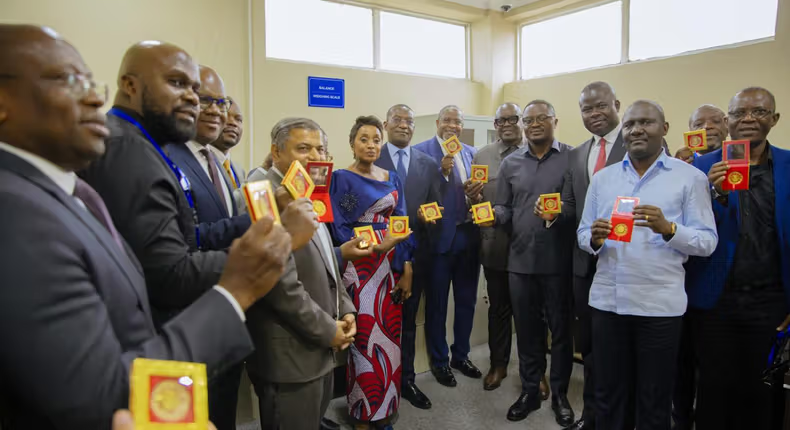
According to reports reviewed by the Accra Street Journal (ASJ), the new refinery—DRC Gold Refinery S.A.—was inaugurated in the city of Kalemie and will allow the country to process its own gold domestically for the first time.
Authorities say the facility represents a turning point for the Congolese mining sector, which has historically exported large quantities of raw gold for refining abroad.
📢 GET A DETAILED ARTICLES + JOBS
Join ASJ's WhatsApp Channel and never miss a post or opportunity.
A New Stage for Congo’s Gold Industry
The refinery is expected to process between 500 and 600 kilograms of gold per month, covering the entire value chain from purchasing raw gold to refining it into bullion bars.
Once operational at full capacity, the facility will produce gold refined to 99.9% purity, enabling the country to export refined bullion rather than unprocessed ore.
Officials say this development will help position the Democratic Republic of the Congo as a state-backed exporter of refined gold in global commodity markets.
The inauguration ceremony was attended by several senior government officials, including:
-
Louis Watum Kabamba, Minister of Mines
-
Guylain Nyembo, Minister of State for Planning
-
Julie Shiku, Minister of Portfolio
During the launch, Mines Minister Kabamba described the refinery as a strategic step toward transforming the country’s mineral wealth into a driver of national development.
Formalising Gold Trading
The refinery is part of a partnership between the state-backed DRC Gold Trading and Lunga Mining.
One of the key objectives of the project is to formalise the gold trading system, particularly in a sector where artisanal mining plays a significant role.
For years, large volumes of gold produced in eastern Congo have been smuggled across borders, depriving the government of tax revenues and limiting benefits for local communities.
By creating a domestic refining hub, authorities hope to:
-
DR Congo Launches First Gold Refinery to Capture More Value from Its Mining SectorImprove traceability in the gold supply chain
-
Offer transparent trading channels for miners
-
Ensure fair pricing for artisanal producers
-
Increase government revenue from the sector
Officials say the refinery will also help integrate thousands of artisanal and small-scale miners into the formal economy.
Capturing More Value from Africa’s Gold
The project reflects a broader trend across the African continent as governments attempt to retain more value from their natural resources.
For decades, many African countries exported raw minerals while the most profitable stages of processing—refining, manufacturing and global trading—were carried out abroad.
Now, several governments are investing in domestic refining capacity to keep a larger share of the value chain within their economies.
Countries such as Ghana and Tanzania have expanded gold refining infrastructure in recent years, while others including Mali and Burkina Faso have explored similar initiatives.
For resource-rich economies, local processing is seen as a strategy to increase export revenues, create industrial jobs and strengthen economic sovereignty over mineral resources.
Political Support for Mining Reforms
Officials also credited Félix Tshisekedi, President of the Democratic Republic of the Congo, for supporting efforts to reform the mining sector and improve the management of the country’s mineral wealth.
Under the current administration, authorities have increasingly emphasized policies aimed at improving transparency, strengthening state oversight and increasing local participation in the mining value chain.
For analysts following Africa’s mining sector, the Kalemie refinery could serve as a test case for whether domestic processing can effectively curb smuggling and increase national revenues.
A Strategic Step for Congo’s Resource Economy
Gold remains one of the Democratic Republic of the Congo’s most valuable natural resources, alongside cobalt and copper.
However, weak regulation and cross-border smuggling have long undermined the sector’s contribution to government revenue and economic development.
By introducing domestic refining capacity, the government hopes to gain better control over production flows while improving the economic benefits flowing to the country.
For the Accra Street Journal, the launch of the Kalemie refinery signals a broader shift in Africa’s resource strategy—one focused not only on extracting minerals, but also on processing, refining and capturing greater value within the continent’s economies.
Source: Accra Street Journal
Last Updated on March 14, 2026 by Samuel Kwame Boadu
Disclaimer: Some content on Accra Street Journal may be aggregated, summarized, or edited from third-party sources for informational purposes. Images and media are used under fair use or royalty-free licenses. Accra Street Journal is a subsidiary of SamBoad Publishing Hub under SamBoad Business Group Ltd, registered in Ghana since 2014.
For concerns or inquiries, please visit our Privacy Policy or Contact Page.

Samuel Kwame Boadu is a Ghanaian media entrepreneur and storyteller with a passion for amplifying urban voices and uncovering everyday truths. He is the Editor-in-Chief and Founder of Accra Street Journal, a dynamic digital platform dedicated to capturing the pulse of Ghana’s capital—its people, culture, challenges, business, sports and innovations.